
died 361·Feast June 10
St. Maximus of Naples
Exiled Bishop and Martyr of Naples
Overview
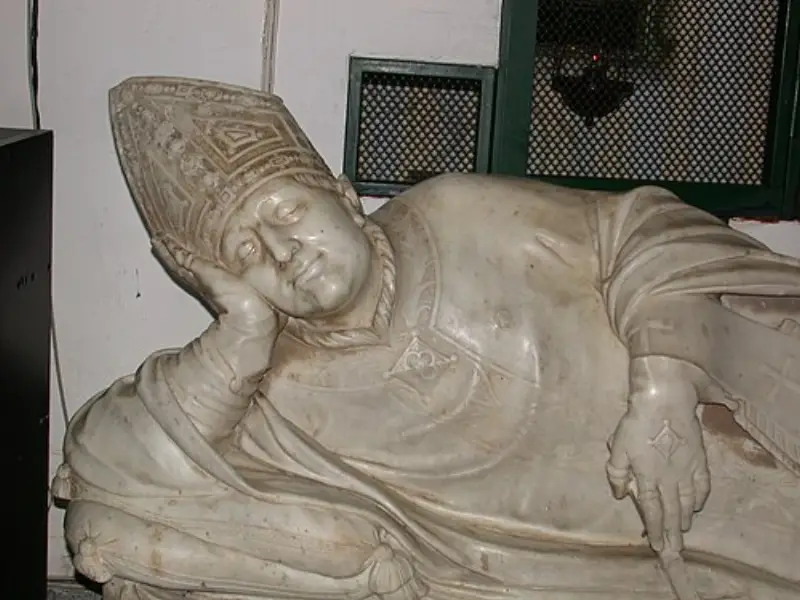
Maximus governed the church of Naples as its bishop in the middle of the fourth century and died a martyr in exile in the year 361. A steadfast defender of the decrees of the Council of Nicaea, he opposed the spread of Arianism with a firmness that cost him his see: he was sent into exile and Zosimos, a proclaimer of the Arian doctrine, was seated in his place. Legend relates that Zosimos found his punishment in his own mouth — each time he tried to speak in public, his words failed him, and the faithful credited the silencing to the prayers of the banished bishop. In exile Maximus sealed his witness with martyrdom. His relics are venerated at Naples Cathedral and in the Chiesa di Sant'Eframo Vecchio in Naples, where they remain objects of popular devotion. The Roman Catholic Church keeps his feast on 10 June and the Eastern Orthodox Church on 23 June, and he is honoured as martyr, confessor and bishop in the memory of the Neapolitan church.
The Complete Life
Guardian of the Decrees of Nicaea
Maximus shepherded the church of Naples as its bishop in the middle years of the fourth century, the generation in which the decrees of the Council of Nicaea divided the episcopate of the empire against itself. He was celebrated as a stalwart champion of those decrees, resisting the advance of Arianism with a constancy that would cost him his charge. The episcopal throne of Naples gave him standing among the churches of Campania, and from it he opposed the doctrine that denied the full godhead of Christ. Such resistance put him directly in the path of the Arian party, which could strike at its opponents through the favour of the imperial court. In the end Maximus was dispatched into exile, and the see he had governed was handed over to Zosimos, a man who proclaimed the Arian teaching in his place. The bishop left his city not in disgrace but in fidelity — a confessor deposed for keeping the faith the council had confessed, and one whose removal taught Naples exactly what his office had been worth. For the Neapolitans the choice their bishop was forced to make became a lesson in what episcopal office meant: not the enjoyment of a throne, but the guardianship of a confession, to be exercised at whatever price the times exacted.
§ References
The Silenced Intruder
The seizure of his see called forth one of the best-loved legends of the Neapolitan church. Zosimos, installed in the exiled bishop's place, discovered that his voice had been taken from him: whenever he rose to address the people, speech failed him entirely. The faithful of Naples, robbed of their rightful pastor, read in the muteness of the intruder a miracle worked through the intercession of Maximus far away. The story argued its own case: the Arian teacher who could not preach stood refuted more decisively than any sermon could have refuted him. Maximus himself preached nothing through those years but the spectacle of his endurance. Banishment had silenced him within the city, yet his prayer was believed to speak there daily on its behalf. The legend carried within it the theology of his ordeal — that the true bishop of a church is the one who holds the faith of Nicaea, whatever intruder may occupy his chair — and it bore that conviction down into the memory of the common people. Whether the failure of his voice was natural infirmity or judgment, the people of the city knew what they believed, and their belief outlived every attempt to settle the matter by argument.
§ References
Martyrdom in Exile
In exile Maximus sealed his witness with martyrdom, dying in the year 361 far from the city he had governed. He is honoured as martyr and confessor together, two titles that mark out the two halves of his passion: the confession of the Nicene faith that stripped him of his see, and the death that took his life. The Roman Catholic and Eastern Orthodox traditions alike remember him among the bishops who suffered for the decrees of the council rather than bend to the prevailing party. His body was brought back to Naples and became the treasure of the church he had led; his relics are venerated at Naples Cathedral and in the Chiesa di Sant'Eframo Vecchio in Naples, where devotion to them has never wholly ceased. The man who displaced him survives in history as a footnote to another's sanctity, remembered chiefly as the silenced preacher whose public failure advertised, year after year, the prayers of the bishop he had wronged. Death in exile completed what deposition had begun, and the church of Naples, which had lost its pastor twice over, received in return an intercessor at the altar of God whom no authority could again remove.
§ References
Two Feasts and a City's Treasure
The Roman Catholic Church keeps the feast of Maximus on 10 June, the Eastern Orthodox Church on 23 June — a double commemoration that measures his standing in East and West alike. His canonization lies earlier than the formal processes of canonization; he belongs to the pre-congregation saints whose cult rests on the devotion of the communities that kept their memory green. In Naples he ranks with the ancient bishops whose faith shaped the city: the cathedral where his relics rest is itself a monument to the orthodoxy for which he suffered. His story passed into the tradition of the confessor-bishops of the fourth century — bishops exiled for Nicaea, supplanted by intruders, and vindicated by the course of events — and the legend of Zosimos' tongue tied in knots kept his name alive among the people long after the controversies of his age had faded from general recollection. The exiled shepherd still belongs to the city that would not forget him. Cities keep the saints who suffered for them, and Naples has never been an exception; in its cathedral the bishop who left in chains rests at the heart of the church he refused to surrender.
§ References
The Record
- Canonization
- Pre-congregation saint, venerated as martyr and confessor
Prayer
Bibliography
Show 1 sources
- "St. Maximus". Catholic Online
Profile text adapted from the Wikipedia article, licensed CC BY-SA 4.0.
Pray with this saint every day
Save St. Maximus of Naples to your favorites, read the full profile, and get feast-day reminders in the Saints app.
Get the Saints AppFree on the App Store for iPhone and iPad