
died 476·Feast unknown
St. Maximus of Salzburg
Abbot-bishop and martyr of early Salzburg
Overview
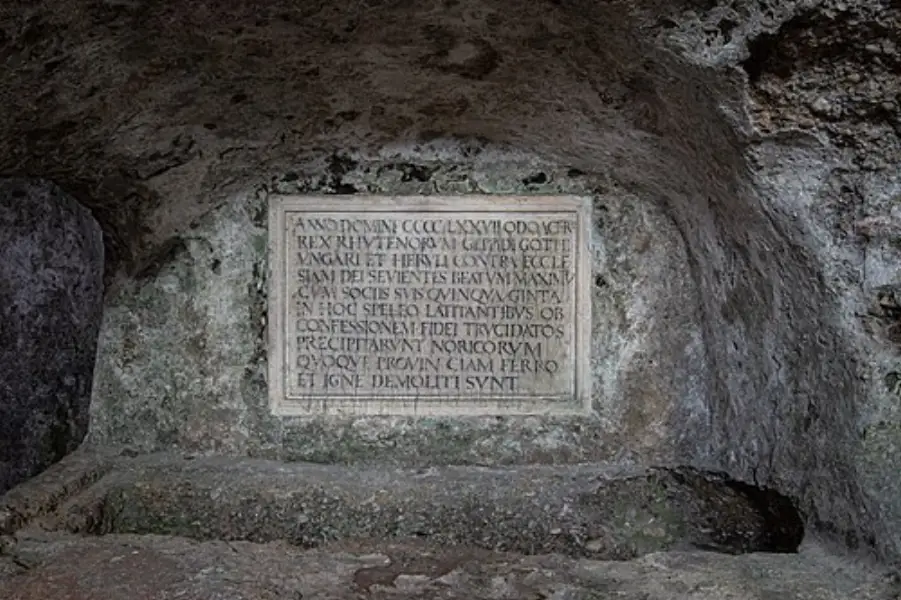
Maximus of Salzburg died in the year 476 as the first recorded head of a see that had only just been born. The bishopric of Salzburg was established in 474, in the last years of Roman rule in the Alpine lands, and Maximus governed it as abbot-bishop, holding in one office the discipline of a monastic community and the care of a flock. He had been formed in the school of Severinus of Noricum, the monk and apostle of the Danube provinces whose disciple Maximus is accounted. His end came by violence: according to one account he was hanged, while other traditions tell that he and his parishioners were hurled together from a cliff. With the pastor dead, the young bishopric was abandoned, and the Christian faith withdrew from the region for three centuries, not returning until the eighth century, when Arno arrived as bishop and later became archbishop of Salzburg. A plaque commemorating his martyrdom was set in the catacombs of St. Peter's Cemetery in 1521.
The Complete Life
A Disciple of Severinus on the Frontier
Maximus belonged to the last Christian generation of Roman Noricum, formed by the teaching and example of Severinus, the ascetic missionary who organized relief and prayer along the endangered Danube frontier in the mid-fifth century. From such a school came the habits that marked his episcopate: austerity, closeness to his people, and stamina in an age when imperial protection was collapsing. When the see of Salzburg was erected in 474, Maximus took charge of it in the double office of abbot and bishop, a combination common in the missionary church of that era, where the cathedral community lived under monastic rule and the bishop led it as its abbot. His charge was small, new, and exposed. Salzburg stood in territory that the orderly structures of the empire were slipping away from, and the Christian community there depended almost entirely on the constancy of its pastor. It was in that weakness that Maximus exercised his ministry, holding together a cathedral household and a scattered flock for the two years the record allows us to see. The date of the see's founding leaves him a bishop for barely two years before his death, yet those two years carried the whole first chapter of Christianity in the city, and everything the later church at Salzburg possessed of antiquity began in his charge.
§ Maximus of Salzburg
Martyrdom and the Silence That Followed
The sources disagree about the manner of Maximus's death, but not about its character: he died a martyr. Some accounts state plainly that he was hanged; others preserve a sterner memory, that the bishop and his parishioners were seized together and thrown from a cliff, so that pastor and flock perished in a single act of violence. The date handed down is 476, the very year in which the last western emperor was deposed, and the coincidence is a fitting emblem of the age. With Maximus gone, the bishopric he had shepherded for barely two years was abandoned; no successor is recorded. The Christian faith did not merely weaken in the region, it withdrew altogether, leaving the Alpine lands around Salzburg without a church for some three hundred years. Only in the eighth century did the gospel return there, when Arno came as bishop and afterward became archbishop of Salzburg, rebuilding on foundations that men like Maximus had laid with their lives. Whichever form the tradition follows, the witnesses agree on what the death meant: a bishop taken with his own people, a church left without a shepherd, and a frontier diocese that ended its short life in blood rather than in surrender.
§ Maximus of Salzburg
A Plaque in the Catacombs
The memory of the martyred abbot-bishop did not vanish with his church. In 1521, a memorial plaque recording his martyrdom was installed in the catacombs of St. Peter's Cemetery at Salzburg. The placement was fitting: the catacombs by that cemetery preserve the oldest Christian memory of the city, and a monument to the man who died for the see of 474 belongs naturally among them. Through the plaque, the city that lost its first bishop to violence acknowledged, a millennium later, the debt it owed him. Writers on the archbishops of Salzburg and the standard dictionaries of church history and of the eastern Alps kept his name in circulation. No writing preserves his voice, and no feast date has come down in the record that survives; what remains is the place, the plaque, and the story of a church that died with him and was born again three centuries later. Today he stands as the witness of that vanished generation, the pastor whose death closed the first chapter of Christianity in Salzburg and whose story waited, three centuries long, for Arno, bishop and later archbishop, to open the next.
§ References
Timeline
- 474
The see of Salzburg was established, and Maximus served it as abbot-bishop.
§ Maximus of Salzburg
- 476
Maximus was martyred, by hanging according to some accounts, or thrown from a cliff with his parishioners according to others.
§ Maximus of Salzburg
- 1521
A memorial plaque to his martyrdom was installed in the catacombs of St. Peter's Cemetery in Salzburg.
§ Maximus of Salzburg
The Record
- Canonization
- Pre-congregation martyr, honored since the early medieval period
Prayer
Bibliography
Show 4 sources
- "The Archbishops of Salzburg." www.exulanten.com. Retrieved 2022-03-05.
- Crabb, George (1825). Universal Historical Dictionary: Or, Explanation of the Names of Persons and Places in the Departments of Biblical, Political, and Ecclesiastical History, Mythology, Heraldry, Biography, Bibliography, Geography, and Numismatics. Illustrated by Portraits and Medallic Cuts. Baldwin, Cradock, and Joy.
- Baedeker (Firm), Karl (1899). Eastern Alps. Dulau and Company. p. 94.
- "CATHOLIC ENCYCLOPEDIA: Salzburg." www.newadvent.org. Retrieved 2022-03-05.
Profile text adapted from the Wikipedia article, licensed CC BY-SA 4.0.
Pray with this saint every day
Save St. Maximus of Salzburg to your favorites, read the full profile, and get feast-day reminders in the Saints app.
Get the Saints AppFree on the App Store for iPhone and iPad