
c. 380 – c. 465·Feast June 25
St. Maximus of Turin
First bishop of Turin and homilist
Overview
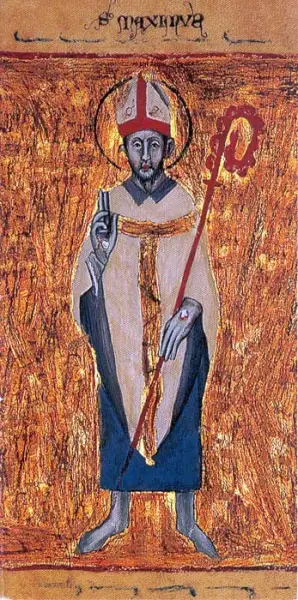
Maximus of Turin, known in Italian as San Massimo, was a prelate of the late fourth and fifth centuries remembered as the first bishop of Turin. Believed to be a native of Rhaetia, he was formed in the school of Ambrose of Milan and Eusebius of Vercelli, and the historian Gennadius of Massilia praised him as a deep reader of scripture and a preacher of real learning. In 397, watching at Anaunia among the Rhaetian peaks, he saw three missionary bishops put to death, men dispatched by Ambrose to help Vigilius of Trento; in the following year he took charge of Turin, a diocese then subject to Milan. His tenure fell in an age of barbarian incursions, when the city filled with soldiers and refugees; he acted as guardian of Turin, rebuked landowners who hoarded wealth while the poor suffered, and urged the ransom of prisoners of war. About a hundred of his sermons survive, alongside numerous discourses that illuminate the customs of northern Italy during the invasions. He died shortly after 465, and the city of Turin honors him as its patron saint.
The Complete Life
A Native of Rhaetia in the School of Ambrose
Maximus is believed to have come from Rhaetia, the alpine region corresponding to the north of modern Italy, though the facts of his upbringing remain wrapped in the uncertainty of the age. What the tradition preserves is the company he kept: he stood as a disciple of Ambrose of Milan and of Eusebius of Vercelli, two of the most formidable bishops of the Latin church, and from them he drew both his theology and his courage in office. The antiquarian writer Gennadius of Massilia left a portrait of the scholar he became, calling him a profound student of the scriptures and a preacher of real learning. A vivid glimpse of the young Maximus comes from his own preaching: he relates in one sermon that in the year 397 he was present at Anaunia in the Rhaetian Alps when three missionary bishops, Sisinnius, Martyrius, and Alexander, were put to death. Ambrose himself had sent the three north to assist Vigilius at Trento, and their blood, shed before the eyes of the future bishop of Turin, joined the churches of the alpine valleys and the Po plain in a single story of mission.
§ Life
Bishop and Guardian of a Threatened City
In 398 Maximus took up the see of Turin, which then stood as a suffragan church under Milan. His episcopate coincided with the first great convulsions of the barbarian invasions, and Turin became a shelter for the frightened: the chronicler of his life records that the city filled with soldiers and with refugees seeking safety behind its walls. In those circumstances Maximus defined his office as a guardianship, watching over the city materially and spiritually at once. He did not spare the comfortable. The landowners who kept fine houses inside the walls and estates in the countryside were rebuked for burying their wealth in secret while the suffering crowded their doorways. Those who hoped to profit from the unrest met the same voice of reproof, and instead of gain he set before them another use for their silver: the redemption of prisoners taken in the wars. A judgment preserved from later hagiography says of him that through those troubled years of invasion he shepherded his people with wisdom and success, and the sermons he preached in those years show how much of that governance was done from the pulpit.
§ Life
The Preacher of Northern Italy
Maximus worked above all as a preacher, and his sermons are the reason his name endures. Pope Benedict XVI said of his writing that it greatly advanced the spread and the firm rooting of Christianity across northern Italy. about a hundred of the sermons survive. They catch the life of the age with unusual vividness: they preserve the customs and daily circumstances of the Lombard people as the Gothic wars swept over the land, and one homily records how Attila's forces razed the city of Milan. Two sermons in particular, the seventeenth and the eighteenth, are addressed to the rich, calling to mind that believers owe their civil duties even when times are hard. With the machinery of civil administration failing, Maximus taught from the twenty-sixth sermon that paying taxes was itself a duty, however unwelcome, because no functioning society could be had otherwise. Other homilies move through the seasons of the church's year and the feasts of the Lord, and on the days of the saints he preached on the saint whom that day commemorated. Several of these lessons passed into the Roman Breviary, giving his voice a place in the daily prayer of the universal Church. Tradition also assigns him a part in the making of another apostle: Patrick Francis Moran records that Maximus consecrated Saint Patrick as bishop on Patrick's journey home from Rome toward Ireland.
§ Works
The Martyrology and the Roe
The Roman Martyrology keeps Maximus on the twenty-fifth of June with an entry that gathers up his life's work in a single sentence: it names him first bishop of the Turin see, remembers how a fatherly word of his drew whole crowds of pagans toward faith in Christ, and recalls that he led those converts by heavenly teaching to their reward of salvation. He is venerated in both the Catholic Church and the Eastern Orthodox Church, and the city of Turin honors him as its patron. His image in art goes back to a legend that a later age appended to his memory. A life of the saint, written after the eleventh century and printed in the Acta Sanctorum, is judged entirely unreliable as history, yet it fixed his iconography. It tells of a cleric who followed the bishop with evil intent to a retired chapel where Maximus often prayed; the man was suddenly seized with a thirst so desperate that he begged the saint for help. A roe deer happened by, and Maximus stopped the animal so that his persecutor could drink its milk. For this reason artists have ever since shown the saint as a bishop pointing at a roe, a picture of charity that disarms malice.
§ Veneration
A Corpus Gathered Across the Centuries
The written remains of Maximus reached the modern age through a long work of collection and sifting. A first edition of his numerous discourses was prepared by Bruno Bruni and published in 1784, comprising one hundred and eighteen homilies, a like set of one hundred and sixteen sermons, and six tractates, together with an appendix of writings of doubtful ownership: thirty-one sermons, three homilies, and the two long epistles written to a sick friend. The discourses are characteristically brief, delivered in a forcible style that at times runs to ornament. They touch an extraordinary range of liturgy and history: abstinence in Lent, the absence of fasting and kneeling during paschal time, the fast before Pentecost, the condemnation of Jovinianus at the synod of Milan in 389, the coming invasion of the barbarians, the destruction of the church of Milan, the pagan superstitions that still lingered among his people, and the supremacy of the apostle Peter. Many items that Bruni assigned to Maximus are now judged doubtful, and the critical edition published by Almut Mutzenbecher in the Corpus Christianorum Series Latina in 1962 established the genuine corpus of Maximus I of Turin. Boniface Ramsey's annotated English translation of 1989 carried the sermons to a new readership.
§ Works
Timeline
- 380
Maximus was born at about this time, probably in Rhaetia.
§ Life
- 389
The synod of Milan at which Jovinianus was condemned, an event he later recalled in his ninth homily.
§ Works
- 397
At Anaunia in the Rhaetian Alps he witnessed the martyrdom of Sisinnius, Martyrius, and Alexander, missionary bishops sent by Ambrose to aid Vigilius of Trento.
§ Life
- 398
He became bishop of Turin, at that time a suffragan see of Milan.
§ Life
- 465
Maximus died shortly after this year.
§ Life
- 1784
His numerous discourses were first edited by Bruno Bruni and published.
§ Works
- 1962
Almut Mutzenbecher published his authentic corpus in the Corpus Christianorum Series Latina, Turnhout.
§ Works
- 1989
Boniface Ramsey, OP, published an annotated English translation of his sermons in the Ancient Christian Writers series.
§ Translations
In Their Own Words
In Turin, Saint Maximus, the first bishop of this See, who with his fatherly word called crowds of pagans to the faith of Christ and guided them with heavenly doctrine to the prize of salvation.
made a great contribution to the spread and consolidation of Christianity in Northern Italy
governed his flock wisely and successfully in the troublous times of the Barbarian inroads into Italy
The Record
- Major works
- About 100 extant sermons·118 homilies, 116 sermons, and 6 treatises in the Bruni edition of 1784·Sermons 17 and 18 on the civil obligations of the well-to-do·Sermon 26 on the duty of paying taxes·Homilies on the seasons of the ecclesiastical year and the feasts of Our Lord·Two long epistles addressed to a sick friend
- Patron of
- Turin
- Symbols
- Depicted as a bishop pointing at a roe
- Canonization
- Pre-congregation; entered in the Roman Martyrology on 25 June
Prayer
Bibliography
Show 7 sources
- Ott, Michael. "St. Maximus of Turin." The Catholic Encyclopedia Vol. 10. New York: Robert Appleton Company, 1911.
- Pope Benedict XVI, "St. Maximus of Turin", L'Osservatore Romano, 7 November 2007, p. 11.
- Arduino, Fabio. "San Massimo di Torino Vescovo", Santi e Beati, June 14, 2005.
- Mershman, Francis. "St. Vigilius." The Catholic Encyclopedia Vol. 15. New York: Robert Appleton Company, 1912.
- Monks of Ramsgate. "Maximus". Book of Saints 1921. CatholicSaints.Info. 14 March 2015.
- Moran, Patrick Francis Cardinal. "St. Patrick." The Catholic Encyclopedia Vol. 11. New York: Robert Appleton Company, 1911.
- Butler, Alban. "Saint Maximus, Bishop of Turin, Confessor". Lives of the Fathers, Martyrs, and Principal Saints 1866. CatholicSaints.Info. 25 June 2013.
Profile text adapted from the Wikipedia article, licensed CC BY-SA 4.0.
Pray with this saint every day
Save St. Maximus of Turin to your favorites, read the full profile, and get feast-day reminders in the Saints app.
Get the Saints AppFree on the App Store for iPhone and iPad