
c. 580 – 662·Feast August 13
St. Maximus the Confessor
Monk and defender of Christ's two wills
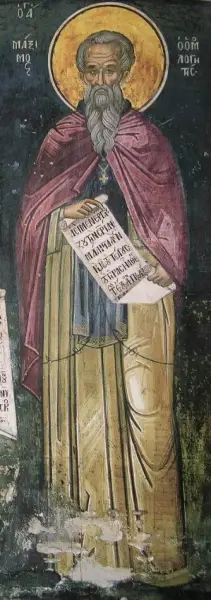
Overview
Maximus the Confessor, also called Maximos and known as Maximus the Theologian and Maximus of Constantinople, was a monk, a theologian, and a scholar of Neoplatonism who worked in the seventh century. Born about 580, he served in youth as a civil servant and aide to the emperor Heraclius before abandoning public life for monastic vows at Chrysopolis, where he rose to be abbot. Driven east by the Persian conquest of Anatolia, he settled near Carthage and studied there under Sophronius, immersing himself in the Christological writings of Gregory of Nazianzus and Pseudo-Dionysius. When the doctrine of Monothelitism arose, teaching that Christ possessed only a divine will, Maximus opposed it with the full weight of his learning, defending the Chalcedonian faith that in Jesus a human will operated alongside the divine. He debated the deposed patriarch Pyrrhus, took part in the Lateran Council of 649, and was arrested at Rome in 653. Tried at Constantinople as a heretic, he was sentenced to exile, and in 662 he was mutilated, losing his tongue and right hand, and banished to Lazica, where he died on August 13 of that year. The Third Council of Constantinople vindicated his teaching, and the Church counted him among its saints soon after his death.
The Complete Life
A Civil Servant of the Empire
The facts of Maximus's youth are poorly recorded, and scholars have long debated even where he came from. The tradition that makes him a native of Hisfiyya in Palestine has been questioned on the ground that a Palestinian birth was a common seventh-century device for discrediting an opponent, while the quality of the education he plainly received points to Constantinople, or possibly to Caesarea or Alexandria, as the only places it could have been had. What is not in doubt is the height he reached: while still young he entered the imperial civil service and became an aide to the emperor Heraclius, reaching the office of Protoasekretis, among the mightiest posts the Empire had to bestow. Scholars judge it very unlikely that a man of low social birth, as one hostile biography claims, could have climbed so far by the age of thirty; the likelier reconstruction gives him an aristocratic family and an exceptional schooling in philosophy, mathematics, and astronomy. He studied the Platonic dialogues and the works of Aristotle, together with the later Neoplatonic commentators, Plotinus, Porphyry, Iamblichus, and Proclus. One thing he set down about himself: he never studied rhetoric, and his plain, unstylish Greek, by Byzantine standards, bears him out.
§ Early life
From the Palace to the Monastery
For reasons he never explained in the few autobiographical remarks his writings allow, Maximus walked away from the public career that lay open before him and entered monastic life at the Philippicus monastery in Chrysopolis, the town opposite Constantinople across the strait. There the former imperial official was raised to be abbot. The peace of the monastery did not last: when the Persian armies overran Anatolia, Maximus fled west across the sea to a monastery near Carthage, in Byzantine North Africa. That exile proved to be the making of his theology. At Carthage he came under the tutelage of the monk Sophronius, and with him he read in detail the Christological writings of Gregory of Nazianzus and of Pseudo-Dionysius the Areopagite, the two authors who would shape all his later work. His achievement, in one modern summary, lay in setting those teachings within an Aristotelian logical frame, a shape the age could receive and one that shielded the doctrines from distortion. He remained in Carthage for a long residence, writing as a theological and spiritual author, and the exarch Gregory and the eparch George, the leading men of the African province, held him in esteem.
§ Early life
The Battle Against the One Will
While Maximus was in Carthage the controversy broke out that would consume the rest of his life. The debate concerned how the human and divine natures meet in the person of Christ, and it was the latest round in disputes that had run since the First Council of Nicaea in 325 and had been sharpened at Chalcedon in 451. The Monothelite party, promulgated by Patriarch Sergius I of Constantinople and by Maximus's own friend and successor as abbot of Chrysopolis, Pyrrhus, granted Chalcedon's two natures yet held that in Christ only a divine will existed, with no human will beside it. Against this Maximus stood firm for two wills. When Pyrrhus lost the patriarchate and fell into exile, the two former friends met in public debate before many North African bishops; Maximus maintained that the incarnate Christ wills in both his natures, human and divine, and Pyrrhus conceded the error of his position. In 645 Maximus traveled with him to Rome. There, probably resident at San Saba, he stood beside the newly elected Pope Martin I at the Lateran Council of 649, where 105 bishops condemned Monothelitism in acts that some believe Maximus himself drafted.
§ Involvement in Monothelite controversy
Theology of Exit and Return
The mind that defended Chalcedon was also one of the last great speculative theologians of the undivided Church. As a student of Pseudo-Dionysius, Maximus preserved and interpreted the Neoplatonic inheritance of Plotinus and Proclus, and his commentary on the Areopagite was carried forward in the West by John Scotus Eriugena. His thought is clearest in his theological anthropology, where he took over the Platonic pattern of exit and return: the human race, fashioned in God's image, exists so that salvation may carry it home into union with its maker. That stress on divinization, theosis, secured his lasting place in Eastern Christianity. It stands behind his strict Christology as well, since God had first bound himself wholly to mankind in the incarnation, mankind may in turn be wholly joined to God; yet had the Savior lacked a human will, the road of salvation would have shut, for man could never then be made divine. He argued, too, the unconditionality of the incarnation, and has been described, like Origen and Gregory of Nyssa, as a proponent of universal reconciliation, though the claim is disputed. Many of his works were gathered into the Greek Philokalia, the classic anthology of Eastern Orthodox spirituality.
§ Theology
Trial, Mutilation, and Exile
The triumph at the Lateran Council brought the imperial government down on its authors. Emperor Constans II backed the Monothelite doctrine, and in 653 both Pope Martin and Maximus were arrested in Rome. Martin was condemned without trial and died before he could be shipped to the capital; Maximus was taken to Constantinople instead, to be tried there as a heretic in 658. In the capital both the emperor and the patriarch had embraced the one-will teaching, and Maximus, still confessing the two wills, was condemned to a further four years of banishment. His adversaries charged him at the bar with helping the Muslim advances in Egypt and North Africa; he answered that the accusation was slander. In 662 he was brought to the bar once more and convicted again. This time the sentence fell on his body: his tongue was cut out so that he could speak his rebellion no more, and his right hand was cut off so that he could write no more letters. So mutilated, he was banished to Lazica, the old Colchis, within today's Georgia, and shut up in the stronghold called Schemarum, likely Muris-Tsikhe by what is now the town of Tsageri. He died soon afterward, on August 13, 662. The record of his trials was preserved by Anastasius Bibliothecarius.
§ Trial and exile
Veneration of the Confessor
Maximus belonged to that company of Christians whom the Church recognized as saints almost immediately after their deaths. The word Confessor in his title marks the kind of saint he was: one who suffered for the faith without being put to death for it. The vindication of his teaching made him widely beloved within a generation, and the cause was helped by the miracles reported at his tomb; the tradition of the East tells of three candles that appeared burning over his grave and of many healings worked there. Both the Eastern Orthodox and the Greek Catholic Churches keep his memory twice in the year. The thirteenth of August, the day of his death, commemorates in the Byzantine rite the carrying of his relics back to the Theotokos monastery at Chrysopolis, while his principal feast falls on the twenty-first of January, possibly moved to avoid the Leavetaking of the Transfiguration. The Roman Martyrology of the Catholic Church likewise commemorates him on August 13. The right hand, cut from him at his mutilation, is kept at the Athos monastery of Agiou Pavlou; for centuries it stood as the one relic of the confessor known to survive, until 2010 brought his buried grave to light at Tsageri and 2015 confirmed the relics found there.
§ Veneration
Vindication and the Judgment of History
Along with Pope Martin I, Maximus, together with Pope Martin, received his vindication at the Third Council of Constantinople, sixth of the ecumenical councils, which met across 680 and 681. The council declared that in Christ a human will stands beside the divine one, made Monothelitism a heresy, and pronounced the dead confessor innocent of the charges for which he had been maimed. His standing has only grown since. He is counted among the last men recognized as a Father of the Church by both the Orthodox and the Catholic Churches, and his thought has remained a living force in Eastern Christianity from his own day to this. In the encyclical Spe Salvi of 2007, Pope Benedict XVI called him the great Greek doctor of the Church, though whether the pope meant to confer the title Doctor or to record that Maximus already held it was left unclear; the Sacred Congregation for the Causes of Saints has treated the words as an informal declaration. A cautionary note belongs to the story as well: an early Life of the Virgin transmitted under his name, the earliest complete biography of the Mother of God, is now judged by scholars not to be his, since neither its characteristic themes nor its manuscript history connects it securely to his genuine corpus.
§ Legacy
Timeline
- 580
Maximus was born at about this time, at Hisfiyya in Syria Prima or at Constantinople.
§ Early life
- 638
Patriarch Sergius I of Constantinople, the leading proponent of Monothelitism, died and was succeeded by Pyrrhus.
§ Involvement in Monothelite controversy
- 645
Maximus debated the deposed Patriarch Pyrrhus on Monothelitism before North African bishops; Pyrrhus admitted his error, and Maximus accompanied him to Rome.
§ Involvement in Monothelite controversy
- 649
He was present when Pope Martin I convened the Lateran Council, whose 105 bishops condemned Monothelitism.
§ Involvement in Monothelite controversy
- 653
Pope Martin I and Maximus were arrested in Rome on the orders of Emperor Constans II.
§ Involvement in Monothelite controversy
- 658
Maximus was brought to Constantinople, tried as a heretic for refusing Monothelitism, and sent back into exile.
§ Trial and exile
- 662
Convicted of heresy at a second trial, Maximus had his tongue and right hand cut off and was exiled to the fortress of Schemarum in Lazica.
§ Trial and exile
- 13 Aug 662
Maximus died at Tsageri in Lazica, in present-day Georgia.
§ Trial and exile
- 680
The Third Council of Constantinople proclaimed that in Christ a human will stands beside the divine, vindicating Maximus and condemning Monothelitism.
§ Legacy
- 2010
His grave was discovered at Tsageri, Georgia; his relics were authenticated there in 2015.
§ Veneration
In Their Own Words
Three candles appeared over the grave of St Maximus and burned miraculously. This was a sign that St Maximus was a beacon of Orthodoxy during his lifetime, and continues to shine forth as an example of virtue for all.
the great Greek doctor of the Church
The Record
- Major works
- Mystagogia (Mystagogy)·Ambigua ad Iohannem·Ambigua ad Thomam·Capita de caritate (Chapters on Charity)·Capita theologica et oeconomica·Quaestiones ad Thalassium·Disputatio cum Pyrrho·Liber Asceticus·Expositio orationis dominicae (Commentary on the Lord's Prayer)·Computus ecclesiasticus·Opuscula theologica et polemica·Epistulae I–XLV
- Canonization
- Pre-congregation; raised to the saints soon after his death
Prayer
Bibliography
Show 6 sources
- Allen, Pauline; Neil, Bronwen (2015). The Oxford Handbook of Maximus the Confessor. Oxford University Press. p. 20. ISBN 978-0-19-967383-4.
- Constas, Nicholas (2014). On Difficulties in the Church Fathers: The Ambigua, Volume 1. Cambridge, MA: Harvard University Press, Dumbarton Oaks Medieval Library Series, Volume 28. ISBN 978-0-674-72666-6.
- M. Gildas (1913). "St. Maximus of Constantinople". In Herbermann, Charles (ed.). Catholic Encyclopedia. New York: Robert Appleton Company.
- Balthasar, Hans Urs von (2003). Cosmic Liturgy: The Universe According to Maximus the Confessor. Ignatius Press. ISBN 0-89870-758-7.
- Berthold, George C. (1997). "Maximus Confessor". In Everett Ferguson (ed.). Encyclopedia of Early Christianity. New York: Garland Publishing. ISBN 0-8153-1663-1.
- Jankowiak, M.; Booth, P. (2015). "A New Date-List of the Works of Maximus the Confessor" in The Oxford Handbook of Maximus the Confessor. Oxford: Oxford University Press. pp. 72–3. ISBN 978-0-19-967383-4.
Profile text adapted from the Wikipedia article, licensed CC BY-SA 4.0.
Pray with this saint every day
Save St. Maximus the Confessor to your favorites, read the full profile, and get feast-day reminders in the Saints app.
Get the Saints AppFree on the App Store for iPhone and iPad