
c. 1475 – c. 1556·Feast January 21
St. Maximus the Greek
Athonite scholar and translator in Muscovy
Overview
Maximus the Greek, born Michael Trivolis and known in Russian as Maksim Grek, was a monk, publicist, writer, scholar, and translator who spent the greater part of his life in Russia. He came of a noble Greek family of Arta, with connections to the Byzantine court and roots at Mystras in Laconia, and he signed himself Maximus Grecus Lakedaimon. Educated on Corfu and in the cities of Renaissance Italy, he knew Poliziano, Ficino, Pico della Mirandola, and the printer Aldus Manutius, and was deeply moved by the preaching of Savonarola. In 1504 he left the Dominican house of St. Mark for Mount Athos, taking monastic vows at Vatopedi in 1507. Summoned to Moscow in 1518 to translate Church Slavonic texts, he completed the Psalter with Russian collaborators and went on to correct the service books, but his criticism of Muscovite injustice, his stand with the Non-Possessors against monastic landholding, and his opposition to Vasili III's divorce brought him before church councils in 1525 and 1531. Condemned and imprisoned, he spent two decades in monastery exile before being transferred to the Trinity Lavra of St. Sergius, where he died in 1556. The Russian Orthodox Church canonized him in 1988.
The Complete Life
A Noble Greek of Arta and Italy
The man the Russians would call Maksim Grek was born Michael Trivolis about 1475 at Arta, then within the Ottoman Empire, the child of Christian Greek parents of rank. His father Manuel, perhaps a military governor of Arta in Byzantine days before Ottoman forces took the city in 1449, had moved there from Constantinople together with his wife Irene; the family had ties to the Byzantine emperor and later associations with the Palaiologos dynasty of Mystras, and its origins lay in Laconia, the country of ancient Sparta, as Maximus's own signature, Maximus Grecus Lakedaimon, always proclaimed. His uncle Demetrios was a scribe who copied Plato's Timaeus in Corfu and Plotinus's Enneads in Crete, and in that world of books the boy was formed. He studied first on Corfu under John Moschos and John Lascaris, and set out with him for Florence in 1492 or 1493, pursuing a course of study that carried him through Bologna, Ferrara, Milan, Padua, and Venice. In Italy he mastered ancient languages and plunged into philosophy, especially Neoplatonism, moving in the circle of Aldus Manutius and meeting Poliziano, Ficino, Pico della Mirandola, Scipio Callerges, and Fonteguerri. Above all the preachers of the age, the Dominican reformer Girolamo Savonarola seized his conscience; in 1498 the young Greek gathered the martyr's ashes.
§ Early years
The Tonsure at Vatopedi
About 1504, by the common reckoning, Michael Trivolis walked out of the Dominican monastery of St. Mark and turned east to the Holy Mountain, exchanging the humanist circles of Italy for the monastic republic of Athos. At the Monastery of Vatopedi he received the tonsure in 1507 and the name Maximus. The conversion completed a journey that had been preparing for years: the disciple of Savonarola's preaching and of Greek patristic learning found in the Athonite tradition the form of life that could hold both. He lived there as a monk for roughly a decade, largely unknown beyond his monastery, until the summons came that changed his history. In 1515 Grand Prince Vasili III of Moscow asked the abbot of Vatopedi to lend him a monk named Savva to translate religious texts into Church Slavonic. Savva was too old for the task, and the abbot sent the energetic Maximus instead, though the monk knew no Church Slavonic at all; the brotherhood vouched for him, and he set out for the north. He reached Moscow in 1518 and was met with great honor at the grand prince's court.
§ Career
Translator and Reformer in Moscow
Maximus's first great labor in Russia was the translation of the Psalter, which he carried out together with Russian scholars, among them Dmitry Gerasimov, and with scriveners of the court; the finished work was solemnly approved by the clergy and by the grand prince himself. When his request to return home to Athos was refused, he settled to the longer work of correcting the service books and rendering Greek texts into Slavonic. He could not stay within the translator's silence. Observing what he judged the defects and injustices of Muscovite life, and finding them in open conflict with Christian ideals, he began to expose and criticize them, and around him gathered men of like mind, Ivan Bersen-Beklemishev and Vassian Patrikeyev among them. In the great quarrel over monastic estates that had split the Russian clergy into Possessors and Non-Possessors, he took the side of Nilus of Sors and his startsy, making permanent enemies of the Josephite party. His circle talked freely of the shortcomings of Russia's policies, the style of life among the clergy, the exploitation of peasants, and the system of feeding local officials off the peasantry. It was a dangerous honesty, and it set the course of his ruin.
§ Assignment to Moscow
The Philosopher Among Princes
The spirituality Maximus brought to Moscow was that of a man formed equally by Mount Athos and the Renaissance, and the Russians read him as a philosopher as much as a monk. Prince Kurbskii, who met him in 1518 and later told his story in the Tale of Maxim the Philosopher, preserved an exchange at the court of Vasili III: the monk marveled at the immense crowds of Greek volumes kept there and told the prince that not even in Greece had he beheld so many works. That testimony stands as the first notice on record of the hoard of ancient manuscripts kept by the tsars, the library that was lost and became a quarry for later seekers. Behind the anecdote lies the character of the man, a scholar who read the books of the Greeks as paths to the knowledge of God, and who believed that neither princes nor prelates could be exempt from the truth they contained. His defense at his trials told the same story: the charges against him were built on mistranslations and on his imperfect Russian, exploited by enemies, while what he actually offered Muscovy was the conscience of Orthodox learning, insisting that the gospel be heard above the interests of court and cloister alike.
§ Career
Condemnation, Confinement, and Peace
The reckoning came in 1525, when a sobor accused Maximus of nonconformism and heresy on the strength of his views and his renderings of ecclesiastical books, disregarding his imperfect command of Russian and the plain mistakes of the Russian scriveners; a slip in his grammar was twisted into a denial that the Holy Spirit eternally exists as the Third Person of the Trinity. His ties to Vassian Patrikeyev, to Bersen-Beklemishev, and to the Turkish ambassador Skinder, Metropolitan Daniel's hostility, and above all his opposition to Vasili III's divorce of Solomonia Saburova had decided his fate. He was exiled to the Joseph-Volokolamsk Monastery and held in a dungeon, refused communion and correspondence. A second sobor in 1531, armed with fresh charges, sent him to the Otroch Monastery at Tver for the next twenty years. The patriarchs of Antioch, Constantinople, and Jerusalem pleaded for him in vain, and his own appeals to Ivan the Terrible and Metropolitan Macarius went unanswered, for Moscow feared his pen. In 1551 boyars and Hegumen Artemiy won his transfer to the Trinity Lavra of St. Sergius, where he declined an invitation to the Bashkin council in 1554 and died in 1556, buried in the Lavra's Refectory Church.
§ Imprisonment
Canonization in the Year of the Millennium
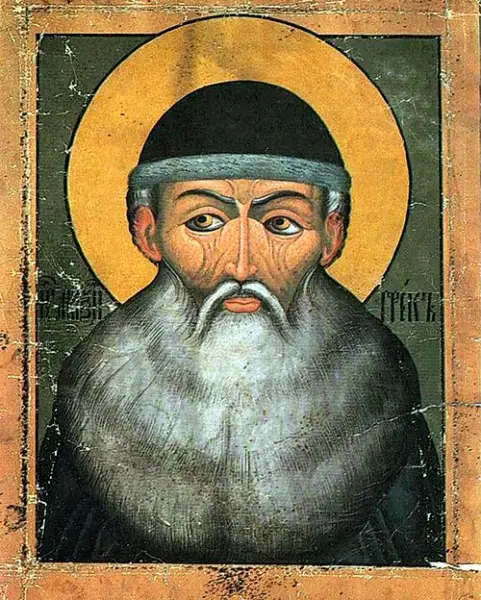
The Church that had tried and banished Maximus came, in time, to number him among its saints. On June 6, 1988, at the Trinity Lavra of St. Sergius itself, the Local Council of the Russian Orthodox Church meeting in its jubilee year, with Patriarch Pimen I of Moscow presiding, enrolled him in the calendar, and the canonization fell in the year of the millennium of the Baptism of Rus. The honor restored a memory that the Old Believers had never let go: Maximus has always been held in the greatest repute by that communion, whose churches ordinarily display his image. His feast is kept on January 21, and he is venerated across the Eastern Orthodox Church, commemorated as a monk, confessor, and teacher whose fidelity survived both the dungeon and the council chamber. The principal shrine of his cult is natural enough: the Troitse-Sergiyeva Lavra, where he ended his long exile and where his body lies in the Refectory Church. Icons show him with the attributes recorded in his tradition, a long gray or silver beard and the monastic vestments of the Athonite habit he wore from 1507 until his death nearly half a century later.
§ Legacy
A Builder of Russian Christian Tradition
Maximus played an important part in shaping Russian Christian tradition, and he did it with his pen. He left behind a voluminous body of original writing and of translations into Russian Church Slavonic, and he consumed great energy and ink in defending his own innocence and Orthodoxy to the generations that watched his trial. For his Muscovite readers he interpreted and explained a whole world they did not know: points of ancient and Biblical history, the practice and teaching of the Orthodox Church, and the features of the contemporary world beyond Muscovy's frontiers. Most famously, he was the first to bring word of the discovery of the New World to Russian readers, a piece of reporting that joins the Athonite monk to the age of Columbus. His life became a parable told by others: Prince Kurbskii's Tale of Maxim the Philosopher preserved his memory among the disaffected, the Old Believers kept his icon in every church, and modern historians have traced in his career the meeting of Renaissance Europe, Byzantine learning, and Muscovite piety. When the Russian Orthodox Church canonized him in 1988, it ratified what a long line of readers had already concluded: that the foreign scholar who was punished as a troublemaker had been, in truth, one of the formative teachers of Russian Christianity.
§ Legacy
Timeline
- 1475
Michael Trivolis, the future Maximus, was born at Arta to the noble Greek couple Manuel and Irene.
§ Early years
- 1492
He traveled with John Lascaris to Florence and began a course of Italian study running through Bologna, Ferrara, Milan, Padua, and Venice.
§ Early years
- 1498
He gathered the ashes of the reformer Girolamo Savonarola, whose preaching had profoundly influenced him.
§ Early years
- 1504
He left the Dominican monastery of St. Mark for Mount Athos, according to the usual account.
§ Career
- 1507
He took monastic vows at the Monastery of Vatopedi on Mount Athos.
§ Career
- 1515
Grand Prince Vasili III asked the abbot of Vatopedi to send a learned monk to translate religious texts; Maximus was chosen in place of the aged Savva.
§ Career
- 1518
Maximus arrived in Moscow, was received with honor, and took up his translation work, meeting Prince Kurbskii there.
§ Career
- 1525
A church council accused him of nonconformism and heresy over his views and translations, and he was exiled to the Joseph-Volokolamsk Monastery and imprisoned.
§ Imprisonment
- 1531
A second council condemned him again; he was banned from communion and exiled to the Otroch Monastery in Tver for the next twenty years.
§ Imprisonment
- 1551
At the solicitation of boyars and Hegumen Artemiy, he was transferred to the Troitse-Sergiyeva Lavra.
§ Imprisonment
- 1554
He refused an invitation to join the council dealing with the heresy of Matvei Bashkin, wary of entanglement.
§ Imprisonment
- 1556
Maximus died at the Troitse-Sergiyeva Lavra in Sergiyev Posad and was buried in its Refectory Church.
§ Death
- 1988
He was canonized by the Local Council of the Russian Orthodox Church in its jubilee year, at the Trinity Lavra of St. Sergius.
§ Legacy
The Record
- Major works
- Translation of the Psalter into Church Slavonic·Correction of the service books for divine service·Voluminous original writings and translations into Russian Church Slavonic·Accounts of ancient and Biblical history, Orthodox teaching, and the world beyond Muscovy·First report to Muscovite readers of the discovery of the New World
- Symbols
- Long gray or silver-coloured beard·Monastic vestments
- Canonization
- Canonized 6 June 1988 by the Local Council of the Russian Orthodox Church at the Trinity Lavra of St. Sergius (Patriarch Pimen I of Moscow)
Prayer
Bibliography
Show 6 sources
- Treadgold, Donald W. (1973). The West in Russia and China: Religious and Secular Thought in Modern Times (Volume I: Russia, 1472–1917). Cambridge: Cambridge University Press. ISBN 978-0-521-09725-3.
- McGuckin, John Anthony (2010). The Encyclopedia of Eastern Orthodox Christianity. John Wiley & Sons. ISBN 978-1-4443-9254-8.
- Speake, Graham (2018). A History of the Athonite Commonwealth: The Spiritual and Cultural Diaspora of Mount Athos. Cambridge: Cambridge University Press. ISBN 978-1-108-42586-5.
- Haney, Jack V. (1973). From Italy to Muscovy, The Life and Works of Maxim the Greek. Munich: Wilhelm Fink. ISBN 9783770509256.
- Steiris, Georgios (2015). "Maximus the Greek: Born: Arta c.1470/1475 Died: Sergiyev Posad 1556". In Sgarbi, Marco (ed.). Encyclopedia of Renaissance Philosophy. Switzerland: Springer International Publishing Switzerland. pp. 1–3. ISBN 978-3-319-02848-4.
- Golubinskii, E. E. (1900). Istoriia Russkoi Tserkvi (Volume 2, Part 1) Tserkvi. Moscow, Russia: Universitetskaia Tipografiia.
Profile text adapted from the Wikipedia article, licensed CC BY-SA 4.0.
Pray with this saint every day
Save St. Maximus the Greek to your favorites, read the full profile, and get feast-day reminders in the Saints app.
Get the Saints AppFree on the App Store for iPhone and iPad