
c. 1241 – 1298·Feast November 19
St. Mechtilde of Hackeborn
Nightingale of Helfta and Mystic of the Sacred Heart
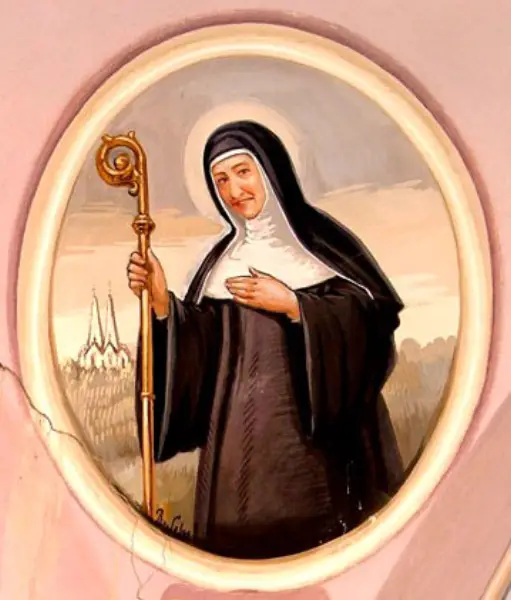
Overview
Mechtilde of Hackeborn, also called Mechtilde of Helfta, was a Saxon Benedictine nun of the thirteenth century, renowned for her musical gifts and for the book of heavenly revelations attributed to her. Born into one of the noblest Thuringian families, she entered the Cistercian monastery of Rodarsdorf as a child to join her elder sister Gertrude of Hackeborn, and followed her in 1258 to the new foundation at Helfta near Eisleben. There she served as chantress, directing the convent's sacred music and training its choir, and headed its school; her beautiful voice earned her the title Nightingale of Helfta, and she reported that Christ himself called her his nightingale in her visions. Late in life a crisis revealed that two nuns had been recording the spiritual favours she received; assured by a vision that this was God's will, she permitted the writings to circulate as the Book of Special Grace. She died at Helfta on 19 November 1298, and her cult, joined to that of Gertrude the Great, nourished devotion to the Sacred Heart across Europe.
The Complete Life
A Fragile Child of a Noble House
Mechtilde was born in 1240 or 1241, given the name Matilda von Hackeborn-Wippra, into one of the most powerful baronial families of Thuringia, kindred to the Hohenstaufen and possessed of lands in northern Thuringia and the Harz. Her elder sister would become the illustrious Abbess Gertrude of Hackeborn, whose energy carried their community to its famous home at Helfta. Because some barons of Hackeborn were also lords of Wippra, family members took their names from either estate, which later caused some writers to mistake Mechtilde von Hackeborn and Mechtilde von Wippra for two different women. The child herself seemed so frail at birth that her attendants, dreading she would die unbaptized, ran her to a priest who was preparing for Mass. The man, regarded as a saint, christened her and pronounced a startling prophecy: the infant would not die, but would become a religious in whom God would work many wonders and would close her days in a good old age. The long life and reputation that followed were read back as the fulfilment of that baptismal word. In the prophecy spoken at the font, the nuns of Helfta later read the whole shape of a long and luminous life.
§ Birth and baptism
Novice at Rodersdorf, Sister of Helfta
When Mechtilde was seven, her mother took her to visit her elder sister Gertrude, then a nun of the Cistercian monastery at Rodersdorf. The little girl was so captivated by the cloister that her parents consented to let her enter the novitiate there. Gifted in mind and body alike, she advanced remarkably in both virtue and learning. About 1258 her sister, now abbess, moved the community to an estate at Helfta granted by her brothers Louis and Albert, and Mechtilde went with her. At Helfta her abilities found their field. She was soon known for humility, fervour, and the amiability that had marked her from childhood; she took charge of the convent's library, illuminated manuscripts, and wrote her own Latin texts, and she composed many prayers. The abbess also made her headmistress of the convent school. In 1261 the community received a five-year-old child whom the abbess committed to Mechtilde's care — the girl who would grow into Gertrude the Great, one of the towering figures of German mysticism, formed under Mechtilde's guidance. Schoolroom, library, and choir stall alike passed through her hands, marks of the most variously gifted nun of her house.
§ Early life
Nightingale, Visionary, and Herald of the Sacred Heart
Mechtilde's fame in her own day rested first on music. Her talents and beautiful voice won her the name Nightingale of Helfta, and she said that in her visions Christ called her by that name. She served as the convent's chantress, its domina cantrix, for the rest of her days, directing its liturgical singing and coaching the choir, and was said never to tire of praising God even through severe bodily suffering. Troubled souls and learned Dominican friars alike sought her counsel. Her revelations, in which Christ, his Mother, and the angels appeared as living presences, gave her teaching a concrete imagery. She cherished the angels as companions of men and women on earth and in heaven; the Virgin taught her a daily devotion of three Hail Marys honouring the power of the Father, the wisdom of the Son, and the love of the Holy Spirit; and Christ showed her his Sacred Heart, urging her to greet it each morning and to honour it in the Blessed Sacrament. With Gertrude she became an ardent herald of devotion to the heart of Jesus, a spirituality that would one day encircle the Church.
§ Devotion to the Sacred Heart of Jesus
The Book of Special Grace and a Quiet Death
At about fifty, Mechtilde passed through a grave spiritual crisis accompanied by physical suffering. There she discovered that two sisters close to her heart had been keeping a private record of the favours God granted her, and the finding left her deeply unsettled. She turned first to prayer, and received a vision of Christ holding the book of her revelations and assuring her that everything in it had been set down by his will and inspiration, so that she had no cause for alarm. He desired that the volume bear the title Book of Special Grace, promising it would become exactly that for many readers; once she saw that the work would redound to God's honour, her unease dissolved and she even corrected the manuscript with her own hand. Pope Benedict XVI later noted that her sister Gertrude contributed to its sixth book. Immediately after her death the work was made public, and copies multiplied rapidly through the networks of the Friars Preachers. Mechtilde died at Helfta on 19 November 1298, most likely buried at Old Helfta beside Gertrude, though the exact spot is unknown.
§ The Book of Special Grace
From Dante's Purgatory to a Modern Calendar
The Book of Special Grace travelled far. A few years after her death it reached Florence, where under the title La Laude di donna Matelda it nourished devotion to divine mercy; Boccaccio tells how Florentines repeated its praises daily before their sacred images. Gertrude, who helped compile the book, mourned that never had one like her arisen in the monastery, nor ever would again. Her image of the soul's ascent up a seven-terraced mountain of purification is among the inspirations proposed for the Matelda whom Dante meets at the close of the Purgatorio, though many scholars judge the Florentine poet's figure likelier shaped by Mechthild of Magdeburg. Four centuries on, printed chapbooks had spread the heart-devotion her visions carried so widely in Europe that it rose to a universal liturgical feast, with Mass and Office composed by John Eudes. A gilded wooden statue of her stands in the abbey church of Tyniec in Poland; the Benedictine sisters of Ferdinand, Indiana, sponsor a sacred music series in her honour; and in 2022 the Episcopal Church enrolled her with Gertrude in its calendar of saints.
§ Legacy
Timeline
- 1241
Born Matilda von Hackeborn-Wippra into a noble Thuringian family, in 1240 or 1241
§ Birth and baptism
- 1248
Taken at seven years old to visit her sister Gertrude at the monastery of Rodersdorf, and enters the novitiate there
§ Early life
- 1258
Follows her sister Gertrude, now abbess, to the monastery's new estate at Helfta
§ Early life
- 1261
Entrusted with the care of a small girl of five, the future Gertrude the Great
§ Early life
- 1291
At about fifty, suffers a grave spiritual and physical crisis on learning that two nuns have recorded her revelations; a vision of Christ with the book settles her
§ The Book of Special Grace
- 19 Nov 1298
Dies in the monastery of Helfta; her feast is kept on the anniversary of her death
§ The Book of Special Grace
- 2022
The Episcopal Church adds her and Gertrude to its calendar of saints, with a common feast on 21 November
§ Legacy
In Their Own Words
What do you fear? This child most certainly will not die, but she will become a saintly religious in whom God will work many wonders, and she will end her days in a good old age.
Everything you have and by which you can please Me you have from Me and through Me.
All this has been committed to writing by My Will and Inspiration; and, therefore you have no cause to be troubled about it.
The Record
- Major works
- Liber Specialis Gratiae (The Book of Special Grace)·Composed prayers in Latin·Illumination of manuscripts and direction of the convent school at Helfta
- Patron of
- Against blindness
- Symbols
- Scales and a sword·Heart·Book·Dove
- Canonization
- Pre-congregation; venerated as a saint since the medieval cult of Helfta
Prayer
Bibliography
Show 6 sources
- "CATHOLIC ENCYCLOPEDIA: St. Mechtilde". www.newadvent.org. Retrieved 2020-06-23.
- Benedict XVI, Pope (29 September 2010). General Audience, St Peter's Square, Rome.
- Witt, Claudia. "Mechtild of Hakeborn 1241 - 1299". Kloster Helfta. Archived from the original on 22 December 2015. Retrieved 14 December 2015.
- Eckenstein, Lina (1896). Woman under monasticism: chapters on saint-lore and convent life between A.D. 500 and A.D. 1500. London, UK: Cambridge University Press. p. 341.
- Gardner, Edmund Garratt (1913). Dante and the Mystics: A Study of the Mystical Aspect of the Divina Commedia and Its Relations with Some of Its Mediaeval Sources. London, UK: J.M. Dent & sons Ltd.
- Pope Francis, Dilexit nos, paragraph 110, published on 24 October 2024, accessed on 25 January 2025.
Profile text adapted from the Wikipedia article, licensed CC BY-SA 4.0.
Pray with this saint every day
Save St. Mechtilde of Hackeborn to your favorites, read the full profile, and get feast-day reminders in the Saints app.
Get the Saints AppFree on the App Store for iPhone and iPad