
c. 1207 – c. 1282·Feast September 16
St. Mechthild of Magdeburg
Beguine Mystic and First Poet of God in Low German
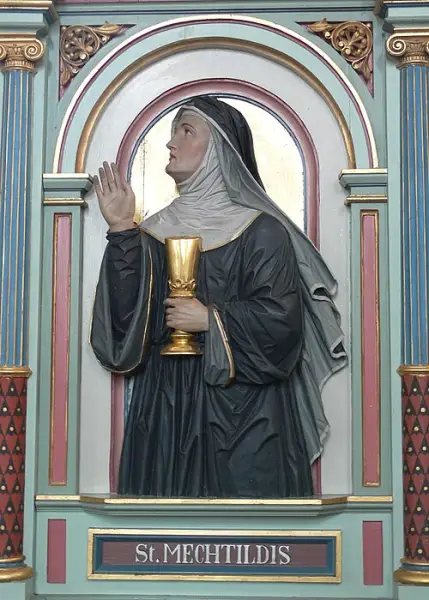
Overview
Mechthild of Magdeburg, born around 1207, was a Beguine and one of the great mystics of the Middle Ages, remembered above all as the first mystic to write in Low German. Born into a noble Saxon family, the Holy Spirit first came to her when she was twelve years old; in 1230 she left her home, renouncing worldly honour and riches, to join the Beguines of Magdeburg. There she exercised a position of authority within the Beguine community, drew close to the Dominicans, and became a tertiary of their order. Her confessor, Henry of Halle, encouraged her to compose her visions, prayers, and dialogues in the book known as The Flowing Light of the Godhead. Her candour toward church dignitaries and her claims of theological insight stirred fierce opposition, and in old age, isolated, criticized, and blind, she found refuge about 1272 at the Cistercian monastery of Helfta, where she completed her book. The date of her death is uncertain — 1282 is commonly given, though some scholars place it in the 1290s. Her writings, largely forgotten for centuries, were rediscovered in the nineteenth century and are now counted among the masterworks of medieval mysticism.
The Complete Life
A Noble Saxon Childhood
Hard facts about Mechthild's beginnings are scarce; nearly all that is known comes from hints scattered through her own writing. She was born around 1207 into a noble Saxon family, in the German-speaking north where Middle Low German was the speech of town and court. Her education in that vernacular, rather than in the Latin of the schools, would later prove decisive for the shape of her literary career. What her writings do record with confidence is the turning point of her childhood: at the age of twelve, as she tells in the fourth book of The Flowing Light, she received her first vision of the Holy Spirit. That early encounter set the pattern of a life lived in the conviction that God speaks directly to a willing soul. For a girl of her rank, the expected paths were marriage or the cloister; Mechthild would choose a third way, the unenclosed life of the Beguines, which let a woman pursue holiness in the world without vows or a permanent rule. The vision of her twelfth year was the seed from which that daring choice grew.
§ Life
Beguine of Magdeburg and Friend of the Dominicans
In 1230 Mechthild left her home and, as she put it, renounced worldly honour and worldly riches, to become a Beguine at Magdeburg. The Beguines were communities of women who lived lives of prayer and chastity without taking monastic vows, and within this circle Mechthild appears, by her own evidence in Flowing Light 6.7, to have held a position of authority comparable to that of her contemporary Hadewijch. In Magdeburg she grew close to the Dominicans, joining their order as a tertiary, reading widely among the friars' writers, whose influence can be traced in her book. Henry of Halle, her Dominican confessor, urged her forward and lent practical help as she set her revelations down in writing — an act of obedience that turned private graces into public literature. Her boldness, however, bred enemies. Her criticism of church dignitaries and her claims to theological insight provoked such opposition that some called for her writings to be burned. As she aged she grew isolated, a target of widespread criticism, and she also lost her sight, entering a darkness that her mystical confidence outlasted.
§ Life
The Flowing Light of the Godhead
The Flowing Light of the Godhead gathers visions, prayers, dialogues, and mystical narrative into a single book, written in Middle Low German with phrases of Latin interwoven, between 1250 and 1280. Its growth came in three stages: the first five books were complete by about 1260, a sixth was added over the following decade, and the seventh, differing in tone from all that preceded it, was written after Mechthild's move to Helfta. She wrote in the language of her region at a time when most wisdom literature appeared in Latin, and this audacity makes her an early champion of German as a tongue worthy of divine things. Her prose is exuberant and highly sophisticated, moving between courtly imagery, bridal mysticism, and fierce rebuke. The hell visions of her pages are thought by some scholars to have fed Dante's imagination for the Divine Comedy, and she herself has been identified with the Matelda of his Purgatorio, though no concrete evidence supports the claim and important differences remain. Whatever the poets owed her, the mystics of Helfta and the German tradition stand in her debt.
§ Works
Refuge at Helfta and an Uncertain End
Around 1272, old, blind, and embattled, Mechthild accepted the protection of the Cistercian monastery of Helfta, the same house that nurtured her younger contemporaries Mechthild of Hackeborn and Gertrude the Great. There, sheltered by a community of highly educated nuns, she completed the written record of the many divine revelations she claimed to have experienced. Whether she formally entered the Cistercian order or simply resided at Helfta and shared its liturgy without monastic vows remains unclear — a fitting ambiguity for a woman who had never fit the usual categories. The date of her death is likewise uncertain. The year 1282 is commonly cited, but some scholars believe she survived into the 1290s. What is certain is the work she left: a book without parallel in the medieval vernacular, translated into Latin by Dominicans of Halle around 1290 and later into Alemannic Middle High German by the priest Henry of Nördlingen. Her last years at Helfta thus bore the richest fruit of her long obedience, securing for posterity the visions first glimpsed by a girl of twelve in Saxony. Old, blind, and out of favour, Mechthild had found at last the peace in which to write her gentlest book.
§ Life
Forgetting and Rediscovery
Although The Flowing Light was rendered into Latin within Mechthild's lifetime, her book was largely forgotten by the fifteenth century, its sole surviving manuscript lying in the Einsiedeln library in Switzerland. There the text was rediscovered in 1861, and in 1869 Pater Gall Morel published the first printed edition; the Solesmes monks followed with a Latin text in the 1870s, and modern critical editions and an English translation have since made her widely readable. Since that recovery her stock has risen steadily: she is studied as a philosopher and mystic and read as a devotional classic, remembered as an early proponent of German as a language fit for the holy. Her home city honours her in its liturgical books on 16 September, as a blessed of the Diocese of Magdeburg, while Anglican calendars keep her on 19 November and the Episcopal Church on 28 May. In 2010 a sculpture by Susan Turcot was raised in the Magdeburg Sculpture Park, and medievalist Hildegard Elisabeth Keller gave her a speaking part among the timeless women of her radio trilogy. Silence, for once, did not have the last word.
§ Remembrance days and artifacts
Timeline
- 1207
Born into a noble Saxon family, around 1207
§ Life
- 1230
Leaves home, renouncing worldly honour and worldly riches, to become a Beguine at Magdeburg
§ Life
- 1250
Begins composing The Flowing Light of the Godhead, written over roughly the following thirty years
§ Works
- 1260
The first five books of The Flowing Light are finished by about this year
§ Works
- 1272
Around 1272 joins the Cistercian monastery of Helfta, which shelters her in her last years
§ Life
- 1282
Death usually assigned to 1282, although other scholars extend her life into the following decade
§ Life
- 1290
Dominican friars of the Halle community translate the first six books of The Flowing Light into Latin
§ Works
- 1861
The sole surviving manuscript of The Flowing Light, kept in the Einsiedeln library in Switzerland, is rediscovered
§ Works
- 2010
A sculpture of her by Susan Turcot is installed in the Magdeburg Sculpture Park
§ Remembrance days and artifacts
In Their Own Words
renounced worldly honour and worldly riches
The Record
- Major works
- Das fließende Licht der Gottheit (The Flowing Light of the Godhead), seven books composed between 1250 and 1280
- Patron of
- The city of Magdeburg·German mystical literature
- Symbols
- Open book·Flowing light·Beguine dress
- Canonization
- Pre-congregation; venerated as a blessed in the Diocese of Magdeburg
Prayer
Bibliography
Show 6 sources
- Hollywood, Amy M. (1995). The soul as virgin wife: Mechthild of Magdeburg, Marguerite Porete, and Meister Eckhart. Notre Dame: University of Notre Dame Press. ISBN 0-268-01753-0.
- Poor, Sara S. (26 March 2013). Mechthild of Magdeburg and Her Book: Gender and the Making of Textual Authority. University of Pennsylvania Press. p. 32. ISBN 978-0812203288.
- McGinn, B. (1998). The flowering of mysticism: Men and women in the new mysticism (1200-1350). Crossroad. pp. 222–244. ISBN 978-0-8245-1742-7.
- Bevan, Frances A., ed. (1896). Matelda and the Cloister of Hellfde: Extracts from the Book of Matilda of Magdeburg. London: James Nisbet & Company.
- Lindemann, Kate (14 December 2014). "Mechtild of Magdeburg". Kate Lindemann's Women Philosophers pages. Society for the Study of Women Philosophers. Retrieved 22 August 2017.
- Holder, Arthur, ed. (2010). Christian spirituality: the classics. London: Routledge. p. 106. ISBN 978-0-203-87472-1.
Profile text adapted from the Wikipedia article, licensed CC BY-SA 4.0.
Pray with this saint every day
Save St. Mechthild of Magdeburg to your favorites, read the full profile, and get feast-day reminders in the Saints app.
Get the Saints AppFree on the App Store for iPhone and iPad