
dates unknown; early British or Irish period·Feast Not recorded
St. Medan
Enigmatic Celtic Saint of Galloway and Angus
Overview
Medan belongs to the early British or Irish age of saints; scholars infer her existence and her very name chiefly from place-name evidence, above all the name Kirkmaiden, yet her cult is attested across Scotland and as far south as Cornwall. Two churches called Kirkmaiden face one another across Wigtownshire — one in Galloway's Rinns, the other at Glasserton near Monreith in the Machars — and legend recounts how the saint crossed Luce Bay from one site to the other with her nuns, a rock serving them as a boat. Everything else about Medan is disputed: identity, name, sex and origin have all been questioned by scholars. The name may conceal a masculine original misread through its likeness to the English word maiden, or a Gaelic honorific beginning with the element mo, my. It has been connected with the virgin saint Etain of Tumna near Boyle in County Roscommon, with the abbess Modwena or Moninne of Killevy who died on 5 July 517 or 519 and is said to have founded churches in Scotland, and with the masculine Muadan commemorated in Argyll and Ireland as a form of my Aedan. A male Medan was buried at Bodmin in Cornwall, a Modan was venerated from Rosneath to Caithness, and the church of Kingoldrum in Angus was dedicated to St Medan.
The Complete Life
Two Churches across Luce Bay
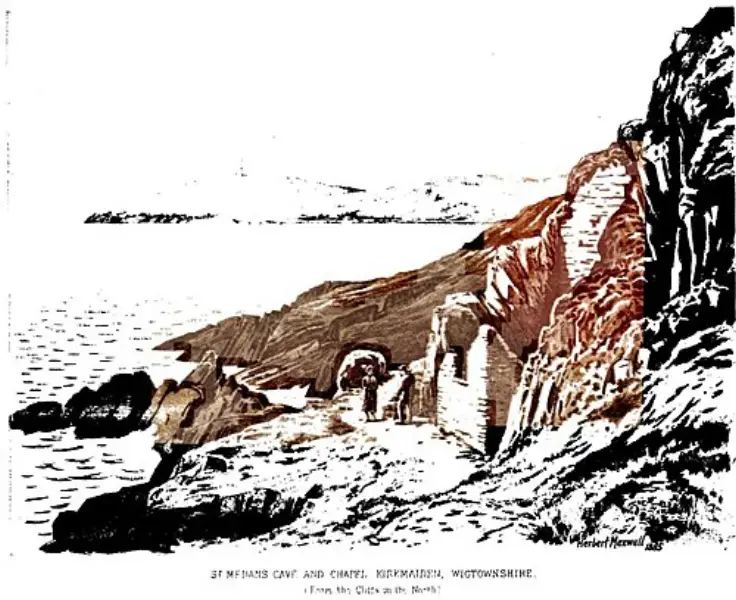
The cult of Medan is anchored in Wigtownshire, in the far southwest of Scotland, where two churches bearing the name Kirkmaiden stand within sight of one another across the waters of Luce Bay. One lies in Galloway's Rinns; its partner stands at Glasserton, in the Machars near Monreith. A sea-miracle accounts for the doubled dedication: the saint, with her community of nuns, is said to have travelled from one location to the other across the bay, using a rock as a boat. The theme would not have been strange to Celtic hagiography, for other saints of that world are said to have voyaged on similarly improbable vessels, but at Kirkmaiden it belongs to Medan herself and marks her as a leader of women in the Christian settlement of Galloway. At the Kirkmaiden on the Machars the memory took durable geographic form: St Medan's Cave and Chapel lie at the foot of the degraded cliffline, a shelter of rock and ruin where the saint's community is remembered. From these two Wigtownshire foundations the name of Medan passed into the landscape of Scotland, carried by dedications that outlived every written account of her life.
§ The occurrence and legend of Medan
A Name the Scholars Still Debate
Every question about Medan — who she was, what her name meant, even her sex and her homeland — is disputed, and the arguments themselves have become her afterlife. The name echoes the English word maiden, which may point to a man's name that later ages mistook for a woman's; it may equally begin with the Gaelic honorific mo, my. It has been linked with Etain, a name proposed for the virgin of Tumna by Boyle in County Roscommon — though one scholar would explain Cill Medoin, in Tuam's diocese, plainly as the Irish for a middle church; and with Modwena, also called Moninne or Darerca, abbess of Cill Sleibe Cuilinn at Killevy near Slieve Gullion, who died on 5 July 517 or 519 and is said to have founded churches in Scotland. The case for a man is perhaps stronger: the name resembles Muadan, commemorated on both sides of the Irish Sea and glossed as a version of my Aedan, the name borne by sixteen saints including Aedan of Lindisfarne. Bodmin in Cornwall received the burial of a male Medan, perhaps remembered too at Tregavethan, and Modan, a man, is venerated at Rosneath, Falkirk, Airlie, Fraserburgh, Fintray and Freswick. In Angus, the church of Kingoldrum, thought originally a Celtic establishment and dedicated to St Medan, with a St Medan's Well nearby, was given to Arbroath Abbey by William the Lion in 1211-14; Medan is also counted one of the three companions of St Drostan, evangeliser of Aberdeenshire and founder of Deer Abbey. A 1901 dedication to a female St Medan at Troon in Ayrshire, and even a golf course named St Medan's near the Kirkmaiden at Monreith, show the name still living in the landscape.
§ Who was Medan?
Timeline
- 5 Jul 517
If Medan is identified with the abbess Modwena, or Moninne, of Killevy, her death falls on 5 July 517 or 519
§ Who was Medan?
- 1211
The church of Kingoldrum in Angus, dedicated to St Medan, is given to Arbroath Abbey by William the Lion
§ Who was Medan?
- 1901
A church dedicated to a female St Medan is erected at Troon in Ayrshire
§ Who was Medan?
The Record
- Patron of
- Kirkmaiden in the Rinns of Galloway·Kirkmaiden in Glasserton, Wigtownshire·Kingoldrum, Angus
- Canonization
- Pre-congregation; known only through church dedications and place names
Prayer
Bibliography
Show 5 sources
- MacQueen, John. Place-Names in the Rhinns of Galloway and Luce Valley, Stranraer and District Local History Trust. 2002 pp. 50 & 51
- R A Ogden, An Unknown Planet?, 2008, Park Corner Press, Warrington, p 41
- Eilert Ekwall, The Concise Oxford Dictionary of English Placenames, OUP, 1960, p. 479.
- "St Drostan of Deer". www.cushnieent.force9.co.uk. Retrieved 31 January 2008.
- "Troon St Meddans Church of Scotland". Archived from the original on 13 April 2014. Retrieved 6 June 2023.
Profile text adapted from the Wikipedia article, licensed CC BY-SA 4.0.
Pray with this saint every day
Save St. Medan to your favorites, read the full profile, and get feast-day reminders in the Saints app.
Get the Saints AppFree on the App Store for iPhone and iPad