
c. 456 – 545·Feast June 8
St. Medardus
Bishop of Noyon in the Frankish Kingdom
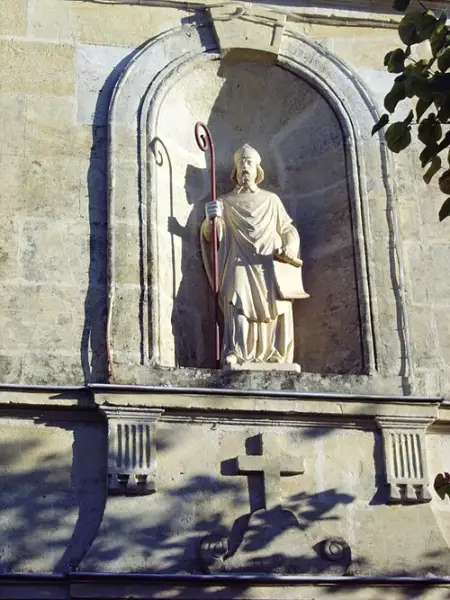
Overview
Medardus, in French Médard, was bishop of Noyon and one of the most honoured churchmen of Merovingian Gaul. Born around 456 at Salency in Picardy to a Frankish noble father and a Gallo-Roman mother, he grew up in the unsettled years that followed the fall of the Western Roman Empire. Ordained at thirty-three by Bishop Alomer of Vermand, he succeeded that bishop in 530 as bishop of Vermand, and the next year moved his see to Noyon, the strongest fortress of the region, where enemies were few and the faith could be carried to the pagan Flemings. In 532 he accepted direction of the diocese of Tournai as well, joining the two sees for over six centuries, and there he received Radegund, the Thuringian captive queen, as a deaconess and nun. A trusted councillor of King Clotaire I, he died at Noyon on 8 June 545. His relics were translated to Crouy near Soissons, where the great abbey of Saint-Médard rose over his tomb. His memory spread through northern France, Cologne, and western Germany, wrapped in weather lore that still bears his name.
The Complete Life
A Son of Two Peoples
Medardus was born around 456 at Salency in the Oise country of Picardy, the child of a household that joined the two peoples of Roman Gaul: his father, Nectaridus, belonged to the Frankish nobility, while Protagia, his mother, came of Gallo-Roman stock. His lifetime spanned the convulsive change of an era. The last western emperor was deposed in 476, and between 481 and 511 the Salian Frankish king Clovis conquered and united several Germanic successor states into the Kingdom of Francia, the seed of both modern France and Germany. Later legend wove his boyhood into this landscape, imagining the child accompanying his father on business to Vermand and Tournacum, frequenting the schools there and shunning worldly dissipations. The Roman Martyrology preserves a far more fanciful tale — that Gildard, Bishop of Rouen, was his twin in every sacred milestone, born, consecrated, and buried on the same days. Chronology refutes it: Gildard sat among the fathers at Orléans in 511, but Medardus received consecration only in 530, and the earliest lives of Medardus say nothing of any brother. The facts, so far as they reach, show a Gallo-Roman youth raised on the frontier of a new Frankish world.
§ Life
Ordination and the See of Vermand
Medardus was ordained at the age of thirty-three, his piety and learning, remarkable for that age of turmoil, persuading Bishop Alomer of Vermand to confer Holy Orders on him. When Alomer died in 530, the choice of a successor fell at once upon Medardus. He raised objections, according to his biographers, but the insistence of the people overcame his reluctance and he accepted the burden of the episcopate in the small and defenceless city of Vermand. His elevation came in the reign of the Merovingian kings who had made themselves masters of northern Gaul, and he would spend his episcopate deep in their politics: he served as a councillor to King Clotaire, who held court at Noviodunum, modern Soissons. The union of Roman ecclesiastical order with Frankish royal power, so characteristic of the sixth century, found in Medardus one of its most trusted brokers. From Vermand he governed a fragmentary diocese in a fractured land, gathering the experience and the reputation that within a year would let him reshape the whole map of the Church in that corner of Neustria.
§ Life
Noyon, Tournai, and the Conversion of the Flemings
In 531 Medardus relocated his see, quitting undefended Vermand for Noviomagus Veromanduorum — today's Noyon — the mightiest stronghold in that stretch of Neustria. It was a decision made for the safety of the Church in an age of private war: that same year Clotaire marched against the Thuringii beside his brother Theuderic I, while struggles with the Burgundians troubled the country. In 532, on the death of Eleutherius, bishop of Tornacum (Tournai), Medardus was invited to take that diocese under his direction as well; he refused at first, but yielded when Clotaire himself pressed him. The union of Noyon and Tournai lasted until 1146, when the sees were finally separated again. Tournai was the forward post for evangelizing the pagan Flemings, and from it Medardus directed mission into the low country of the north. There too he received one of his most famous spiritual children: Radegund of Thuringia, a captive princess whose family Clotaire had destroyed, whom Medardus consecrated as a deaconess and nun before she withdrew to found her own monastery at Saix, becoming one of the great holy women of the age.
§ Life
Death, Translation, and the Abbey of Saint-Médard
Medardus died at Noyon on 8 June 545, the king Clotaire having paid him a final visit at the episcopal city. The story of his burial belongs as much to legend as to history. Clotaire ordered the remains carried to Croviacum, his own manor — today's Crouy — on the threshold of Soissons, and over the tomb there eventually rose the celebrated Benedictine abbey that bears the saint's name. The choice of the site was authenticated, so the tale runs, by a familiar hagiographic sign: when the funeral procession reached Crouy, some three miles from Soissons, the bier became immovable, and only after Clotaire had promised, first half and then the whole borough, to the new church did it grow light enough to carry onward. Whatever weight one gives the story, the outcome was real and enduring. The Abbey of Saint-Médard at Soissons became one of the great religious houses of Francia, the destination of pilgrims and the guardian of the saint's memory, and the king's gift bound the saint's grave permanently into the royal landscape of the Merovingian heartland.
§ Death
Weather Lore, the Rosière, and a Wide Devotion
Medardus was among the most honoured bishops of his time, and his cult spread from northern France through Cologne into western Germany; both Venantius Fortunatus and Gregory of Tours mention it. Art shows him laughing with his mouth wide open, which made him the saint invoked against toothache, and an eagle that once, as a child, hovered over him to shelter him from a storm attached his name to the weather forever. Feast-day lore on both sides of the Rhine promises that whatever the sky does on 8 June it will hold for forty days, a belief shared with England's Swithun. He is patron of vineyards, brewers, captives, the mentally ill, and peasants, and his figure appears on the arms of Wessem in the Netherlands and Lüdenscheid in Germany, while a parish church in Lincolnshire is dedicated jointly to him and Saint Gildard. At his birthplace of Salency the yearly crowning of the Rosière, the most virtuous young girl of the commune — a custom attributed to Medardus himself, with his sister Médrine as the first honouree — carried his name into French village life down to modern times.
§ Legends and customs
Timeline
- 456
Born around 456 at Salency in Picardy, son of the Frankish noble Nectaridus and his Gallo-Roman wife Protagia
§ Life
- 489
Ordained at the age of thirty-three by Bishop Alomer of Vermand
§ Life
- 530
Chosen to succeed Alomer as bishop of Vermand on his death, accepting after the people insist
§ Life
- 531
Transfers the seat of his bishopric from undefended Vermand to the fortress town of Noyon
§ Life
- 532
On the death of Bishop Eleutherius, accepts direction of the diocese of Tournai at King Clotaire's urging
§ Life
- 8 Jun 545
Dies at Noyon on 8 June, after a last visit from King Clotaire
§ Death
In Their Own Words
He often accompanied his father on business to Vermand and Tornacum (modern Tournai), where he frequented the schools, carefully avoiding all worldly dissipation
When the procession reached Crouy, which is about three miles from Soissons, the bier became wholly immovable. The king then promised to give half the borough of Crouy to the new church. On trying again to lift the bier, it was found that the half facing the part given to the church was loose and could be moved, but the other half was as fast as ever. Clotaire now promised the whole borough to the church. The bier instantly became so light that it could be lifted and carried without any trouble to its final destination.
The Record
- Major works
- Union of the dioceses of Noyon and Tournai (532)·Reception of Radegund as deaconess and nun·Institution of the Rosière custom at Salency (by tradition)
- Patron of
- The weather, and protection of those who work in the open air·Against toothache·Against bad weather, but also invoked for rain·Against sterility and imprisonment·Vineyards, brewers, captives and prisoners, the mentally ill, and peasants
- Symbols
- Episcopal garments·An eagle sheltering him from rain·Laughing with mouth wide open
- Canonization
- Pre-congregation; cult attested by Venantius Fortunatus and Gregory of Tours
Prayer
Bibliography
Show 6 sources
- Adrien Baillet, Les vies des saints, 1701, 3 volumes (tome 9, 1739).
- Clugnet, Léon. "St. Medardus." The Catholic Encyclopedia Vol. 10. New York: Robert Appleton Company, 1911.
- A Dictionary of Christian Biography..., (William Smith, Henry Wace, eds.) J. Murray, 1880.
- C.-P.-H, Martin–Marville, "Essai sur les châteaux royaux, villas royales ou palais du fisc mérovingiens et carolingiens", Mémoires de la Société des antiquaires de Picardie, Third Series 3, 1873.
- Gregory, Hist. Francorum IV, ch 19.
- Honzíková, Jarmila, Jan Krotký, Pavel Moc, and Jan Fadrhonc. "Weather Lore (Pranostika) as Czech Folk Traditions." Heritage 6, no. 4 (2023): 3777-3788.
Profile text adapted from the Wikipedia article, licensed CC BY-SA 4.0.
Pray with this saint every day
Save St. Medardus to your favorites, read the full profile, and get feast-day reminders in the Saints app.
Get the Saints AppFree on the App Store for iPhone and iPad