
1134 or 1136 - 1196·Feast August 14
St. Meinhard
First Bishop of Livonia, Apostle of Latvia
Overview
Meinhard was a German Augustinian canon regular who became the first bishop of Livonia and is venerated as the apostle of the Church in Latvia. His life is described in the Livonian Chronicle of Henry, the earliest narrative of the Christian settlement of the eastern Baltic. As a canon at the abbey of Segeberg in Holstein he was possibly stirred by the missionary work of Vicelinus among the Slavs, and in the 1170s or early 1180s he travelled with Lübeck merchants, probably trading in costly furs, on a Catholic mission to convert the pagan Semigallians, Latgalians and Livonians. He settled on the Daugava river at Ikšķile, southeast of modern Riga, raising there in 1184 a stone church in honour of Our Lady. When Lithuanian raiders struck, he brought masons from Gotland to build a fortress against the men who carried off slaves — the earliest stone construction known among the Baltic peoples. Consecrated bishop of Üxküll in 1186 by Hartwig of Uthlede, Archbishop of Bremen, he saw his bishopric confirmed by Pope Clement III in September 1188, who later opened his mission to any monk and, in 1193, granted indulgences to those who joined it. Confronted by rebellion and apostasy, Meinhard turned from peaceful conversion toward the idea of a crusade. Death came in 1196; Riga received his remains in 1226, and they lie today in the cathedral of that city, now Lutheran.
The Complete Life
A Canon of Segeberg Looks North
Meinhard's missionary vocation was formed in the border country of northern Germany. He was a canon at the abbey of Segeberg in Holstein, a house that stood within living memory of the great northern missions, and it was possibly the example of Vicelinus, the apostle of the Wagrian Slavs, that first bent his thoughts toward the pagan peoples beyond the Elbe. The opportunity came through commerce. In the 1170s or early 1180s Meinhard travelled with merchants of Lübeck, probably engaged in the profitable trade of costly furs, to Livonia on the eastern Baltic, where the Semigallians, Latgalians and Livonians still practised their ancestral religions. The partnership of trade and mission marked the whole enterprise: the same boats that carried axes, cloth and furs up the Daugava now carried also a canon regular bent on preaching Christ. Meinhard chose his station wisely, settling on the Daugava at Ikšķile, known to the Germans as Üxküll, southeast of what is today Riga, where the river highway joined the peoples of the interior to the Baltic sea roads. There, far from his Holstein abbey, the canon became a settler, a builder and at last a bishop, the first shepherd of a Church that did not yet exist.
§ Life
Stone and Faith on the Daugava
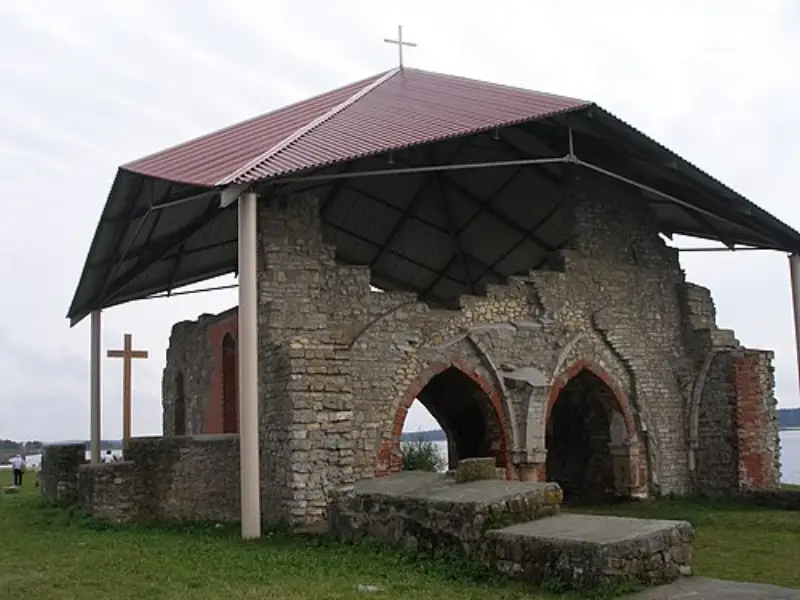
Meinhard's mission expressed itself first in building. In 1184 he raised a stone church at Ikšķile dedicated to Our Lady, the beginning of a material Christianity in a land of timber. When Lithuanian raiders attacked, seeking captives to carry off as slaves, the bishop brought stonemasons from Gotland for a bulwark against renewed raids; the Baltic peoples had raised no earlier work in stone, and the ruins of his church stand yet, preserved since the 1970s on an artificial island raised against the flooding caused by the Riga Hydroelectric Power Plant, and covered with metal in 2002 for conservation. A second stone castle rose at Salaspils, called Holm by the Germans, offered as a gift to the newly converted. Yet those he had come to serve did not always welcome the missionary's gifts: they rose against Meinhard and attacked him, seeking nothing less than his expulsion from Livonia. A brief return to Germany brought he was consecrated in 1186 as Bishop of Üxküll by Hartwig of Uthlede, Archbishop of Bremen, and Pope Clement III confirmed the new bishopric in September 1188. Peaceful persuasion won the mission its first converts; resistance and backsliding, however, pushed Meinhard toward conceiving of the enterprise as a crusade — a fateful turn that his successors, Berthold of Hanover and Albert of Riga, would carry into the Livonian Crusade.
§ Life
The Old Bishop and His Unruly Flock
The last years of Meinhard's episcopate were spent shepherding a Church that repeatedly slipped from his hands. Pope Clement III supported him by allowing any monk to join the Livonian mission in 1190, and his successor Celestine III went further in April 1193, opening active recruitment to the mission, relaxing for its recruits the disciplines of monastic food and dress, and offering indulgences to volunteers. Among those the call brought into the field was Theodorich of Loccum Abbey, who opened an independent mission at Turaida, the Germans' Treyden. Yet conversions remained fragile, and the rebellions of the baptized drove the aged bishop to contemplate means beyond preaching. He died in 1196, having ruled as Bishop of Livonia from his consecration in 1186, and the see passed in turn to Berthold of Hanover and Albert of Riga, who launched the Livonian Crusade and founded at Riga the crusading military order of the Livonian Brothers of the Sword. Meinhard thus stands at the hinge between two ages of the northern mission: the age of the unarmed canon preaching beside his stone church, and the age of the armed pilgrimage that followed him. Riga took in his remains in 1226; they repose in the city's cathedral, Lutheran today, an enduring token of the Church he founded.
§ Life
Restored Veneration in Free Latvia
Meinhard's cult was formally restored in our own time by Pope John Paul II. On 8 September 1993, during his visit to the Baltic states after the recovery of their independence, the Pope announced with solemnity his decision to raise anew the saint's yearly memorial of 14 August — a papal deed held equivalent to canonization. The restored feast of 14 August had long stood in the calendars that remembered him: the Augustinian canon and first bishop of Livonia had been honoured as the apostle of the Church in Latvia, the medieval Livonia whose conversion he began. The restoration returned a native apostle to a Church that Soviet rule had lately suppressed, and bound the modern Catholic community of Latvia to the twelfth-century beginnings of its faith on the Daugava. His relics, translated to Riga in 1226, rest in the now-Lutheran Riga Cathedral, making the saint a figure shared across confessional lines in the religious memory of the city. The ruins of his church at Ikšķile, protected on their island in the reservoir and conserved under metal sheeting since 2002, remain a place of pilgrimage where the first stone Christianity of the Baltic peoples can still be touched.
§ Life
Timeline
- 1184
Builds a stone church dedicated to Our Lady at Ikšķile on the Daugava, the first known stone building among the Baltic tribes
§ Life
- 1186
Briefly returning to Germany, he is consecrated Bishop of Üxküll by Hartwig of Uthlede, Archbishop of Bremen
§ Life
- Sep 1188
Pope Clement III confirms the new bishopric of Üxküll
§ Life
- 1190
Clement III permits any monk to join Meinhard's Livonian mission
§ Life
- Apr 1193
Celestine III authorizes missionary recruitment, relaxes rules on monks' food and clothing, and grants indulgences to those who join the mission
§ Life
- 1196
Dies as first Bishop of Livonia and is succeeded by Berthold of Hanover
§ Life
- 1226
His remains are translated from Livonia to Riga, where they rest in the now-Lutheran Riga Cathedral
§ Life
- 8 Sep 1993
Pope John Paul II, visiting the Baltic states, proclaims the restoration of the saint's yearly memorial of 14 August to the Church's calendar
§ Life
The Record
- Major works
- Stone church of Our Lady at Üxküll (Ikšķile), whose ruins survive·Stone fortress on the Daugava built with masons from Gotland against Lithuanian raiders·Stone castle at Salaspils (Holm), given to the newly converted
- Patron of
- Latvia·Livonia
- Canonization
- Pope John Paul II solemnly proclaimed the restoration of his veneration on 8 September 1993, a papal act considered equivalent to canonization
Prayer
Bibliography
Show 7 sources
- Butler, Alban (1995). Butler's Lives of the Saints, Volume 12. p. 283.
- Fonnesberg-Schmidt, Iben (2007). The popes and the Baltic crusades, 1147-1254. The Northern World. Vol. 26. BRILL. pp. 66-68, 73-74. ISBN 978-90-04-15502-2.
- Butler, Alban; Jones, Kathleen (2000). Butler's lives of the saints. Vol. 12. Liturgical Press. p. 283. ISBN 0-8146-2388-3.
- "Ikskile church ruins on the St Meinard island", Latvian tourism board
- Turnbull, Stephen R.; Dennis, Peter (2004). Crusader castles of the Teutonic Knights: The stone castles of Latvia and .. . Fortress. Vol. 19. Osprey Publishing. pp. 4-5. ISBN 1-84176-712-3.
- Jovaiša, Liudas (2008). "Bažnyčia Mindaugo krikšto laikais". Mindaugas karalius (in Lithuanian). Aidai. p. 17. ISBN 9789955656562.
- "Rare opportunity to visit St. Meinhard's island by foot", LSM.lv news, August 24, 2017
Profile text adapted from the Wikipedia article, licensed CC BY-SA 4.0.
Pray with this saint every day
Save St. Meinhard to your favorites, read the full profile, and get feast-day reminders in the Saints app.
Get the Saints AppFree on the App Store for iPhone and iPad