
died 530·Feast November 6
St. Melaine
Sixth-Century Bishop of Rennes in Brittany
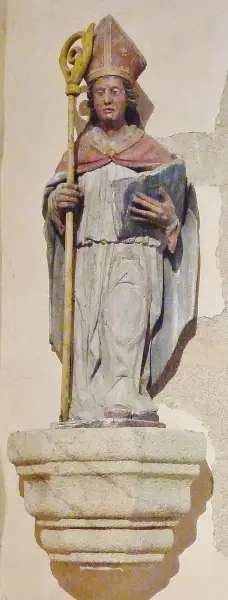
Overview
Melaine — Latin Melanius, Breton Melani, Welsh Mellon — was a sixth-century Bishop of Rennes in Brittany. Born at Plaz in Brain near Redon to a Gallo-Roman family, he first embraced the monastic life, founding and governing a small monastery close to his home. When Bishop Amand of Rennes died, the local population compelled the reluctant abbot to take up the episcopate. As bishop he was remembered for many miracles and for putting an end to heathen practices in his diocese, and when Clovis extended Frankish rule over the region, Melaine became one of the king's trusted advisors. He opposed immigration from Britain into Armorica and in 511 attended the First Council of Orléans. He died at Plaz in 530; tradition tells that his body, laid on a boat on the river Vilaine, returned to Rennes against the current without oars or sail. Rennes laid him to rest in its abbey church of Notre-Dame en Saint-Mélaine, and veneration gathered quickly and remains the principal patron of the Diocese of Rennes, with a feast on 6 November.
The Complete Life
Gallo-Roman Roots near Redon
Melaine was born at Plaz in Brain, near Redon in eastern Brittany, into a Gallo-Roman family — descendants of the old provincial population whose Latin culture still underlaid the Armorican countryside in the generations after Roman rule. From such households the last heirs of Roman Gaul still supplied the Church with its bishops. The hagiographer Sabine Baring-Gould preserved the outline of his beginnings: he became a monk, and in time the abbot of a small monastery that he had established near his home. This double identity, hermit-founder and eventual bishop, was typical of sixth-century Gaul, where episcopal authority often grew out of monastic credibility rather than administrative career. The old lists of the bishops of Rennes carry some confusion: the scholar Louis Duchesne argued that the Amandus reckoned among the city's bishops at the end of the fifth century was really Amand of Rodez, and struck the name from his authentic list. Whatever the truth of his predecessor, Melaine's own attachment to the region of his birth never broke — it was there he built his church and gathered his monks, and there, in the place called Plaz, that his life would end. In dying where he had first built and prayed, he kept faith with the pattern of his whole vocation.
§ Traditional history
A Reluctant Bishop for Rennes
Tradition, again as gathered by Baring-Gould, tells that when Bishop Amand of Rennes died, the people of the city compelled Melaine to become their next bishop, and that he accepted the office with great reluctance. The motif of the reluctant bishop is beloved of hagiographers, but in Melaine's case it rings true to the character his cult preserved: a man formed in the monastery, who preferred the disciplines of prayer to the turbulent honours of an episcopal throne in a frontier diocese. Rennes stood where Breton and Frankish spheres met, and its bishop needed both spiritual authority and political nerve. Once installed, Melaine exercised both. He was remembered as a wonderworker whose miracles adorned his episcopate, and as a reformer who put an end to heathen practices lingering among his people — the old observances of the countryside that Christian preaching had not yet fully displaced. The congregation of monks and servants of God that he gathered with his own hands, as the Roman Martyrology records, kept the monastic seed of his vocation alive at the heart of his diocese.
§ Traditional history
Advisor to Clovis and Council Father
During Melaine's rule as bishop, the map of Gaul was redrawn around him: Clovis took over the region, and Melaine became a trusted advisor of the Frankish king. The alliance between Gallo-Roman bishops and the newly Catholic Merovingian monarchy was among the decisive facts of sixth-century history, and Melaine's standing with Clovis marks him as one of its trusted brokers in the Armorican borderland. He took a decided line on another frontier question, opposing immigration from Britain — the migration of Britons across the Channel that was steadily reshaping Brittany and giving it its name. His standing in the wider Church is fixed by a firm date: in 511 he attended the First Council of Orléans, the great assembly of Gallic bishops convoked in the reign of Clovis. There, among the metropolitans and scholars of the Frankish Church, the monk-bishop from Rennes helped shape the canons that ordered Christian life in the new kingdom. It is the one event of his career that chronology pins down with certainty, and it shows the local saint acting on the national stage. Few bishops of a frontier see could claim both a king's confidence and a place among the fathers at Orleans.
§ Traditional history
Death at Plaz and the Boat on the Vilaine
Melaine died in 530 at Plaz, the place of his birth, by the river Vicenonia — the Vilaine — where he had built a church with his own hands and gathered his congregation of monks and servants of God. The tradition of his passing carries one of the loveliest of Breton legends: his body was laid on a boat, and the vessel made its way back up to Rennes unaided by oar or sail, delivering the bishop to his cathedral city by a power that admitted no human explanation. His remains were laid in Rennes's Abbey Church of Notre-Dame en Saint-Mélaine; the tomb there became a centre of prayer. The 2004 edition of the Roman Martyrology keeps his memory on 6 November, recording that he passed to God at Plácium on the Vicenóniam; an older English translation of the martyrology, that of 1956, lists him instead under 6 January with a tribute to his innumerable virtues and a heart fixed on heaven. The two dates testify to how widely and how long his passing was remembered. In dying where he had first built and prayed, he kept faith with the pattern of his whole vocation, a monk to the end.
§ Traditional history
Patron of Rennes and of Cornish Villages
Melaine was quickly revered as a saint, and devotion surged after a fire destroyed the wooden tower above his grave and his tomb emerged miraculously unharmed — a sign the people of Rennes did not mistake. He remains the first patron of the Diocese of Rennes, and the city's abbey church of Notre-Dame-en-Saint-Melaine took its dedication from him. His cult crossed the Channel. Cornwall honours him as patron of St Mellion and Mullion, two villages that preserve a tradition of his visit; in Wales his feast is celebrated locally on 10 October at St Mellons, now in Cardiff, though there is ambiguity over whether the Mellonius honoured there — said to have been born in the place — is this same Melaine or the possibly legendary fourth-century Bishop of Rouen of that name. In the Diocese of Quimper his feast is kept on 6 January. Few bishops of early Brittany left so wide a wake: from the Vilaine to the Cornish coast, place after place still carries the memory of the monk of Plaz. For a bishop of the sixth century, such a geography of devotion is a rare and remarkable harvest.
§ Veneration
Timeline
- 511
Attends the First Council of Orléans
§ Traditional history
- 530
Dies at Plaz in 530; his body is laid in the Abbey Church of Notre-Dame en Saint-Mélaine at Rennes
§ Traditional history
In Their Own Words
At Rhedónibus (Rennes) in Brittany, bishop, who passed to God in the place called Plácium on the River Vicenóniam (Vilaine), where with his own hands he built a church and gathered a congregation of monks and servants of God.
The Record
- Major works
- Foundation of a small monastery near his home at Plaz in Brain
- Patron of
- Principal patron saint of the Diocese of Rennes·The villages of St Mellion and Mullion in Cornwall
- Symbols
- Bishop's crozier·Boat returning upriver without oars
- Canonization
- Pre-congregation; principal patron saint of the Diocese of Rennes
Prayer
Bibliography
Show 6 sources
- "Saint Melaine de Rennes", Nominis.
- Baring-Gould, Sabine. The Lives of the Saints - Vol. I, 1914.
- Duchesne, Louis (1910). Fastes épiscopaux de l'ancienne Gaule: II. L'Aquitaine et les Lyonnaises. Paris: Fontemoing (1910), pp. 344–345.
- Monks of Ramsgate. "Melanius". Book of Saints, 1921. CatholicSaints.Info. 12 April 2015.
- Doble, G. H. (1962). The Saints of Cornwall Part II. Truro: Dean and Chapter; pp. 109–119.
- Martyrologium Romanum, 2004, Vatican Press (Typis Vaticanis), page 609.
Profile text adapted from the Wikipedia article, licensed CC BY-SA 4.0.
Pray with this saint every day
Save St. Melaine to your favorites, read the full profile, and get feast-day reminders in the Saints app.
Get the Saints AppFree on the App Store for iPhone and iPad