
c. 350 – before 410·Feast June 8
St. Melania the Elder
Desert Mother and Foundress on the Mount of Olives
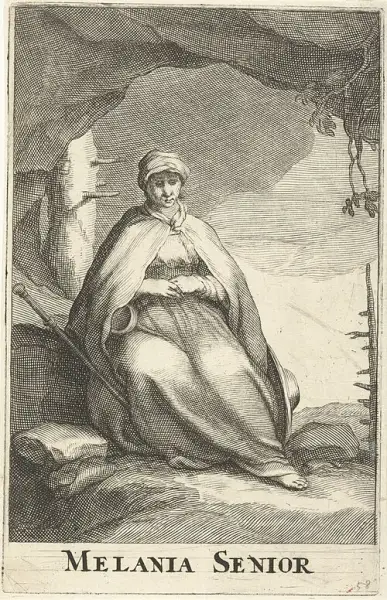
Overview
Melania the Elder, Latin Melania Maior, born around 350 in Spain, was one of the wealthiest citizens of the Roman Empire who gave her fortune to the ascetic movement that flourished after Christianity became legal. Married at fourteen into the patrician gens Valeria and widowed by twenty-two, she left her surviving son with a guardian and set out for Egypt, where she stayed with the monks of the Nitrian desert and used her wealth to shelter the persecuted. When exile scattered the ascetics after 373, she followed them to Palestine, suffering a brief imprisonment in the process. She settled in Jerusalem, building a convent for herself and a monastery on the Mount of Olives for her spiritual companion Rufinus of Aquileia — together among the earliest monastic communities of the Holy Land. A follower of Origen's teaching, she mentored Evagrius of Pontus, corresponded with Jerome and Augustine's circle, and around 400 travelled to Rome, where her influence drew her granddaughter Melania the Younger to the religious life. She died before 410, remembered as a Desert Mother of the Church.
The Complete Life
Heiress of an Empire
Melania was born around 350 in Hispania, the daughter of Marcellinus, a man of consular rank, and a kinswoman of the poet-ascetic Paulinus of Nola. Her family stood among the wealthiest of the Roman world, and at fourteen she was married, probably to Valerius Maximus signo Basilius of the powerful patrician gens Valeria, though some identify her husband with a politician named Maximus. The couple settled in the suburbs of Rome, where the habits of a great senatorial household unfolded as expected. Then death emptied the house: by the time she was twenty-two, her husband and two of her three sons were gone. The young widow kept her surviving son, Valerius Publicola, and her enormous fortune. To the aristocratic world this was a woman to be remarried and re-anchored; Melania read her situation differently. Her conversion to a wholehearted Christian life in Rome turned bereavement into vocation, and the girl who had been married at fourteen began, in her twenties, to prepare one of the most radical renunciations the late antique world had seen. Few conversions of that era set out from so high a place in the social order.
§ Pagan period
From Rome to the Nitrian Desert
Melania placed her son with a guardian and, accompanied by her servants, set out for Alexandria to join the Christian ascetics and visit the monks of Nitria, in the desert that is today the Wadi Natroun. It was a journey few senators' daughters had ever imagined, from the villas of Italy to the cells of the Egyptian fathers. She stayed some six months among the monks, and her patronage flowed to them as freely as her admiration: Christine Schenk notes how her money and standing were poured out for monks, priests, and bishops of the Nitrian Desert. The friendship of the desert shaped the rest of her life. When violence against the Church followed Athanasius's death in 373 and bands of monks were driven into exile at Diocaesaraea in Palestine, Melania went after them and kept them funded — loyalty that cost her a brief imprisonment, ended only when the governor learned the rank of the woman he had locked up. She had chosen her side: not the senatorial order that claimed her by birth, but the community of ascetics whose company she counted as treasure.
§ With the Egyptian monks
Foundress on the Mount of Olives
In Jerusalem Melania raised the twin houses for which she is best remembered: a convent where she herself lived, and a monastery on the Mount of Olives destined for Rufinus of Aquileia, the theologian who was her closest spiritual friend. The double house stood among the earliest Christian monastic communities of the Holy Land, planted in the very landscape of the resurrection. From it she exercised an influence that reached across the empire. She became the spiritual mentor of Evagrius of Pontus, whose texts entered the Eastern Orthodox Philokalia; it was she who persuaded him to go to Egypt and join the desert ascetics, and she carried on a correspondence with him during his years there. A follower of Origen, she promoted the asceticism she considered indispensable for salvation, and she stood in the thick of the Origenist controversy of the 390s, where her pro-Origenist sympathies drew down the particular fury of Jerome, who punned on her name, branded her dark in name and darker in nature, and set about deleting his former warm praises of her. Palladius of Galatia, with more restraint, styled her a woman of great learning whose heart was set on the world.
§ Jerusalem
Rome, Africa, and the Last Journey
Around the year 400 Melania travelled from Jerusalem to Rome to visit her son; he had recently taken as wife Caeionia Albina, the daughter of Caeionius Rufius Albinus. The visit bore unexpected fruit: through her influence, her granddaughter, known to history as Melania the Younger, later embraced the religious life and would surpass even her grandmother in the scale of her renunciations. Melania also visited her kinsman Paulinus and his wife Therasia at Nola, bringing him a relic of the True Cross — a gift Paulinus recorded with colour in his Letters. In 406 Augustine of Hippo wrote to Paulinus that his kinswoman was then in North Africa when her son Valerius died, an ageing mother once more receiving news of bereavement from afar. Of her own end the sources diverge slightly: she died before 410 by most accounts, though some place her death around 417. The outline of her last decade, spent among kin and pilgrimage routes between Rome, Africa, and the East, shows the same restless generosity that had carried a Spanish heiress to the Egyptian desert forty years before.
§ Visit to Rome and North Africa
Desert Mother for the Generations
Melania is regarded as a saint in the Eastern Orthodox Church and the Anglican Communion, with a common feast on 8 June. Her historical importance runs on several tracks at once. As a foundress, her Mount of Olives communities belong to the earliest generation of monasticism in the Holy Land, a bridge between the Egyptian desert and the Jerusalem liturgy. As a patron, she showed what aristocratic wealth could become when redirected to the Church's service, and her example ran directly through her family: the granddaughter she influenced in Rome, Melania the Younger, followed her into renunciation and monastic foundation. As a scholar and correspondent she stands in the company of Jerome, Augustine, Paulinus of Nola, and Evagrius of Pontus, a woman whose learning even her critics conceded — the learned lady of Palladius's description. She is remembered as a Desert Mother of the generation after Constantine, when the faith newly freed from persecution produced a new kind of martyrdom in the renunciation of wealth. Her biography, pieced from the letters of the great men who knew her, remains one of the clearest windows onto that ascetic revolution.
§ Influence
Timeline
- 350
Born around 350 in Hispania, daughter of Marcellinus, a man of consular rank
§ Pagan period
- 364
Married at the age of fourteen and moves with her husband to the suburbs of Rome
§ Pagan period
- 372
By the age of twenty-two has lost her husband and two of her three sons
§ Pagan period
- 373
When persecution breaks out after the death of Bishop Athanasius, follows the exiled monks to Diocaesaraea in Palestine and supports them; briefly imprisoned by the governor
§ With the Egyptian monks
- 400
Around the year 400 leaves for Rome to see her son, newly married to Caeionia Albina
§ Visit to Rome and North Africa
- 406
Her son Valerius dies in 406 while she is in North Africa
§ Visit to Rome and North Africa
- 410
Dies before 410, according to most sources, though some give a date around 417
§ Life
In Their Own Words
used her wealth and influence to help monks, priests, and bishops in the Nitrian Desert.
black in name and black in nature.
a very learned lady who loved the world
The Record
- Major works
- Convent in Jerusalem·Monastery on the Mount of Olives for Rufinus of Aquileia·Spiritual mentorship of Evagrius of Pontus and correspondence with him in Egypt
- Patron of
- Desert ascetics and monastic foundresses·Noblewomen embracing the religious life
- Symbols
- Foundation deed·Palm of the desert·Reliquary of the True Cross
- Canonization
- Pre-congregation; venerated in the Eastern Orthodox and Anglican churches
Prayer
Bibliography
Show 7 sources
- William Greenwalt: Melania the Elder (c. 350-c. 410), in World History: A Biographical Encyclopedia, Gale Research Inc., 2002, via Encyclopedia.com.
- Clark, Elizabeth A. (1999). "Melania, Elder", in Augustine Through the Ages: an Encyclopedia. Allan Fitzgerald, John C. Cavadini (eds.), Wm. B. Eerdmans Publishing, p. 552. ISBN 9780802838438.
- Dietz, Maribel (2010). Wandering Monks, Virgins, and Pilgrims, Penn State Press; pp. 122–125. ISBN 9780271047782.
- Schenk, Christine CSJ (2017). Crispina and Her Sisters: Women and Authority in Early Christianity. Minneapolis, MN: Fortress Press. p. 345. ISBN 978-1-5064-1189-7.
- Murphy, Francix X., "Melania the Elder: a biographical Note", Traditio, Vol. 5 (1947), pp. 59–77, New York, Fordham University.
- Parmentier, M. (1985). "EVAGRIUS OF PONTUS' "LETTER TO MELANIA" I". Bijdragen (in Dutch). 46 (1): 2–38. doi:10.2143/BIJ.46.1.2016261. ISSN 0006-2278.
- Palladius, "Melania the Elder", The Lausiac History. Chapter XLVI.
Profile text adapted from the Wikipedia article, licensed CC BY-SA 4.0.
Pray with this saint every day
Save St. Melania the Elder to your favorites, read the full profile, and get feast-day reminders in the Saints app.
Get the Saints AppFree on the App Store for iPhone and iPad