
c. 383 – 31 December 439·Feast 31 December (13 January on the Gregorian calendar for those on the Julian reckoning)
St. Melania the Younger
Desert Mother and Ascetic of Rome
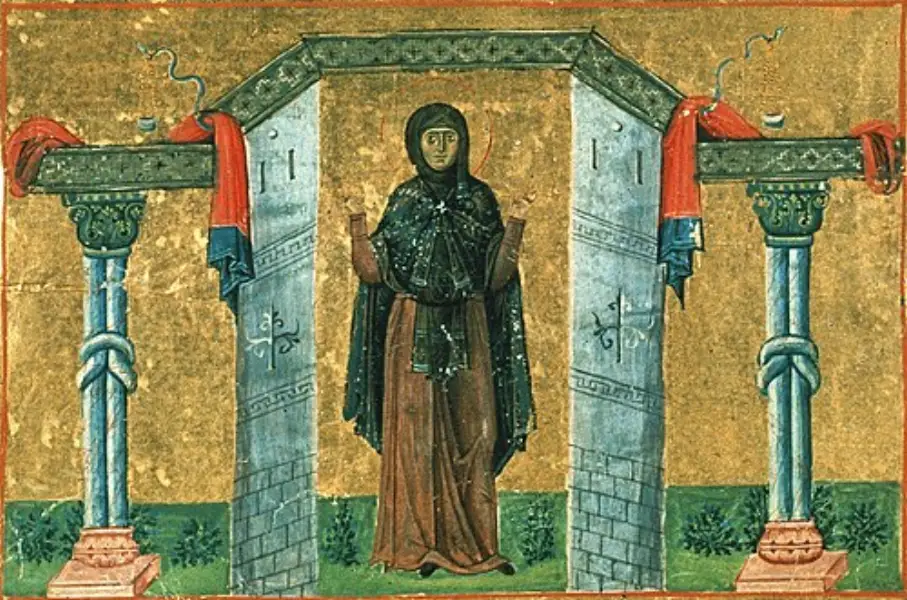
Overview
Melania the Younger, born around 383 into the senatorial aristocracy of Rome, became one of the most renowned ascetic women of late antiquity. The only child of Valerius Publicola and Caeionia Albina, and granddaughter of Melania the Elder, she was given in marriage at fourteen to her cousin Valerius Pinianus against her own wishes. After the loss of her two children and the death of her father, she and her husband renounced conjugal life and began to dismantle one of the greatest fortunes in the empire, disposing of estates across Italy, Sicily, Africa, Britain, Spain and Mauretania for the benefit of churches, monasteries and the poor. The Gothic threat drove them from Rome to a monastic life in Sicily, then to seven years at their estate near Tagaste in North Africa, where they befriended Augustine of Hippo and founded twin monasteries. In 417 Melania moved to Palestine, founded a second convent near the Mount of Olives, and after Pinianus' death built a men's cloister and a church where she passed her remaining years. She died in Jerusalem on 31 December 439. Gerontius recorded her life in a hagiography composed around 452, and her memory is kept as a Desert Mother on 31 December.
The Complete Life
Marriage and Life in Roman Society
Melania grew up at the summit of Roman society, a family whose offices and imperial connections spanned generations. Her union with Pinianus was arranged when she was still a girl, and the ancient life of the saint records how she chafed under the ceremonial splendour demanded of a matron of her rank while longing for a life of penance. She pressed her husband to adopt continence, but he wished to continue the line. The deaths of their two children broke the impasse: grief turned both spouses toward the ascetic course, and her dying father, who had forced the marriage on her, asked and received her pardon. As sole heir to her father and grandfather she came into a patrimony so vast that even its smallest properties yielded abundant rents.
§ Rome
The Great Divestment
From 404 Melania set about dissolving her wealth. Silken robes became altar cloths; gold ornaments went to the churches; whole communities of poor families and slaves followed her to the countryside and were treated as brothers and sisters. Selling property on this scale proved laborious — purchasers could rarely pay outright, and the invasion of the Goths left part of the estates unsold until scheming relatives and officials nearly succeeded in confiscating them, a plot undone only by a bread riot that cost the prefect Pompeianus his life. The palace on the Coelian Hill, too magnificent for any buyer, was pillaged and partly burned in Alaric's sack and then relinquished for nothing.
§ Rome
Sicily and Africa
The household settled for two years at a grand seaside villa near Messina, probably at Pistunina, while Melania continued selling what remained in Italy and Sicily and watched from across the straits as Alaric's men destroyed Reggio. A planned visit to Paulinus of Nola was frustrated by a storm that cast the ship onto a pirate-ravaged island, whose captive inhabitants she ransomed with her own money. Africa became the family's refuge: on an estate near Tagaste so large it contained two episcopal sees, they endowed the impoverished local church with gold and silver vessels, embroidered altar cloths and extensive lands, and at the counsel of Augustine, Alypius and Aurelius of Carthage spread regular support among the churches and monasteries of the region. There Melania became Mother Superior of a convent of her former slaves, with Pinianus governing a men's cloister beside it. The episode remembered as the Pinian affair saw the congregation of Hippo force her husband to swear he would stay as their priest, provoking Augustine to threaten resignation.
§ Sicily and Africa
Palestine
In 417 the party travelled to the Holy Land through Alexandria. Near the Mount of Olives Melania established a second convent, and after her husband's death around 420 she added a men's cloister and a church, spending the rest of her life within their walls. Her discipline was severe: haircloth next to the skin, brief sleep on bare ground, and a diet of herbs and vegetables dressed with a little oil.
§ Palestine
Legacy and Hagiography
Two near-contemporary accounts preserve her memory: Palladius, who knew her circle, wrote of her in the Lausiac History, and Gerontius of Jerusalem composed a full hagiography around 452. Her estates were so extensive — domains in Britain, Sicily, Iberia, Africa, Numidia, Mauretania and Italy — that her disposal of them reshaped the church's finances on two continents. The town of Sainte-Mélanie in Canada bears her name today.
§ Legacy
Timeline
- 383
Is born in Rome, the sole heir of Valerius Publicola and Caeionia Albina
§ Rome
- 404
After her father's death leaves the family palace for a country villa, sheds her costly wardrobe for coarse wool, and begins sheltering the poor with her household
§ Rome
- 408
Departs Rome with Pinianus, her mother Albina and Rufinus of Aquileia for a monastic residence near Messina in Sicily
§ Sicily and Africa
- 410
Her Caelian Hill palace, pillaged by Alaric's invaders and partly burned, is finally given away; after Rufinus dies the family crosses to Africa
§ Rome
- 417
Travels by way of Alexandria to Palestine and settles in a hermitage close to the Mount of Olives, founding a second convent
§ Palestine
- 420
Around this year Pinianus dies; she answers the loss with new building work — a monastery for men and a basilica — and makes the enclosure her home to the end
§ Palestine
- 439
Dies in Jerusalem on 31 December, aged about fifty-five
§ Introduction
In Their Own Words
It was settled that the young couple, scarcely more than children, should reside with Publicola in his palace on the Coelian Hill.
The Record
- Symbols
- Garment of coarse wool·Haircloth and hard ground of penance·Keys to the storehouses of a great estate given away
- Canonization
- Pre-congregation; venerated from antiquity in East and West
Prayer
Bibliography
Show 10 sources
- Schlitz, Carl (1913). "St. Melania (the Younger)". In Herbermann, Charles (ed.). Catholic Encyclopedia. New York: Robert Appleton Company.
- Rampolla del Tindaro, Mariano; Leahy, Ellen Mary Agnes; Thurston, Herbert (1908). The life of St. Melania [microform]. University of Chicago. London: Burns & Oates.
- Miller, Patricia Cox (2005). Women in Early Christianity: Translations from Greek Texts. Catholic University of America Press.
- Chin, C. M.; Schroeder, C. T. (2017). Melania: Early Christianity through the Life of One Family. University of California Press.
- Coon, Lynda L. (1997). Sacred fictions: holy women and hagiography in late antiquity. Philadelphia: University of Pennsylvania Press.
- Cohick, Lynn H. (2017). Christian women in the patristic world: their influence, authority, and legacy in the second through fifth centuries. With Amy Brown Hughes. Grand Rapids, MI.
- Palladius, The Lausiac History (1918), Chapter LIV The Elder Melania.
- Butler, Alban (1962). Butler's lives of the saints. Vol. 4. P.J. Kenedy & Sons. p. 647.
- White, Carolinne, ed. (2010). Lives of Roman Christian Women. Penguin Books Limited.
- Elizabeth A. Clark, The Life of Melania the Younger. New York, 1984.
Profile text adapted from the Wikipedia article, licensed CC BY-SA 4.0.
Pray with this saint every day
Save St. Melania the Younger to your favorites, read the full profile, and get feast-day reminders in the Saints app.
Get the Saints AppFree on the App Store for iPhone and iPad