
died 381·Feast 12 February
St. Meletius of Antioch
Patriarch of Antioch and Confessor
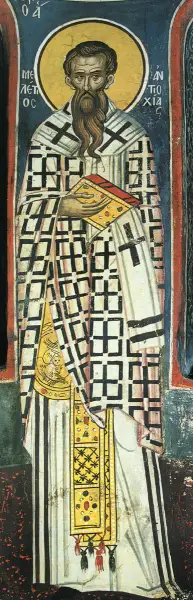
Overview
Meletius of Antioch, born of wealthy and noble parents at Melitene in Lesser Armenia, led the church of Antioch through twenty-one strife-ridden years, 360 to 381, much of them in banishment and in the thick of the era's Christological controversies. Elevated through the court party of Bishop Acacius of Caesarea, he served briefly as bishop of Sebaste before resigning, then became patriarch of Antioch — and promptly startled everyone by preaching before Emperor Constantius II in terms that sounded Nicene. Banished three times under the Arian emperors Constantius II and Valens, he returned each time to find rival bishops installed against him, most stubbornly Paulinus, chosen by the Eustathian party; the resulting division is remembered as the Meletian schism. He was never a wholehearted Nicene and never simply an Arian; with the passing years, though, he edged closer and closer to the creed's wording, and by the end of his life orthodoxy's champions claimed him: he presided over the great synod of Antioch in 379 and over the First Council of Constantinople in 381, where he died soon after the opening sessions. The emperor Theodosius I had his body borne back to Antioch and laid to rest with the honours given to a saint. He ordained John Chrysostom deacon, mentored the church's reconciliation with Basil of Caesarea's circle, and is venerated across the Catholic, Eastern Orthodox and Oriental Orthodox traditions on 12 February.
The Complete Life
Bishop of Sebaste
Meletius came from Melitene in Lesser Armenia, the son of rich and noble parents, and surfaced in the record around 357 attached to the circle of Acacius of Caesarea, chief advocate of the Homoean formula that confessed the Son to be like the Father while refusing to define essence. As a cleric of the court party he was placed in the see of Sebaste in succession to Eustathius — an appointment the Homoousian clergy resented so deeply that Meletius soon stepped down from it. The episode set the pattern of a career lived between rival definitions: his own formula, one ancient quip runs, was so delicately indefinite that it could scarcely be grasped at all.
§ Bishop of Sebaste
Antioch and the First Exile
Early in 360, after the council of Seleucia, Meletius was translated from the dissolved arrangement to Antioch itself, succeeding Eudoxius. Within a year he was gone: the old account, backed by Epiphanius and John Chrysostom, says he preached before Constantius II in explicitly Nicene terms and was deposed for it, though the historian Loofs objected that the sermon contains nothing the court party need have feared, and points instead to clashes with his clergy. Whatever the cause, the exile opened the schism — the Eustathians of Antioch chose the presbyter Paulinus as their own bishop, and although the synod of Alexandria sent deputies in 362 to heal the breach, Lucifer of Cagliari had already consecrated Paulinus before they arrived. When Julian's policy let Meletius come home, Antioch therefore held three rival claimants at once.
§ First period and exile
The Meletian Schism
At the heart of the quarrel between Meletius' followers and the older Eustathian party lay a fine point of Trinitarian grammar: the Meletians confessed Father, Son and Spirit as three hypostases, while the Eustathians spoke of one hypostasis and three prosōpa, a Greek word that can mean both person and mask. Basil of Caesarea worried that the prosōpa language blurred what Sabellius had blurred before, and pressed for the confession of each person in a true hypostasis; Philip Schaff later summarised the difference as one side stressing the divine essence's triplicity and the other its unity. Athanasius, arriving in Antioch on the emperor's orders, sought communion with Meletius, was kept waiting, and gave his communion to Paulinus instead — with the result that the mainstream Nicene party in the West recognised only Paulinus for years.
§ Patriarch of Antioch
Later Exiles and Return
Valens banished Meletius twice more, in 365 and again in 371 or 372. The complications multiplied meanwhile: in 375 the heretical bishop Apollinaris of Laodicea consecrated Vitalis, one of Meletius' own presbyters, as yet another claimant. Valens' death in 378 changed everything — Gratian removed the Homoean Euzoius from Antioch and turned the churches over to Meletius, and the new eastern emperor Theodosius I showed him marked favour, for the patriarch had been edging ever closer to the Nicene creed.
§ Second and third exiles
Triumph and Death
Back in Antioch, Meletius was acclaimed the leader of orthodoxy. In October 379 he chaired the great synod of his city, where East and West reached dogmatic agreement, and he furthered Gregory of Nazianzus' cause in Constantinople. In 381 he presided over the First Council of Constantinople, the Second Ecumenical Council — and died shortly after its opening, while Theodosius, who had received him with special honour, ordered his remains carried home to Antioch for a saintly burial. The schism outlived him: Paulinus was denied sole recognition, Flavian took Meletius' chair, the Eustathians elected Evagrius in 388, and only in 415 did the Eustathians at last accept Flavian. Ambrose and the Council of Aquileia in the same year had urged a general council to end the Meletian schism; John Chrysostom, whom Meletius had ordained deacon, brokered the reconciliation of Flavian with Rome and Alexandria in 399.
§ Triumph
Timeline
- 357
First appears as a supporter of Acacius of Caesarea and the Homoean position, and succeeds Eustathius as bishop of Sebaste before resigning under Homoousian pressure
§ Bishop of Sebaste
- 359
Attends the council of Seleucia in the autumn and subscribes to the Acacian formula
§ First period and exile
- 360
Becomes patriarch of Antioch early in the year, succeeding Eudoxius, who has been translated to Constantinople
§ First period and exile
- 361
Is exiled after preaching before Emperor Constantius II, according to the old tradition, revealing views of the same essence
§ First period and exile
- 362
Returns under Julian's policy and finds two rivals: Paulinus, consecrated by Lucifer of Cagliari for the Eustathians, and the legacy of the deposed Eudoxius party
§ First period and exile
- 365
Is banished by decree of the Arian emperor Valens
§ Second and third exiles
- 371
Is exiled a second time under Valens; in 375 his presbyter Vitalis is consecrated a rival patriarch by Apollinaris of Laodicea
§ Second and third exiles
- 378
After Valens' death, Emperor Gratian expels Euzoius from Antioch and hands the churches over to Meletius, whom Theodosius I also favours
§ Second and third exiles
- 379
Presides in October over the great synod of Antioch, where the dogmatic agreement of East and West is settled
§ Triumph
- 381
Presides over the First Council of Constantinople, aids Gregory of Nazianzus toward the capital's see, and dies soon after the council opens; Theodosius sends his body to Antioch for burial with a saint's honours
§ Schism after his death
In Their Own Words
The doctrinal difference between the Meletians and the old Nicenes consisted chiefly in this: that the latter acknowledged three hypostases in the Divine Trinity, the former only three prosōpa; the one laying the stress on the triplicity of the divine essence, the other on its unity.
The Record
- Symbols
- Patriarchal omophorion·Gospel book, sign of his preaching before the emperor
- Canonization
- Pre-congregation; venerated as a saint and confessor
Prayer
Bibliography
Show 8 sources
- Chisholm, Hugh, ed. (1911). "Meletius of Antioch". Encyclopædia Britannica. Vol. 18 (11th ed.). Cambridge University Press. pp. 93–94.
- Cross, F. L.; Livingstone, E. A., eds. (2009) [2005]. "Melitius, St". The Oxford Dictionary of the Christian Church (3rd rev. ed.). Oxford University Press.
- Leclercq, Henri; "Meletius of Antioch", Catholic Encyclopedia Vol. 10, New York, Robert Appleton Company, 1911.
- Schaff, Philip (1997) [1910]. "The Meletian Schism at Antioch". The History of the Christian Church. Vol. III, Nicene and Post-Nicene Christianity. Oak Harbor: Logos Research Systems.
- "Councils of Aquileia", Catholic Encyclopedia Vol. 1, New York, Robert Appleton Company, 1907.
- Socrates Scholasticus, "The Ecclesiastical History", Book V.9.
- Dictionary of Christian Biography and Literature to the End of the Sixth Century A.D., "Meletius, bishop of Antioch".
- Cavallera, F.; Le Schisme de Mélèce, Paris, Picard, 1906.
Profile text adapted from the Wikipedia article, licensed CC BY-SA 4.0.
Pray with this saint every day
Save St. Meletius of Antioch to your favorites, read the full profile, and get feast-day reminders in the Saints app.
Get the Saints AppFree on the App Store for iPhone and iPad