
c. 100 – c. 180·Feast 1 April
St. Melito of Sardis
Bishop, Apologist and Father of the Old Testament Canon
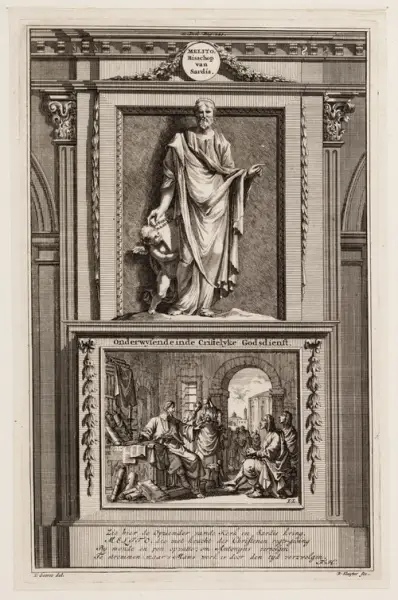
Overview
Melito of Sardis, who died around 180, stood first among the bishops of Roman Asia in his own day, prized alike for personal authority and for a literary output most of which is now lost. Jewish by birth and steeped in the Greek education of his thoroughly Hellenised native city, he combined Stoic rhetorical training with a Johannine theological instinct. He is remembered above all for four things: the earliest known Christian list of the Old Testament books, a term he himself coined, compiled after a journey to the Levant; the treatise Peri Pascha, recovered in 1940 and hailed by F. L. Cross as the weightiest patristic text to come to light in modern times; a Quartodeciman defence of keeping Easter on the fourteenth of Nisan; and an Apology for Christianity addressed to Marcus Aurelius around 169–170, in which he pleaded that the empire had only flourished since the faith arrived. His high Christology declared Christ at once fully God and fully man, in two natures united in one person, written against Marcion. Polycrates of Ephesus, in a letter to Pope Victor preserved by Eusebius, calls him a eunuch who lived wholly in the Holy Spirit and reports that he was buried at Sardis. His feast is kept on 1 April.
The Complete Life
Jewish and Hellenistic Roots
Sardis had been Greek for centuries by the time Melito was born, but its Christian community carried a strong Jewish imprint, and he himself was Jewish by birth. His extant works never quote the New Testament directly, yet his theology is thought to follow the Johannine tradition, taking John's Gospel as the chronology of Jesus' life and death. Schooled by sophists in rhetoric and skilled in the allegorical reading of Homer, he drew especially on the Stoics Cleanthes and Poseidonius — a formation that shaped how he read Moses and the Exodus, and that pushed him toward holding the Christian Passover at the very time of the Jewish one.
§ Jewish and Hellenistic roots
Peri Pascha
Peri Pascha, written in the second century and rescued for the modern world by Campbell Bonner in 1940, is either a homily or — some argue — a liturgy built on the haggadah, the retelling of God's works at Passover. For Melito, Christ's death fell at dusk on the fourteenth, just as the paschal meal was being readied. The work is also read as a window into second-century Christian feeling toward Judaism: it lays the killing of Christ on the Jewish people, spares Pilate, and presses supersessionism so far as to call Jewish practice a first draft to be dissolved once the truth had come, closing with the furious charge that Israel smashed the Lord to the ground and lies dead while he rose. This dark legacy of the sermon is remembered alongside its literary splendour.
§ Peri Pascha
The Quartodeciman Controversy
On what Eusebius records, Melito is often labelled a Quartodecimanist: he kept the Christian Passover on the fourteenth of Nisan, alongside the Jewish feast, following Johannine chronology and a paschal-lamb typology. The practice drew scrutiny from Epiphanius, John Chrysostom and Pseudo-Hippolytus, and raised questions about fasting and uniformity that outlasted him. The Council of Nicaea eventually fixed the resurrection feast to a Sunday for the sake of uniform practice, settling against the custom Melito had defended.
§ Quartodeciman controversy
Apology to Marcus Aurelius
Eusebius' Chronicon places Melito's Apology for Christianity before Marcus Aurelius in 169–170, amid the Easter dispute at Laodicea. Known in a Syriac version rediscovered and translated by William Cureton, the plea describes Christianity as a philosophy born among the barbarians that had flourished under Rome, argues that the empire had grown great with the faith in its midst, and asks the emperor to renounce the new edicts under which Christians were plundered and slandered. He recalled Hadrian's virtuous example and called for an end to violence against the growing churches.
§ Apology to Marcus Aurelius
High Christology
Writing against Marcion, Melito professed the one Christ to be no less God than he was wholly human — a single being in two essences. His godhead was shown in the signs and miracles after his baptism; before that event he concealed his divinity and knew hunger like any man. Melito kept the divine and human natures distinct even while confessing them together in one Christ, and his emphasis, like John's, on the unity of the Son and the Father gave his teaching its high, severe profile.
§ Melito's high Christology
The First Old Testament Canon
Around 170, after his journey to the Levant and very likely a visit to the library at Caesarea Maritima, Melito produced the earliest known Christian list of the canon of the Old Testament — a phrase he coined. His list excludes Esther, and Nehemiah separately named, along with all the Apocrypha, though the standard reading takes Esdras as Ezra-Nehemiah and Lamentations as folded into Jeremiah; scholars still debate whether the Wisdom of Solomon counts as an alternate name for Proverbs or, with Eusebius, as a separate book included. In the Eklogai he set out elaborate parallels between the Old Covenant as form or mold and the New as the truth that broke the mold.
§ Old Testament canon
Death and Legacy
Little is preserved about his end beyond Polycrates' testimony that he was interred at Sardis, awaiting resurrection and judgement. His fame as a writer lasted into the Middle Ages, so heavily that many pseudepigraphal works circulated under his name; Eusebius catalogued the genuine ones, most now lost, while fragments survive, some in Syriac versions kept in the British Museum and translated by Cureton. Jerome, quoting the lost Tertullian, reports that many of the faithful esteemed him as a prophet.
§ Death and legacy
Timeline
- 100
Is born around this time into a Jewish family at Sardis, the former Lydian capital, long since a Greek city
§ Jewish and Hellenistic roots
- 169
Addresses an Apology for Christianity to Marcus Aurelius during the Easter controversy at Laodicea, according to Eusebius' Chronicon
§ Apology to Marcus Aurelius
- 170
After travelling to the Levant, probably visiting the library at Caesarea Maritima, assembles the first Christian catalogue of the Hebrew scriptures — the 'Old Testament', a name he was the first to use
§ Old Testament canon
- 180
Dies at about eighty years of age and is buried at Sardis
§ Death and legacy
- 194
Polycrates of Ephesus, writing to Pope Victor, attests that Melito, 'the eunuch' whose whole walk was in the Holy Spirit, lies buried at Sardis
§ Death and legacy
- 1940
Campbell Bonner brings the lost treatise Peri Pascha to light in the modern world
§ Peri Pascha
In Their Own Words
Melito the eunuch, whose whole walk was in the Holy Spirit.
The Record
- Major works
- Peri Pascha (On the Passover)·Apology for Christianity to Marcus Aurelius (preserved in Syriac translation)·Eklogai, six books of extracts from the Law and the Prophets concerning Christ·The first Christian canon list of the Old Testament
- Symbols
- Bishop's crozier of Roman Asia·Scroll of the Law, sign of his canon work
- Canonization
- Pre-Congregation; honoured as a saint and Church Father
Prayer
Bibliography
Show 10 sources
- Herbermann, Charles, ed. (1913). "St. Melito". Catholic Encyclopedia. New York: Robert Appleton Company.
- Stewart-Sykes, Alistair, The Lamb's High Feast: Melito, Peri Pascha And The Quartodeciman Paschal Liturgy At Sardis, Brill, 1998.
- Knapp, Henry M., 'Melito's Use of Scripture in "Peri Pascha": Second-Century Typology,' Vigiliae Christianae, Vol. 54, No. 4 (2000), pp. 343–374.
- Cohick, Lynn (October 1998). "Melito of Sardis's PERI PASCHA and Its Israel". Harvard Theological Review. 91 (4): 351–372.
- Cohick, Lynn. The Peri Pascha Attributed to Melito of Sardis: Setting, Purpose, and Sources. Brown Judaic Studies, 2000.
- Hall, S.G. Melito Of Sardis: On Pascha And Fragments. Oxford University Press, 1979.
- Metzger, Bruce M. (1997). The Canon of the New Testament: Its Origin, Development, and Significance. Clarendon Press.
- Melito of Sardis, (English translation) in Ante Nicene Fathers, Vol 8.
- Melito of Sardis, (Greek original) in Eusebius, Church History, 4.26, Loeb, ed. Kirsopp Lake.
- Melito, and Stuart George Hall. 1979. On Pascha and fragments. Oxford early Christian texts. Oxford: Clarendon Press.
Profile text adapted from the Wikipedia article, licensed CC BY-SA 4.0.
Pray with this saint every day
Save St. Melito of Sardis to your favorites, read the full profile, and get feast-day reminders in the Saints app.
Get the Saints AppFree on the App Store for iPhone and iPad