
c. 229 – 314·Feast October 22
St. Mellonius
Fourth-century Bishop of Rouen from Wales
Overview
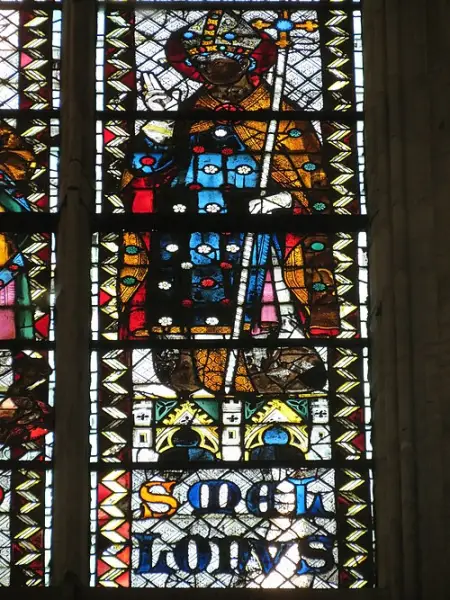
Saint Mellonius, who bore the surname Probus, is honored as an early fourth-century bishop of Rotomagus, the city now called Rouen, in the Roman province that corresponds to present-day Normandy. Tradition gives his birth year as about 229 and places it at Llanewrwg, the settlement today known as St Mellons, near Cardiff in Wales. As a young man he crossed to Rome to deliver the tribute owed by Britain, and in that city his life changed course: Pope Stephen I brought him to the Christian faith, ordained him a priest, and in time consecrated him a bishop. After Pope Stephen was put to death in 257, Mellonius journeyed into Gaul, and in 261 he took up the see of Rouen in succession to Nicasius. He shepherded that church for half a century, proclaiming the gospel in the city and handing on his office in peace. In 311 he withdrew to a hermit's cell at Hericourt, where he died in 314. His feast is kept on 22 October, and he is venerated by Roman Catholics, Eastern Orthodox Christians, and members of the Church in Wales.
The Complete Life
A Youth in Wales and a Turning Point in Rome
Mellonius first saw the light of day, according to the tradition preserved in his Life, at Llanewrwg, the place now called St Mellons, near Cardiff in Wales, around the year 229. He carried the surname Probus, a Latin name that speaks of uprightness of character, and it set him apart from other holy men of similar name whose stories were later entangled with his own. Britain in his youth lay at the far edge of the Roman world, and families there still owed tribute to the imperial capital. In the course of paying that debt Mellonius made the long journey south to Rome, the city where the Apostles Peter and Paul had shed their blood. What had begun as an errand of money became an encounter that determined the whole shape of his life. Pope Stephen I received him, instructed him in the Christian faith, and brought him to baptism and full communion with the Church. The young Briton did not return home. He remained in the city of his conversion, entered its clergy, and advanced step by step toward the service of the altar, preparing for a ministry neither he nor his fellow travelers could have foreseen when he set out from Wales.
§ Legend
Ordained and Consecrated by a Martyr Pope
Under Pope Stephen I Mellonius advanced from conversion to ministry. The pope ordained him to the priesthood and afterwards consecrated him a bishop, binding the Welsh convert to the Church of Rome in the closest bond of service. The partnership of the two men was cut short by violence: Stephen was martyred in 257, in the persecution that struck the Roman clergy during the reign of the emperor Valerian. For Mellonius the loss of the bishop who had baptized and ordained him became a summons. Shortly after Stephen's death he left the city of his conversion and set out for Gaul, carrying the episcopal character he had received and the mandate to preach the gospel among peoples who had not yet fully received it. Gaul offered a church hard-pressed by persecution and in need of shepherds. The see of Rouen in the province of Lugdunensis stood at the mouth of the Seine, a center of Roman administration and a natural base for the spread of the faith in the northwest. There, in the course of time, providence would place him at the head of a flock of his own, far from the land of his birth but close in spirit to the pope whose disciple he remained.
§ Legend
Half a Century over the Church of Rouen
In 261 Mellonius succeeded Nicasius of Rouen as bishop of Rotomagus, taking charge of a Christian community in the Roman province of Secunda Provincia Lugdunensis, the region now known as Normandy. The episcopate that followed was extraordinarily long by any measure of the ancient church: half a century of preaching, ordaining, and ordering the life of the faithful in a city that stood astride the Seine. The Roman Martyrology, in its summary of his career, records that he announced the Christian faith in that city and handed on the episcopate, a phrase that gathers up both his work as a missionary bishop and the orderly transfer of his office at the end. Under his care the church of Rouen took root and grew, and his succession from Nicasius placed him in an unbroken line of pastors reaching back to the earliest Christian generations of Gaul. When at last his strength failed he was followed in the see by Avitianus, who received from his hands a church consolidated by fifty years of steadfast leadership. Few bishops of the age could claim so durable a tenure, and the memory of it secured his name in the calendars of the Norman church.
§ Legend
Retirement, Death, and the Wandering of His Relics
After more than fifty years in office Mellonius withdrew in 311 from the government of his see, taking up his abode in a hermit's cell at Hericourt for the closing stretch of his life the silence and austerity of solitary prayer. There he died in 314, an old man who had outlived the persecutions of his youth and seen the church pass into the favor of the empire. His body was buried at Rouen, the city of his long ministry, where his tomb became a center of local remembrance. The relics themselves had a turbulent later history. Toward the close of the eighth century, as Norse warbands began to raid the river valleys of northern Gaul, his remains were translated to a church in Pontoise, out of the reach of the raiders who threatened the Norman coast. There they rested for roughly a thousand years, until the upheavals of the French Revolution scattered the treasures of the French churches and his relics were lost. What survives is the continuity of memory: churches in France and Wales that bear his name, a feast fixed in the universal martyrology, and the record of a life that ran from a Welsh village to the episcopal throne of Rouen.
§ Legend
Veneration Across the Centuries
Mellonius was never the subject of a formal canonization process; the church honored him as a saint from antiquity, and his cult preceded the machinery of papal canonization. His feast is kept on 22 October. The Roman Martyrology has carried his name under that date for centuries, and the modern editions confirm the continuity of his cult. The English rendering of the 1956 edition gives his entry in summary form, recalling a bishop of Rouen ordained by Pope Stephen and dispatched thither to spread the gospel. The revised Latin Martyrologium Romanum of 2004 records him under the name Mallóni with an entry that praises the preaching of the faith in his city and the peaceful handing on of his office. He is venerated today in the Roman Catholic Church, the Eastern Orthodox Church, and the Church in Wales, a rare triple patronage that reflects the two lands of his life, the Wales of his birth and the Normandy of his episcopate. A fifteenth-century illuminated Book of Hours preserves his image among the saints, showing that devotion to him flourished in the late medieval period wherever his memory was kept.
§ Veneration
Churches and Wells in Wales, Normandy, and Brittany
The most visible monument to Mellonius stands far from his Norman see. The Church of St Mellon in St Mellons, Cardiff, is dedicated to him in the very village where tradition says he was born, and for centuries a fair was held there on his feast day. The dedication is itself a piece of history: the church had previously been dedicated to St Lucius, and the change came with the arrival of the Normans, whose ties to Normandy naturally favored the cult of its apostolic bishop. In France the parish church of Thiédeville stands dedicated to him at Héricourt, the place of his retirement and death, where a holy well long witnessed to popular devotion at his memory. Brittany keeps him as well, in a church dedicated to St Mellon at Plomelin. Taken together these foundations trace the sweep of his legend, from a Welsh birthplace through a Norman episcopate to a Breton outpost across the western sea. The confusion of his story with that of St Melaine of Rennes has obscured parts of it, but the dedications endure, anchoring the memory of the bishop of Rouen in the villages and parishes that still gather under his name each October.
§ Legacy
Timeline
- 229
Born at Llanewrwg, the settlement now called St Mellons, near Cardiff in Wales.
§ Legend
- 257
Set out for Gaul shortly after the martyrdom of Pope Stephen I in Rome.
§ Legend
- 261
Succeeded Nicasius of Rouen as Bishop of Rotomagus.
§ Legend
- 311
Retired after a long episcopate to a hermit's cell at Hericourt.
§ Legend
- 314
Died at Hericourt and was succeeded at Rouen by Avitianus.
§ Legend
- 1956
Listed as St Mellon under 22 October in the English translation of the Roman Martyrology.
§ Veneration
- 2004
Entered under 22 October as Mallóni in the revised Martyrologium Romanum.
§ Veneration
In Their Own Words
At Rouen, St Mellon, Bishop, who was ordained by Pope St Stephen and sent thither to preach the Gospel.
At Rothómagi (Rouen), bishop, who in that city announced the Christian faith and handed on the episcopate.
The Record
- Canonization
- Pre-congregation; venerated since antiquity in the Roman Catholic, Eastern Orthodox, and Anglican traditions
Prayer
Bibliography
Show 8 sources
- Cormack, George. "St. Mellon", The Red Dragon: The National Magazine of Wales, Vol. 11, (Giuseppe Mattei, ed.), Daniel Owen, Howell and Company, 1887, p. 72
- Kellen, David. "St Mellons Parish Church", The Parish of St. Mellons, The Church in Wales
- Farmer, David Hugh. The Oxford Dictionary of Saints (5 rev. ed.), Oxford University Press, 2011, p. 307
- Baring-Gould, Sabine (1907). Lives of the British Saints
- Monks of Ramsgate. "Mellonius". Book of Saints, 1921. CatholicSaints.Info, 22 October 2016
- The Roman Martyrology, 1961, The Newman Press, Westminster & Maryland, p. 231
- Martyrologium Romanum, 2004, Vatican Press (Typis Vaticanis), p. 584
- Medieval & Renaissance Manuscripts, The Morgan Library and Museum
Profile text adapted from the Wikipedia article, licensed CC BY-SA 4.0.
Pray with this saint every day
Save St. Mellonius to your favorites, read the full profile, and get feast-day reminders in the Saints app.
Get the Saints AppFree on the App Store for iPhone and iPad