
died 552·Feast August 25
St. Menas of Constantinople
Sixth-century Patriarch of Constantinople under Justinian
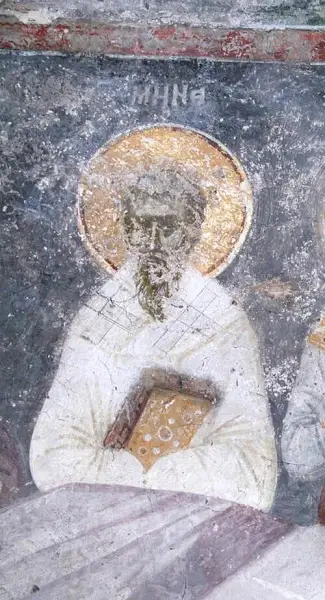
Overview
Saint Menas of Constantinople, known in Greek as Minas, occupied the throne of Constantinople as its 55th patriarch, enthroned on 13 March 536 and laid to rest on 25 August 552. He was an Alexandrian, and he first appears in the records as a presbyter and director of the Hospital of Sampson in the capital, an institution linked by tradition to St Sampson the Hospitable. Emperor Justinian I appointed him to the patriarchal throne, and Pope Agapetus I consecrated him to succeed Anthimus I, whom Agapetus had condemned as a monophysite — the first occasion on which a pope consecrated a Patriarch of Constantinople. Menas presided over the synod of 536 that deposed Anthimus, took a firm stand against Origenism, and steered the church of the capital through the gathering Three-Chapter Controversy. His patriarchate spans the dedication of Justinian's Great Church of Hagia Sophia, at its completion the biggest edifice on earth, and marks the high point of papal influence in Constantinople. In 551 the emperor obliged him to summon what became the Second Council of Constantinople. He died peacefully in 552 and is venerated in both the Eastern Orthodox and Catholic churches, with a common feast on 25 August.
The Complete Life
From Alexandria to the Hospital of Sampson
Menas came from Alexandria, the great intellectual and ecclesiastical capital of the Greek East, though the sources preserve no record of his birth or family. He enters history holding high office in the church of Constantinople, where he served as a presbyter and as director of the Hospital of Sampson, one of the capital's great charitable institutions. The hospital carried the name of Sampson the Hospitable, the physician-saint whose foundation had long cared for the poor and the sick of the city, and tradition binds the two men closely together, presenting Menas as a continuator of Sampson's work of mercy. In that house of healing the future patriarch learned the pastoral craft at its most elementary: the care of bodies before the care of souls. Tradition also connects him with a signal act of providence in the highest circles of the empire, associating him with the recovery of Emperor Justinian I from the bubonic plague, the devastating epidemic that swept the Byzantine world in 542. Whether through his administration of the hospital or his reputation for holiness, Menas had become a figure of consequence in the capital's church long before imperial favor raised him to its highest office.
§ Menas of Constantinople
Consecrated by a Pope of Rome
On 13 March 536 Emperor Justinian I appointed Menas Patriarch of Constantinople, and Pope Agapetus I consecrated him to the office. The pope had come to the capital on a diplomatic mission and found the patriarchal see occupied by Anthimus I, formerly bishop of Trebizond, whom Agapetus judged and condemned as a monophysite. The deposition of Anthimus and the consecration of Menas in his place were events without precedent: never before had a bishop of Rome consecrated a Patriarch of Constantinople. Almost at once the new patriarch received from the emperor an order, whose text has not survived, directing him to convene a synodos endemousa — a standing synod of bishops resident in the capital — to sit in judgment on Anthimus. The judges sat five times over, from 2 May down to 4 June 536, and the synod duly condemned the deposed patriarch, a verdict Justinian confirmed in Novella XLII of his Novellae Constitutiones, addressed directly to Menas. The whole sequence marked a Chalcedonian victory over the monophysite party in the capital and bound the new patriarch inseparably to the emperor's program of doctrinal settlement.
§ Menas of Constantinople
Patriarch in an Age of Controversy
The patriarchate of Menas unfolded amid the doctrinal storms of Justinian's reign. In the same campaign of settlement that produced the synod against Anthimus, the emperor sought to heal the widening rift between the patriarchs of Constantinople and Jerusalem, and within that effort Menas took a public position against Origen, whose speculations had found adherents among the monks of the East. The Origenist crisis merged into the larger and more explosive Three-Chapter Controversy — the emperor's bid to proscribe the works of certain non-Chalcedonian theologians so as to win their party over — an endeavor that instead provoked the resistance of the West. In one respect the emperor's doctrinal policy met with outright failure: almost immediately after the Chalcedonian triumph of 536, an independent network of bishops of monophysite or miaphysite conviction began to ordain its own hierarchy claiming apostolic authority, a movement that hardened into the still-existing Syrian Orthodox Church in separation from the imperial church. Yet the patriarchate also knew moments of splendor. It was under Menas that Justinian dedicated his new church of Hagia Sophia, at that time the biggest structure ever raised and the patriarchal seat itself, and his years in office represent the greatest extent of papal influence that Constantinople ever knew.
§ Menas of Constantinople
Toward the Fifth Ecumenical Council
The last years of Menas were consumed by the search for a formula that might reconcile the Western and Eastern churches around the bitterly disputed Three Chapters. In 551 Justinian compelled him to summon the assembly that history would know as the Second Council of Constantinople, charged with resolving the controversy that neither emperor nor patriarch had been able to settle by decree. Menas did not live to see the council meet. He died peacefully on 25 August 552, after sixteen years on the throne of Constantinople, and the council assembled in the following year under the presidency of his successor, Eutychius of Constantinople, who brought it to its conclusions in 553. The gathering that Menas had been made to call took its place among the ecumenical councils of the church, and its convocation stands as the final act of his public career. He left behind a patriarchate strengthened in its structures, a capital church aligned with Rome to a degree never again equaled, and a memory of gentle endurance, for the sources record his death not as the end of a troubled tenure but as a peaceful passing after long labor.
§ Menas of Constantinople
A Saint of the Undivided Tradition
Menas was never canonized by a formal process; the veneration of a patriarch who had governed the capital's church in communion with Rome arose naturally in the generations after his death, and the church received him among its saints by continuous memory. He is honored today as a saint both in the Eastern Orthodox Church and in the Catholic Church, a common cult that reflects his service in the era before the great separations of East and West. Both traditions keep his feast on 25 August, the day of his death in 552, and the convergence of the two calendars on the same date gives his memory a rare ecumenical character. In the Orthodox synaxaria he stands among the patriarchs of Constantinople who confessed the Chalcedonian faith in an age when the imperial court itself wavered between theological parties. For Catholics he remains a sign of the possibility of communion between the sees of Rome and Constantinople, for his consecration by Pope Agapetus I remains unique in the history of the patriarchate. Sixteen centuries after his death his name is still recited in the diptychs of saints in both communions.
§ Menas of Constantinople
The Patriarch of Hagia Sophia
The legacy of Menas is inseparable from the monumental age in which he led the church of Constantinople. His tenure spans the consecration of Hagia Sophia, Justinian's great church, which rose above the city as the largest building in the world and became the architectural and liturgical heart of Byzantine Christianity; every patriarch who has celebrated in that church since has stood, in a sense, in Menas's place. His patriarchate also marks, in the judgment of historians, the high-water mark of papal influence in the capital, an achievement that later ages of estrangement would look back upon from either side of the divide. His failure to preserve unity — the emperor's policy and his own efforts notwithstanding — bore unexpected fruit, for the monophysite hierarchy that took shape in opposition to his church endures today as the Syrian Orthodox Church. And his name survives in the learned record of his age: the acts of the synod of 536, in which he figured centrally, remain a celebrated source for the linguistic and institutional life of sixth-century Constantinople. He takes his place in the unbroken list of the 55th occupant of the throne founded by Andrew and guarded by saints before him.
§ Menas of Constantinople
Timeline
- 13 Mar 536
Appointed Patriarch of Constantinople by Justinian I and consecrated by Pope Agapetus I in succession to Anthimus I.
§ Menas of Constantinople
- 2 May 536
Opened the first of five sessions of the synodos endemousa ordered by the emperor to examine the case of Anthimus.
§ Menas of Constantinople
- 4 Jun 536
Closed the final session of the synod, which condemned Anthimus, as recorded in Justinian's Novellae Constitutiones XLII.
§ Menas of Constantinople
- 542
By tradition took part in the healing of Emperor Justinian I from bubonic plague.
§ Menas of Constantinople
- 551
Compelled by Justinian to summon the council that would become the Second Council of Constantinople.
§ Menas of Constantinople
- 25 Aug 552
Died peacefully in Constantinople and was succeeded by Patriarch Eutychius.
§ Menas of Constantinople
The Record
- Canonization
- Pre-congregation; venerated as a saint in the Eastern Orthodox Church and the Catholic Church
Prayer
Bibliography
Show 6 sources
- Starodubcev, Tatiana. "Physician and miracle worker – The cult of Saint Sampson the Hospitable and his images in eastern Orthodox medieval painting", Zograf, Vol. 2015, no. 39, pp. 25–46
- Miller, Fergus. "Linguistic Co-existence in Constantinople – Greek and Latin (and Syriac) in the Acts of the Synod of 536 AD", The Journal of Roman Studies, Volume 99, November 2009
- Millar, F. (2008). "Rome, Constantinople and the Near Eastern Church under Justinian: Two Synods of C.E. 536", Journal of Roman Studies, 98
- The Novels of Justinian (Novellae Constitutiones)
- Van Hoof, Lieve, and Peter van Nuffelen. "The Historiography of Crisis: Jordanes, Cassiodorus and Justinian in mid-sixth century Constantinople", The Journal of Roman Studies, Volume 107, November 2017, pp. 275–300
- Herbermann, Charles, ed. (1913). "Mennas". Catholic Encyclopedia. New York: Robert Appleton Company
Profile text adapted from the Wikipedia article, licensed CC BY-SA 4.0.
Pray with this saint every day
Save St. Menas of Constantinople to your favorites, read the full profile, and get feast-day reminders in the Saints app.
Get the Saints AppFree on the App Store for iPhone and iPad