
285 – c. 309·Feast November 11
St. Menas of Egypt
Coptic soldier-martyr and wonder-worker of Abu Mena
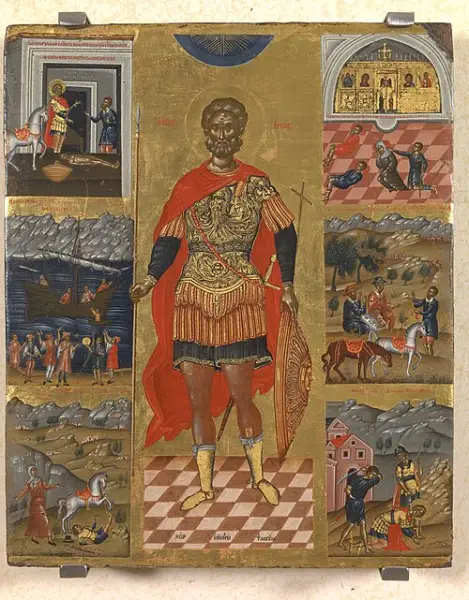
Overview
Saint Menas of Egypt, called Mina, Minas, or Meena in the many tongues that preserve his story, is among the most celebrated martyrs of the Coptic church, honored in East and West alike for the wonders attributed to his intercession. He was born in 285 at Nikiou in the neighborhood of Memphis, the child of Eudoxios and Euphemia, devout Christians who had long been childless. Orphaned at fourteen, he entered the Roman army in his fifteenth year and was given high rank in consideration of his father's name. After three years of service he laid down his arms to belong wholly to Christ and withdrew to the desert, where he passed five years in the solitary life. A vision of angels crowning the martyrs stirred in him the desire to join their company, and he went before the ruler to declare his faith. For this he was put to death at Cotyaeum in Phrygia around 309. His body, preserved from the fire set by his executioners, was carried back to Egypt and laid near Lake Mariout, where the pilgrimage center of Abu Mena grew up around his tomb and drew the sick from across the Christian world.
The Complete Life
A Child Given in Answer to Prayer
Menas was born in 285 at Nikiou, a city in the neighborhood of Memphis in Roman Egypt. His parents, Eudoxios and Euphemia, were ascetic Christians of standing who had waited many years for a child. The story of his naming belongs to the tenderest stratum of his legend. On the feast of the Virgin Mary, Euphemia stood weeping before an icon of the Mother of God, begging for a son, when a sound came from the icon speaking the word Amen. Within months a boy was born, and his mother called him Menas in memory of the voice she had heard. The name would carry echoes of an ancient pharaonic past as well, recalling King Menes of earliest Egypt. The household of his childhood was one of disciplined piety, and his father held authority as ruler of one of the administrative divisions of the country. That stability ended when Menas was about fourteen and Eudoxios died, leaving the boy fatherless on the threshold of manhood. At fifteen, his father's reputation opened the way to a commission in the Roman army, and the Egyptian youth took up service far from the valley of the Nile, posted most commonly to Cotyaeum in Phrygia, though one strand of tradition places him in Algeria.
§ Life and martyrdom
From the Eagle Standards to the Desert
Three years of military service were enough. Menas left the army, resolved to give himself entirely to Christ, and made for the desert, embracing the eremitical life far from the garrison towns of Anatolia. For five years he lived in that solitude, wedded to prayer and austerity, until one day he was granted a vision: angels crowning a company of martyrs in glory. The sight woke in him a longing to stand among them. As he pondered it, a voice addressed him directly, blessing him for a calling that reached back to his childhood and promising three immortal crowns — one for his celibacy, a second for his asceticism, and a third for his martyrdom. The promise settled the matter. He hurried to the ruler's court and declared himself a Christian, courting the death he had been promised. The sources that carry this story are as varied as the Christian world of late antiquity, written in Greek, Coptic, Latin, Syriac, Armenian, Ge'ez, and Old Nubian, a testament to how far the tale of the soldier who chose the desert over the standards traveled in the centuries after his death.
§ Life and martyrdom
Three Immortal Crowns
The promise of three crowns compresses the whole shape of Menas's sanctity into a single image. The first was for celibacy, the renunciation of marriage and posterity that freed him for an undivided life. The second was for asceticism, the five desert years in which he stripped his existence down to prayer and made his body an instrument of the spirit. The third, and the costliest, was for martyrdom, the public confession before the ruler that sealed the other two. His story joins two ideals that the early church often held apart: the soldier's discipline and the hermit's withdrawal. He had served the empire with distinction, yet the same steadiness that made him a good soldier made him, in the desert, an exacting servant of Christ. Coptic tradition never let go of that combination, honoring him in the West as a wonder-worker and in the East as a military saint. The voice that promised the crowns told him they were already prepared; his part was only to claim them. In an age when countless Egyptian Christians faced the same choice, his readiness to abandon rank, comfort, and finally life itself made him a pattern for a whole people under pressure.
§ Life and martyrdom
Martyrdom at Cotyaeum and the Journey Home
Menas was put to death at Cotyaeum in Phrygia around the year 309, a young man of about twenty-four who had already been soldier, deserter of the world, and desert solitary. His executioners burned his body for three days, but fire left it unharmed, and his sister bribed the soldiers to let her carry the remains away. She boarded a ship for Alexandria and laid her brother's body in a church in the city of his birth's province. When the age of persecution had passed, Pope Athanasius of Alexandria received, so the tradition relates, a vision of an angel directing him to load the body onto a camel and carry it toward the Libyan Desert. When the beast reached a well at the far end of Lake Mariout near Alexandria, it sank to its knees and refused to stir, and the Christians buried Menas on that ground. When the Berbers of Pentapolis rose against the cities around Alexandria, a Roman governor carried the body with him as a protector, won his victory through the saint's blessing, and tried to bring it back to the city — but at the same spot by the lake the camel knelt again, and a second camel after it, and the governor at last understood that God had chosen the place.
§ Relics
The Wonder-Worker of Abu Mena
The church raised no decree to make Menas a saint; his cult sprang from the ground around his tomb and spread across the whole Christian world within a few generations. The site of his burial at Abu Mena, near Alexandria, became one of the great pilgrimage centers of late antiquity, its original foundation dated by archaeologists to the late fourth century. The place of the tomb was said to have been forgotten until a shepherd's sick lamb, struggling to rise on the spot, found its scab cured — and soon the sick who lay on that ground recovered from their illnesses. Tradition names the emperor Constantine, or in another telling the fifth-century Zeno, as the father of a sick daughter sent to the spot, cured there, and divinely shown the location of the body, after which a cathedral rose at the site. From that center Menas acquired his fame as the Wonders' Maker, a saint whose intercession healed every kind of illness. Pilgrims carried home little clay flasks stamped with his name and image, and archaeologists have dug them up at Heidelberg, Milan, Dalmatia, Marseille, Dongola, Meols in Cheshire, Jerusalem, Turkey, and Eritrea — scattered witnesses to the reach of his cult.
§ Veneration
A Saint Between Two Camels, from Cairo to El Alamein
Menas remains one of the best-loved saints of the Coptic church, venerated in Oriental Orthodoxy, Eastern Orthodoxy, and the Catholic Church alike. His icon shows him standing between two camels, the beasts that carried his body home to Egypt, or mounted as a young knight with a halberd, an anachronistic memory of his years in the Roman army. He is the patron of Heraklion in Crete and of many towns in Germany and Switzerland, honored as the protector of pilgrims and merchants and invoked for the healing of the sick. His feast falls on 11 November in the Orthodox and Catholic churches of the new calendar, on 24 November for those following the old style, and on 15 Hathor in the Coptic church. In Egypt his memory took monumental form anew when Pope Cyril VI of Alexandria laid the foundations of the Monastery of Saint Mina near the remains of the ancient pilgrimage city; there the saint's relics rest today, together with Cyril's own. And modern faith has added one last chapter: in June 1942, as Rommel's army halted near ruined Abu Mena before El Alamein, believers recount Menas showing himself amid the German camp at the front of a camel caravan, and the Allied victory that followed was laid, in gratitude, at his intercession.
§ Veneration
Timeline
- 285
Born at Nikiou in Egypt, near Memphis, to the ascetic Christian couple Eudoxios and Euphemia.
§ Life and martyrdom
- 309
Executed at Cotyaeum for refusing to recant; his body survived three days of fire untouched.
§ Life and martyrdom
- Jun 1942
Believers record his appearance leading a line of camels by El Alamein, striking terror into the German camp ahead of the Allied victory.
§ El Alamein battle
In Their Own Words
Blessed are you, Menas, because you have been called to the pious life from your childhood. You shall be granted three immortal crowns: one for your celibacy, another for your asceticism, and a third for your martyrdom.
Now this is not the end. It is not even the beginning of the end, but it is, perhaps, the end of the beginning.
The Record
- Patron of
- patron of Heraklion·protector of pilgrims and merchants·patron of many German and Swiss towns·invoked for the healing of illnesses
- Symbols
- depicted between two camels·young knight with a halberd, recalling his Roman army service·man with his hands cut off and his eyes torn out·Christian martyrdom
- Canonization
- Pre-congregation; martyred for refusing to renounce Christ and venerated from the earliest centuries
Prayer
Bibliography
Show 9 sources
- "Menas of Egypt", Greek Orthodox Archdiocese of America
- "Martyr Menas of Egypt", Orthodox Church in America (oca.org), retrieved 2018-03-17
- "Saint Menas", Digital Egypt for Universities (digitalegypt.ucl.ac.uk), retrieved 2018-03-17
- "Menas the Miracle Worker, Saint", Claremont Coptic Encyclopedia
- "St. Menas", copticchurch.net, retrieved 2018-03-17
- "Catholic Encyclopedia: St. Menas", newadvent.org, retrieved 2018-03-17
- Grossmann, Peter (1998). "The Pilgrimage Center of Abû Mînâ", in D. Frankfurter (ed.), Pilgrimage & Holy Space in Late Antique Egypt, Leiden-Boston-Köln: Brill, p. 282
- "Menas", Oxford Dictionary of Byzantium, (Alexander Kazhdan, ed.), New York: Oxford University Press, p. 1339
- Weitzmann, Kurt, ed. Age of Spirituality: Late Antique and Early Christian Art, Third to Seventh Century, pp. 573–578, 1979, Metropolitan Museum of Art, New York, ISBN 9780870991790
Profile text adapted from the Wikipedia article, licensed CC BY-SA 4.0.
Pray with this saint every day
Save St. Menas of Egypt to your favorites, read the full profile, and get feast-day reminders in the Saints app.
Get the Saints AppFree on the App Store for iPhone and iPad