
5th century·Feast July 24
St. Menefrida
Fifth-century Cornish virgin of St Minver
Overview
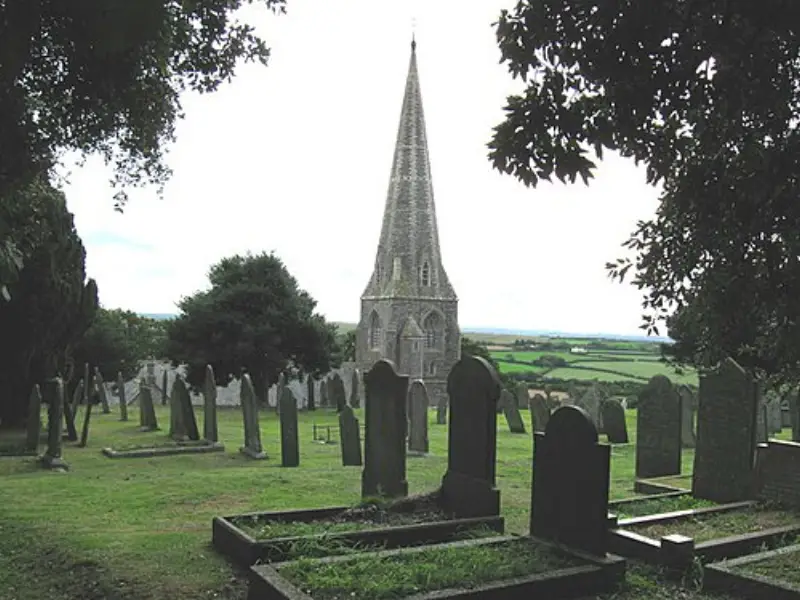
Saint Menefrida is the fifth-century Cornish saint venerated at St Minver, by the Camel estuary on Cornwall's northern coast. Her name survives in several forms — Menefreda, Menwreda, Menfre, Mynfreda, and Minefreda among them — and in the reign of King Henry VIII the parish itself was recorded as St. Menifryde. She was a daughter among the numerous offspring of Brychan, king of Wales, whose sons and daughters seeded holy families across Wales, Cornwall, and Brittany. She is honored as a virgin, not a martyr: the late fifteenth-century traveler William of Worcester copied into his notes, from a calendar at Bodmin, the record Sancta Menefrida, virgo non martir. Her cult is of respectable antiquity, for she is referred to as a saint in documents reaching back at least to 1256. The parish church that bears her dedication at St Minver is built of stone in the Transitional Norman and Early English manner, a lasting monument to the memory of the Welsh king's daughter whom Cornwall took for its own. Her feast is kept on 24 July.
The Complete Life
A Daughter of the House of Brychan
Menefrida was born in Wales in the fifth century, one of the many children of King Brychan, the ruler whose numerous offspring became a dynasty of sanctity across the Celtic West. Brychan's sons and daughters are honored at a host of churches in Wales, Cornwall, and beyond, and Menefrida belongs to that extraordinary family of evangelists and virgins who carried the Christian faith from the Welsh hills to the Atlantic coasts. Her own course took her out of her father's kingdom and across the water into Cornwall, where she settled in the country near the Camel estuary, on the peninsula's northern shore. There the parish of St Minver still preserves her name, worn down by the centuries of local speech into its present form. The many spellings of her name — Menefreda, Menwreda, Menfre, Mynfreda, Minefreda — trace the path of her memory through Cornish records and devotions, and in the age of Henry VIII the parish was written as St. Menifryde, a form closer to the medieval pronunciation of the saint she commemorated.
§ Menefrida
A Virgin, Not a Martyr
Menefrida belongs to the company of Celtic saints whose veneration arose in their own communities without formal process and was preserved in the calendars of the medieval church. Her status as a saint is documented from at least 1256, a date that anchors her cult firmly in the high middle ages even though her life belongs to the evangelizing generations of the fifth century. The most vivid early testimony to her comes from the pen of William of Worcester, the traveler who toured Britain in the late fifteenth century and copied into his notes an entry from a calendar at Bodmin that named her a holy virgin rather than a martyr and fixed her commemoration in late November. The formula distinguishes her carefully among the saints, honoring her purity rather than a martyr's death, and the Bodmin calendar preserves the date on which the monks of Cornwall kept her memory. Her feast is now observed on 24 July. She is honored in the Church of England, whose parish of St Minver keeps her dedication, and by Roman Catholic and Eastern Orthodox Christians who venerate the saints of the undivided church.
§ Menefrida
The Church at St Minver
The parish church of St Minver, near the Camel estuary, is the living monument of Menefrida's cult. Dedicated to her from an early date, it is a stone church raised in the Transitional Norman and Early English manner, its architecture marking the generations of rebuilding and enlargement through which a small Celtic foundation grew into a full medieval parish church. The persistence of the dedication is itself a witness: through the changeable centuries from the fifth to the twentieth, through the Reformation and the sweeping away of so many medieval cults, the people of this Cornish parish continued to worship under the name of their Welsh virgin saint. Henry VIII's surveyors knew the place as St. Menifryde, and modern residents say St Minver — the same name, worn smooth by time. She stands among those female saints of Brychan's line whose dedications stitch together the map of Wales and Cornwall, evidence of the family networks that carried Christianity around the Irish Sea in the age of its conversion. For the parish that bears her name she remains its patron and the origin of its identity, remembered each year on her feast of 24 July.
§ Menefrida
In Their Own Words
Sancta Menefrida, virgo non martir, die 24 Novembris
The Record
- Patron of
- patron of St Minver, Cornwall
- Canonization
- Pre-congregation; honored as a saint since at least 1256
Prayer
Bibliography
Show 6 sources
- William Smith; Henry Wace (30 September 2004). A Dictionary of Christian Biography, Literature, Sects and Doctrines; Julianus to Myensis. Kessinger Publishing, p. 902, ISBN 978-1-4179-4806-2
- Arnold-Forster, Frances Egerton (1899). Studies in Church Dedications: or, England's patron saints. Skeffington & Son
- Orme, Nicholas (1996). English Church Dedications: with a Survey of Cornwall and Devon. University of Exeter Press, p. 105, ISBN 978-0-85989-516-3
- "Caer Guorthigirn, Salisbury, identified by William of Worcester as Vortigern's castle". Vortigern Studies, 14 December 2008
- Catholic Online. "St. Menefrida – Saints & Angels". catholic.org, retrieved 6 September 2017
- "Kelly's Directory 1939 – Description of St Minver, Cornwall (pp. 238 to 240)", August 2006
Profile text adapted from the Wikipedia article, licensed CC BY-SA 4.0.
Pray with this saint every day
Save St. Menefrida to your favorites, read the full profile, and get feast-day reminders in the Saints app.
Get the Saints AppFree on the App Store for iPhone and iPad