
died 720·Feast July 22
St. Meneleus of Menat
Eighth-century founder-abbot of Menat Abbey
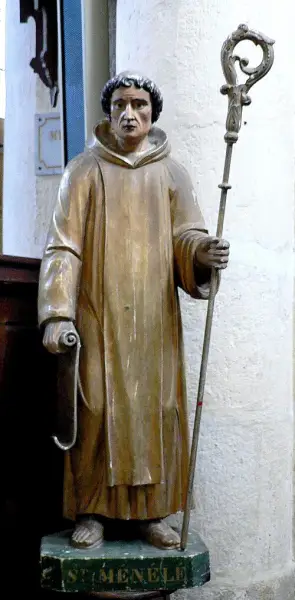
Overview
Saint Meneleus — rendered in French as Menele, Mauvier, Meneve, or Ménélée, and in Latin sources as Menevius — was a Frankish monk of the late seventh and early eighth centuries who founded Menat Abbey near Clermont in Auvergne. A native of Anjou, he was born into a family of the highest connections: the twelfth-century lives trace his descent from the emperor Heraclius, while Alban Butler records a kinship with the house of Charlemagne. Destined by his parents for an advantageous marriage, he fled his home rather than accept the contracted bride, made his way to Auvergne, where St Chaffre himself clothed him in the monastic habit; the holy abbot's monastery of Carmery in the Velay became his first school. Trained there for several years under Abbot Eudo, he was directed by an angel to the spot where he had first met his master, and there, beneath an oak, he raised the monastery that took its name from him and that endures as Menat Abbey. For many years he ruled the house in holiness, and in his old age he named his youthful companion St Savinien to succeed him, dying in 720. His memory is honored with particular devotion in Auvergne and Anjou, and Usuard's martyrology records him on 22 July.
The Complete Life
A Nobleman's Son of Anjou
Meneleus was born in Anjou, in the west of France, into a family whose distinction the medieval sources delighted to trace. The twelfth-century Vita Menelei and Vita S. Theofredi assert his descent from the emperor Heraclius, the Byzantine ruler who had restored the True Cross to Jerusalem, while Alban Butler, writing with the caution of a later age, records only that his family was allied to that of the emperor Charlemagne. Either lineage marks him as a man of the Frankish aristocracy, born to expectations of land, alliance, and posterity. His parents, intent on settling him in the world, pressed upon him a betrothal: a ring came from Baronte, a powerful lord of the region, pledging his daughter's hand in marriage. For a young man whose single ambition from infancy had been to serve Christ with his whole heart, the engagement was intolerable. Rather than accept the bride his family had chosen, he fled his home altogether, leaving Anjou behind and turning his steps toward the monasteries of Auvergne and the Velay, where the religious houses of the Massif Central offered refuge to noblemen who wanted God instead of the world.
§ Butler's account
The School of Saint Chaffre
In his flight Meneleus met Theofredus — the saint venerated in French as St Chaffre or Theofrede — then serving as œconome, the steward of the monastery of Carmery in the Velay, a house founded by Carmen, duke of that country, and known by his name. Butler adds that the two had already crossed paths at Menat before Meneleus followed his master to the abbey. There Meneleus received the monastic habit from Theofredus's hands and passed several years of formation in the community, which was governed in his time by the holy Abbot Eudo. The schooling he received in that house joined the practical discipline of a great monastery to the ascetic tradition of the Auvergne, and it prepared him for a foundation of his own. When his training was complete, an angel directed him to return to the place where he had first encountered Theofredus. There he lay down to sleep beneath an oak, and the angel appeared a second time with a command: to build a monastery on that very spot. The heavenly instruction recalled the patriarchs of scripture, and the house that rose from it — Menat Abbey, seven leagues from Clermont — would be built, as Butler notes, in such a way as to bear the name of its founder.
§ 12th-century sources
The Founding of Menat Abbey
At Menat, in the mountains a few hours' ride from Clermont, Meneleus raised the abbey that his twelfth-century biographers made the center of his legend and that the church of Auvergne made the monument of his sanctity. He governed the community for many years, shaping it after the discipline he had learned at Carmery, and its church and buildings were constructed so deliberately under his hand that the house was known by the founder's name. The foundation gathered to itself the affections of his family as well. His female relatives, who could not endure life without him, searched for him desperately until they found him at Menat; and rather than send them away, he provided for them, building a cella some six kilometers from the abbey, with the church of Sainte-Marie of Lisseul, where they could live religiously near their kinsman. The episode, preserved in the Vita S. Theofredi, shows the abbot as a man who sanctified family bonds rather than severing them. Under his rule Menat grew into a great abbey, remembered by the monks of Ramsgate a dozen centuries later as the crowning work of the man from the west of France who had entered a monastery in Auvergne.
§ 12th-century sources
Successor and Death
In his declining years Meneleus attended to the one matter that would outlast him: the succession of his abbey. He appointed as his successor St Savinien, a companion of his youth, choosing an old friend of his Anjou days to carry on the foundation he had built in Auvergne — a choice that joined the two halves of his life, the family he had left and the monastery he had raised. The arrangement completed, he died in the year 720, full of years and honored by the community he had governed with great sanctity. Butler records that Usuard's martyrology commemorated him on 22 July, the day fixed for his feast, and that he is honored with singular veneration in Auvergne and in Anjou, the two provinces that claimed him, one as birthplace and the other as the scene of his labors. The monks of Ramsgate, summarizing his life in 1921, gave him the same death-date and the same feast, drawing on the accumulated testimony of a cult that has never entirely faded from the region around his abbey. He died, as he had lived, attached to Menat, the house that bore his name.
§ Butler's account
Veneration in Auvergne and Anjou
Meneleus was never canonized by papal process; he belongs to the early medieval abbots whose sanctity was acclaimed by their monks and neighbors and ratified by continuous cult. His feast was fixed on 22 July, the date at which Usuard's ninth-century martyrology already noted him, and the Roman Martyrology tradition has carried the abbot of Menat under that day ever since. The monks of St Augustine's Abbey, Ramsgate, recorded him in their Book of Saints of 1921 under both of the names by which he is best known — Meneleus, in French Menele or Mauvier, and Menevius, the French abbot of Auvergne honored in that province and in Anjou where he was born. Butler's eighteenth-century Lives gave his story its classic English form, retelling the flight from Baronte's ring, the seven years under Abbot Eudo, and the abbey built seven leagues from Clermont. The twelfth-century Vitae, with their imperial genealogy, show how far his legend traveled in the imagination of medieval Auvergne, which claimed for its abbot a descent from the rulers of Byzantium. In both provinces of his life his memory has remained in singular veneration, as Butler attests.
§ Monks of Ramsgate accounts
The Abbey That Bears His Name
Menat Abbey is Meneleus's enduring monument. Founded beneath an oak at the angel's command, seven leagues from Clermont in the Auvergne hills, it grew under his government into a great house and carried his name in its very identity — the monastery of Menat, of Meneleus. Through the centuries the abbey remained a center of religious life in the region, and its church still houses a statue of the founder, standing in the sanctuary he built. His story was preserved by three streams of testimony that flowed together in the modern accounts of his life: the twelfth-century Vitae composed to honor the abbey's past, with their tale of Heraclius's blood, the fugitive bridegroom, and the sisters' cella at Lisseul; Butler's digest of the tradition in his Lives of the Fathers; and the encyclopedic catalogues of the saints, from Usuard's martyrology to the Book of Saints of Ramsgate, that kept his name and feast in circulation. He stands among the founders of the Frankish church, the generation of noblemen-turned-abbots whose houses anchored Christianity in the countryside between the Loire and the Massif Central, and whose memory the villages of Auvergne and Anjou have never let go.
§ 12th-century sources
Timeline
- 720
Died at Menat Abbey after many years governing the community he had founded, with St Savinien as his appointed successor.
§ Monks of Ramsgate accounts
- 1799
Alban Butler's life of the saint, kept under April 12, reached print in the 1799 edition of his great collection of the saints' lives.
§ Butler's account
- 1921
The monks of St Augustine's Abbey, Ramsgate recorded him in their Book of Saints under 22 July.
§ Monks of Ramsgate accounts
In Their Own Words
He was a native of the West of France, but entered a monastery in Auvergne. Later, he founded a great Abbey at Menat near Clermont. In his declining years he appointed as his successor Saint Savinien, a companion of his youth, and died A.D. 720.
When he was of an age to be settled in the world, his parents obliged him to accept a ring sent him by a great lord of the country, named Baronte, as a token that he would marry his daughter; but to prevent this engagement he fled into Auvergne.
The Record
- Major works
- Menat Abbey, founded near Clermont in Auvergne·the church of Sainte-Marie of Lisseul, built for his female relatives
- Patron of
- venerated in the provinces of Auvergne and Anjou
- Symbols
- abbot's habit·the oak beneath which the angel found him
- Canonization
- Pre-congregation; venerated in Auvergne and Anjou and listed in the Roman Martyrology
Prayer
Bibliography
Show 3 sources
- Butler, Alban (1799). The Lives of the Primitive Fathers, Martyrs, and Other Principal Saints. J. Moir, p. 331
- Remensnyder, Amy Goodrich (1995). Remembering Kings Past: Monastic Foundation Legends in Medieval Southern France. Cornell University Press, ISBN 0801429544
- St. Augustine's Abbey, Ramsgate (1921). The Book of Saints: A Dictionary of Servants of God Canonized by the Catholic Church. London: A. & C. Black, p. 266
Profile text adapted from the Wikipedia article, licensed CC BY-SA 4.0.
Pray with this saint every day
Save St. Meneleus of Menat to your favorites, read the full profile, and get feast-day reminders in the Saints app.
Get the Saints AppFree on the App Store for iPhone and iPad