
c. 224-250·Feast November 25
St. Mercurius
Soldier Martyr Known as the Two-Sworded
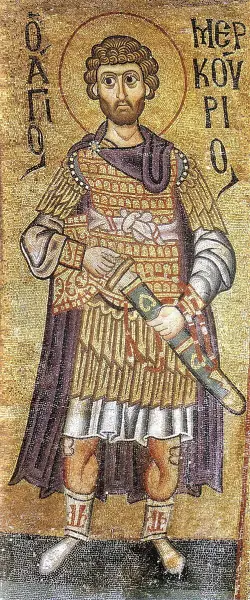
Overview
Mercurius, called in Arabic Abu-Sayfain, Abu-Sifin or Abu-Sefein, the wielder of two swords, served Rome as a soldier though born of Greek blood, and grew into one of Christendom's best-loved warrior saints. Born around 225 in the city of Eskentos in Cappadocia, in eastern Asia Minor, into a family of Greek descent whose converts had named him Philopateer, meaning lover of the Father, he was raised a Christian and enlisted in the Roman army at the age of seventeen under Emperor Decius. Renowned as a swordsman and tactician, he was chosen to succeed his father Yares, renamed Noah at his baptism, as an officer when that father died. When barbarians attacked Rome, the archangel Michael appeared to him holding a shining sword; taking the weapon, Mercurius conquered the enemy and was named a prince by the grateful Decius, bearing henceforth a military sword and a divine one. When Decius began persecuting Christians, compelling all to sacrifice to the pagan gods, Mercurius slipped away rather than offer incense, declared himself a Christian before the emperor, and refused every persuasion to apostatize. Stripped of his rank and tortured, he was sent in iron fetters to Caesarea and beheaded there on 4 December 250 at only twenty-five years of age. Christian tradition holds that he later slew the apostate emperor Julian by a heavenly spear.
The Complete Life
The House of Yares
Mercurius was born around 225 into a family of Greek descent in the city of Eskentos in Cappadocia, in eastern Asia Minor, though some accounts name Rome as his birthplace. His father Yares was an officer in the Roman army, and the household's passage into the faith is preserved in a story of vision and baptism. Hunting one day in the forest with his own father, Yares was attacked by a wild animal that leapt upon the elder man; Yares fainted, and in his unconsciousness he saw a brilliant light and heard a voice addressing him by name, promising that his son Philopatyr would become like a tree bearing good fruit, a witness who would defy all prejudice in God's name. Baptism followed for Yares, his wife and their son, and new names were given to all three: the father became Noah, the mother Saphina, and the boy Philopater, the Greek name meaning lover of the Father. News of their baptism spread quickly through the city, and the prince ordered them arrested and thrown to wild animals, but the beasts harmed them not at all and the family was released. Noah later fought against a barbarian invasion, was captured and held seventeen months in enemy territory, and died not long after returning to his family.
§ Family
The Wielder of Two Swords
After his father Noah's death, the pagan emperor Decius, who ruled from 249 to 251, chose Mercurius to replace him as an officer in the Roman army. His strength and courage were proverbial: comrades honoured him, and in battle after battle his skill with the sword and his tactical eye became famous. His fame took its enduring form in the war against a barbarian invasion of Rome. Decius marched out to meet the enemy but lost heart at the sight of their numbers; Mercurius came to him and told him not to be afraid, because God would kill the enemies and bring victory. After several days of fighting, the archangel Michael appeared to Mercurius holding a shining sword, and the soldier took the weapon from the archangel's hand. From that gift came the name by which the Coptic Church loves him best: Abu Sayfain, the father of two swords, one military and one divine. The barbarians were conquered, and word of the triumph reaching Decius, he raised Mercurius to princely rank. The two swords of the tradition thus tell the whole shape of his vocation: courage in the emperor's service held together with a deeper allegiance that would soon be put to the test.
§ Military career
The Refusal and the Sword of Caesarea
The persecution Decius launched in 249 required every subject to sacrifice before the pagan gods to whom he credited the empire's safety. The archangel Michael appeared to Mercurius, urging him to remember God and not to fear the persecution, and the saint spent the whole night in fervent prayer, confessing his weakness before God. Summoned to the palace to go with the emperor and offer incense to the gods who had given victory, Mercurius melted away through the throng; a guard then reported his absence, and Decius summoned him and asked whether it was true that he had refused to worship the idols who had helped them in the war. Mercurius declared himself a Christian, answering that he worshipped no one except his Lord and his God, Jesus Christ. Every attempt to shake his faith failed, and the emperor answered it by stripping Mercurius of rank and putting him to torture. The people's love for their prince raised the spectre of revolt, so iron fetters were bound upon the saint and he was despatched to Caesarea, where on 4 December 250 the soldier of two swords was beheaded at twenty-five years of age. After the persecution ended, his burial place was revealed, and his body, white as snow, was laid with honour in a church built in his name.
§ Martyrdom
From Cappadocia to Cairo
The cult of Mercurius spread through the whole Christian East. When his grave was revealed after the persecution, the discovery of the fragrant body drew crowds, and a new church was built over his remains in his name. A few years later the Catholicos of Armenia, chief bishop of the Armenian Apostolic Church, visiting Egypt, was asked by the Patriarch of Alexandria for a share of the relics; on 9 Paoni, corresponding to 16 June, part of the blessed relics were transferred to Egypt, where a church bearing the martyr's name received them with devotion, fixing his feast in the Coptic calendar on 25 Hathor, the martyrdom, 9 Paoni, the translation, and 25 Epip, his feast. To the Greeks he stands among the four warrior saints of Christendom, and to Basil of Caesarea's tradition belongs the tale that Mercurius, seen in an icon with a bloodied spear, had struck down Julian the Apostate as the emperor returned from Persia, ending his oppression of Christians. In Egypt his Arabic name Abu-Sefein is invoked to this day: the nuns of the Abu Sefein Monastery in Cairo credit his intercession with saving their property from confiscation for the Ministry of Defense, after, as legend holds, the saint appeared in a vision to President Hosni Mubarak and the government reversed its decision. His image shines in the mosaics of Hosios Loukas and the frescoes of Ohrid and Bosnia, and his memory is kept across Roman, Eastern Orthodox, Oriental Orthodox and Coptic Churches alike.
§ Other traditions
Timeline
- 224
Born in the city of Eskentos in Cappadocia, or by other accounts at Rome
§ Traditional biography
- 249
Emperor Decius begins his persecution, compelling all subjects to offer sacrifice to the pagan gods
§ Martyrdom
- 4 Dec 250
Beheaded at Caesarea on 4 December, aged about twenty-five, after refusing to worship the idols
§ Martyrdom
In Their Own Words
I do not worship anyone except my Lord and my God, Jesus Christ.
Is it true that you refused to worship the idols who helped us during the war?
The Record
- Symbols
- paramerion swords·two swords
- Canonization
- Pre-congregation; great martyr venerated in the Roman Catholic, Eastern Orthodox and Oriental Orthodox Churches
Prayer
Bibliography
Show 6 sources
- Ruskin, John; Bryan, Taylor (1894). St. Mark's Rest, Lectures on art, Elements of perspective. p. 170. St. Mercurius, one of the four Greek warrior saints of Christendom
- Riches, Sam; Salih, Sarah (2005). Gender and Holiness: Men, Women and Saints in Late Medieval Europe. Routledge. p. 78. ISBN 978-1-134-51489-2. Greek soldier-saint Mercurius
- "CHURCH FATHERS: Ecclesiastical History (Sozomen)". www.newadvent.org. Retrieved 2022-10-25.
- "Great Martyr Mercurius of Caesarea, in Cappadocia". oca.org. Orthodox Church in America.
- "The Martyrdom of St. Mercurius Known as the Saint with the Two Swords", Coptic Orthodox Church Network
- Nedosekin, Pavel. "From 'On the East': A Miracle of Great Martyr Mercurius", Pravoslavie
Profile text adapted from the Wikipedia article, licensed CC BY-SA 4.0.
Pray with this saint every day
Save St. Mercurius to your favorites, read the full profile, and get feast-day reminders in the Saints app.
Get the Saints AppFree on the App Store for iPhone and iPad