
6th century·Feast June 7
St. Meriasek
Breton bishop of Vannes honoured in Cornwall
Overview
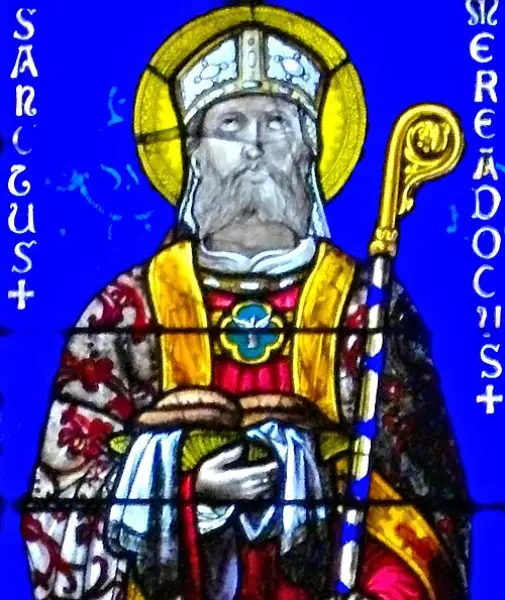
Meriasek, in Breton Meriadeg, was a saint of the sixth century honoured in both Cornwall and Brittany. Born into a ducal family in Brittany, he refused the political marriage that Conan Meriadoc, the legendary king of the Bretons, intended for him, and instead renounced his inheritance to become a priest. Renowned for miraculous cures, he crossed the Channel and founded an oratory at Camborne in Cornwall; Teudar's persecution drove him out; he sailed back to Brittany, came ashore at Plougasnou, and raised a chapel at Josselin in Rohan territory before withdrawing to Pontivy. Crowds drawn by his reputation for wonders followed him wherever he went. He was credited with healing lepers and the disabled, putting the highwaymen of Josselin to flight by prayer, bringing water from solid rock, and calming a storm; when he helped the Viscount destroy the brigands who ravaged his lands, three fairs were founded at Noyal in gratitude at the saint's own request. Raised to the bishopric of Vannes, he kept the hair shirt of an ascetic and ministered to the poor until his death, and was buried in Vannes Cathedral. His life survives chiefly through Beunans Meriasek, a Cornish play of 1504, and he remains patron saint of Camborne.
The Complete Life
A Duke's Son Who Refused a Marriage
Meriasek was born in Brittany into a ducal family, a rank that in the world of his day destined him for alliance and power rather than for the Church. The legends record that Conan Meriadoc, the legendary king of Brittany, designed for him a political marriage that would have bound the young noble's fortunes to the crown. Meriasek saw the matter differently. He preferred to renounce his inheritance entirely and to become a priest, surrendering in a single decision the lands, the marriage bed, and the future that his birth had prepared for him. The choice set the pattern of his whole life: wherever the legends follow him afterwards, he appears as a man who holds nothing back from God, who receives from kings and viscounts only what he can turn into monasteries, chapels, and care for the sick, and who withdraws from every honour the moment it begins to gather crowds about him. The story of the refused marriage, told in the Cornish play of his life, made him for the people of Cornwall and Brittany an enduring model of the religious vocation chosen against the expectations of family and rank alike.
§ Life
Priest and Worker of Cures
Having renounced his inheritance, Meriasek gave himself to the priestly life, and the legends are unanimous that his ministry from the first was marked by miraculous cures. The sick who came to him were restored, and the fame of these wonders spread through Brittany and across the Channel before he himself travelled anywhere. It was this reputation rather than any commission that carried his vocation outward: the priest who could heal by prayer became a founder of holy places, and each foundation became in turn a centre of pilgrimage for the afflicted. His vocation, as the medieval play presents it, joined two callings that the age seldom separated — the contemplative's withdrawal and the wonder-worker's public charity. He sought solitude in the wild places of Cornwall and Brittany, yet could not remain hidden, because the suffering kept finding him out. The bell long venerated at Stival in Brittany under his name reminds us how closely his memory was bound to the sound that called the sick and the poor to prayer. In this union of healing and holiness his biographers saw not celebrity but fidelity: the cures were the overflow of a life given wholly to God.
§ Life
Across the Channel: Camborne, Josselin, Pontivy
Meriasek crossed the Channel from Brittany to Cornwall and founded an oratory at Camborne, the foundation with which his name remains joined as patron of the town. His work there was cut short by persecution: King Teudar, whose hostility the play recounts, forced the saint to leave Cornwall, and he returned to Brittany, landing at Plougasnou on the northern coast. He did not retire then to the security of his family lands. At Josselin, in the territory of the Viscounts of Rohan, he founded a chapel, and the crowds his miracles attracted grew so great that he withdrew again, to Pontivy near the château of Rohan. Even there his peace was interrupted by the needs of others: the Viscount was harassed by brigands who infested his lands, and Meriasek assisted him by calling down the fire of heaven upon the malefactors. In thanks the Viscount endowed three fairs at Noyal, exactly as the saint had asked, endowments that tied the memory of Meriasek into the civic calendar of Brittany. His mission thus ranged from Cornish mining country to the Breton interior, leaving oratories, chapels, and fairs as the enduring landmarks of a single restless apostolate.
§ Life
Ascetic, Healer, and Friend of the Poor
The spirituality that emerges from the legends of Meriasek is austere, intercessory, and unmistakably directed toward the poor. Tradition credits him with cures of leprosy and crippling injury, with routing the highwaymen of Josselin by prayer alone, with drawing water out of solid rock for the thirsty, and with quieting a storm at his word. Yet the same man, when raised to the episcopate, continued to wear a hair shirt beneath his vestments and to practise the ascetic discipline of the desert monks. The miracle stories cluster about the needs of ordinary people — the sick who could reach no physician, the traveller waylaid by robbers, the countryside terrorized by armed men — and they present the saint's power as flowing from a life of fast and prayer spent on behalf of those who had nothing else to offer him. Even as a bishop he remained a minister to the poor, and the sacred well at Camborne, long believed to have power to heal the insane, kept alive for centuries the association between his memory and the sufferer's hope. Holiness, in his legend, is inseparable from mercy shown to the weakest.
§ Life
Bishop of Vannes
In his later years Meriasek was elevated to become bishop of Vannes, the ancient see on the southern coast of Brittany. The elevation changed his station but not his manner of life: the play and the traditions agree that he continued to wear the hair shirt of an ascetic, to practise abstinence, and to devote himself to the poor of his diocese as he had done as a wandering priest. He had spent a lifetime founding chapels and oratories for other people's prayer; now he governed the church of a whole region, and the traditions suggest that he brought to the episcopate the same simplicity that had marked his pilgrim years. He died as bishop of Vannes and was buried in Vannes Cathedral, where his tomb became the natural centre of his Breton cult. From Vannes his memory radiated back across the areas of his ministry — to Josselin and Pontivy, where he had preached and worked his wonders, and across the Channel to Camborne, which claimed him as its own patron. The bishop who had refused a ducal marriage ended his days as a shepherd of the Breton church, buried among the people he had served.
§ Life
The Cornish Play and the Living Memory
The chief monument of Meriasek's memory is literary. His life and legends are known through Beunans Meriasek, a saint's play in the Middle Cornish language preserved in a single manuscript copy dated 1504, most likely taken down at the collegiate church of Glasney in Penryn by Radulphus Ton, working perhaps at the instance of Master John Nans, the college's provost, who afterwards removed to Camborne and died there in 1508. Before Beunans Ke surfaced in 2000, no other saint's play in Middle Cornish was known; the manuscript was rediscovered in the 1860s and printed by Whitley Stokes in 1872, it remains one of the treasures of the Cornish tongue. Through the play the saint's cult passed into modern memory: his patronage of Camborne endured, his legendary will appointed the first Friday in June as his feast, though some places keep it on 7 June, and the sacred well at the town was long thought able to heal the insane. The memory proved renewable. On 13 July 2012, well over a hundred schoolchildren performed an adaptation of the play at Heartlands, the culmination of a scheme that taught schoolchildren the Cornish tongue and the ways of medieval Cornish drama — a sixth-century saint still teaching through the play his devotees wrote about him.
§ Legacy
Timeline
- 1504
The Beunans Meriasek, the Cornish play of his life, was copied into the single surviving manuscript
§ Sources
- 2000
The discovery of Beunans Ke ended the play's status as the only known saint's play in Middle Cornish
§ Sources
- 13 Jul 2012
More than a hundred schoolchildren performed an adaptation of the saint's play at Heartlands in Cornwall
§ Legacy
The Record
- Patron of
- Patron saint of Camborne
- Symbols
- a bell
- Canonization
- Pre-congregation; ancient cult in Cornwall and Brittany, where he is honoured as bishop and confessor
Prayer
Bibliography
Show 5 sources
- Farmer, David. "Meriasek", The Oxford Dictionary of Saints, 5th ed., OUP, 2011. ISBN 9780199596607.
- George, Ken J. (30 November 1991), "Notes on word order in Beunans Meriasek", in Fife, James; Poppe, Erich (eds.), Studies in Brythonic Word Order, Current Issues in Linguistic Theory, John Benjamins Publishing Company, p. 205. doi: 10.1075/cilt.83.06geo.
- Doble, G. H. (1960) The Saints of Cornwall: part 1. Truro: Dean and Chapter; pp. 111-144.
- Whitley Stokes: "Beunans Meriasek: The Life of St Meriasek, Bishop and Confessor: a Cornish Drama" (London & Berlin, 1872), new ed. 1996. ISBN 0-907064-68-X.
- Myrna Combellack: "A Critical Edition of Beunans Meriasek" (PhD thesis, University of Exeter, 1985).
Profile text adapted from the Wikipedia article, licensed CC BY-SA 4.0.
Pray with this saint every day
Save St. Meriasek to your favorites, read the full profile, and get feast-day reminders in the Saints app.
Get the Saints AppFree on the App Store for iPhone and iPad