
died c. 520·Feast December 15
St. Mesmin
Second abbot of Micy near Orléans
Overview
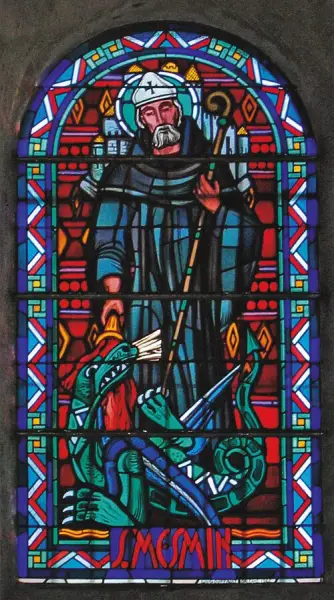
Mesmin, whose name was also written Maximin or Maximinus, was a French saint of the early sixth century closely bound to the Bishopric of Orléans. His uncle was Euspicius, an archpriest of Verdun, whose plea for clemency before King Clovis I during the siege of that city so impressed the king that he granted the priest a royal villa called Micy near Orléans, where the Loire meets the Loiret, for the founding of a monastery. When Euspicius died in 510, Mesmin succeeded him as the second abbot of Micy. Under his rule monastic life flourished; the community followed the Eastern discipline of St. Anthony and St. Basil which Cassian and Martin of Tours had carried into the Western Church, and its monks cleared and drained the surrounding country, taught the country people to prize the farmer's honest labour, and spread monastic life throughout the diocese of Orléans. Among the monks formed under him were St. Lié, later a hermit of the forest of Orléans, and Leonard of Noblac. Mesmin often withdrew to a cave beneath the cliff of Béraire across the river, where local legend set his combat with a dragon. He died on 15 December 520 and was buried in the cave itself; his relics were moved to Orléans around 675 and were partly destroyed by Huguenots in 1562.
The Complete Life
A Nephew of Verdun and the Clemency of Clovis
Mesmin entered history through his uncle. Euspicius, his mother's or father's brother, was archpriest of Verdun, and the young Mesmin belonged to his household and followed his spiritual direction. The turning point came when the city of Verdun was under siege. Euspicius went to Clovis I, king of the Franks, and asked clemency for the rebels within the walls. The king was so struck by the priest's boldness and holiness that he took a personal interest in the activities of Euspicius and his nephew from that day forward. This connection with the Frankish court, unexpected for a churchman of Verdun, shaped the rest of both their lives. When Euspicius sought a place of retreat from the world in 508, the royal favour secured for him an unoccupied villa called Micy near Orléans, and the king bestowed the domain so that a monastery might be established there. For Mesmin, still a young man, the foundation became his school and his inheritance: everything he afterwards accomplished as a monk and an abbot grew out of that act of royal clemency won by his uncle's intercession on behalf of a besieged city's rebels.
§ Life
Formation at Micy and the Eastern Rule
At Micy, Mesmin's vocation took its permanent form. His uncle became the monastery's first abbot, and the community was organized on the rule of the Eastern hermits, the discipline kept by the disciples of St. Anthony and St. Basil, which Cassian and Martin of Tours had carried into the Western Church. This was a demanding inheritance: a spirituality of continual prayer, ascetic renunciation, and manual labour, rooted in the deserts of Egypt rather than the villas of Gaul. Under it Mesmin was formed in the years when Micy was establishing itself as one of the first great monastic houses of the Frankish kingdom. When Euspicius died in 510, the community turned to the founder's nephew, and Mesmin became the second abbot of Micy, holding the office for the remaining decade of his life. His succession preserved the continuity of the foundation at a fragile moment, for the abbey was still young and its royal patronage still new. That the monastery not only survived the founder's death but flourished under his successor testifies both to the quality of the formation Euspicius had given his monks and to the fidelity with which Mesmin carried forward the Eastern rule he had received.
§ Life
An Abbey That Civilized a Countryside
During Mesmin's tenure as abbot, religious life at Micy flourished notably, and its influence reached far beyond the cloister. The community did much to civilize the region about Orléans: its monks cleared and drained long-neglected ground, and they instructed the half-civilized folk of the Loire valley, teaching them to prize honest labour on the land. From Micy the contemplative life fanned out through the diocese of Orléans and the lands about it, as the abbey sent out or formed the men who would carry the contemplative life to other places. Among the monks who lived under Mesmin were two who became saints in their own right: Lié, who afterwards withdrew to be a hermit in the forest of Orléans, and Leonard of Noblac, one of the most widely venerated saints of the medieval West. An abbot's legacy is measured in such disciples, and the sources present Mesmin's Micy as a genuine school of holiness rather than a mere estate of pious landowners. The abbey joined prayer to the plough, and in doing so it converted a landscape as much as a population — an achievement that outlasted the abbot himself and made the little house at the meeting of the two rivers a fountainhead of Frankish monasticism.
§ Life
The Cave of Béraire and the Dragon
Across the river from the abbey, on the northern bank of the Loire, rose the old Gallo-Roman Villa Berarii, perched on a cliff high above the current; it took its name from Berarius, its one-time owner, and the village beneath was called Béraire. Beneath the cliff lay a natural cave to which Mesmin would often withdraw for solitude and prayer, near the towpath that formed part of the route from Paris to Compostela. The cave became the heart of his spirituality: the abbot of a flourishing monastery still needed the desert's silence, and he found it in a hollow of the limestone across the water. Local legend afterwards filled that silence with a combat, telling that Mesmin fought a dragon in the grotto and overcame it — the famous Grotte du dragon de Béraire. Scholars have noted that the tale can be compared with the Druidic ceremonies that persisted into the beginning of the Christian era, as though the saint's victory narrated the conversion of an older sacred place. Whether history or allegory, the dragon of Béraire expressed a truth his monks understood: the man of prayer confronts and subdues the powers that haunt the wilderness, and the cave of temptation becomes, by his vigilance, a cave of peace.
§ Dragon cave of Béraire
Death and Burial in the Cave
Mesmin died on 15 December 520, in the tenth year of his abbacy, and his monks laid him to rest in the very place he had chosen for his prayer: the cave of the dragon of Béraire beneath the cliff across the Loire. The burial joined the abbot permanently to his hermitage, and the site was not allowed to remain a simple grave. Around 550 a church rose over his grave on the ground of the former villa, and the cave beneath it became a place of pilgrimage, drawing the faithful along the riverside road until the coming of the Normans put an end to its tranquility. The village of Béraire took a new name from its saint and has been known ever since as La Chapelle-Saint-Mesmin. A man who had sought obscurity in a hole in the rock thus became, after death, the centre of a whole landscape of devotion — his grave a sanctuary, his village his memorial, and his memory carried up and down the Loire by every pilgrim who stopped at the cliff to pray where the dragon had been and the saint now lay.
§ Dragon cave of Béraire
The Cult of the Saint at Orléans
The veneration of Mesmin took root at once and was formalized in the structures of the church. He is honoured as a saint of the Roman Catholic Church, with his feast kept on 15 December, the day of his death, and his cult remained for centuries especially the possession of the Bishopric of Orléans with which his whole life was bound up. Around 675 his relics were transferred from the cave of Béraire to an oratory at Orléans itself, bringing the saint into the city whose countryside he had helped to convert. The devotion endured the upheavals of the centuries: in 1493 the saint's reliquary came into the keeping of the abbey of Saint-Mesmin de Micy, returning the treasure in some sense to the house he had governed. In 1562 the Wars of Religion dealt the cult a violent blow when Huguenot hands destroyed a portion of the relics; what remained was preserved and rests today in the Saint-Mesmin church at La Chapelle-Saint-Mesmin, on the very ground where the abbot had prayed and was first buried. Few saints of the Merovingian age can show so continuous a record of local attachment, extending from the grave of 520 to the parish church of the present day.
§ Dragon cave of Béraire
A Sister's Legend and a Saint's Name on the Land
Beyond the abbey and the cave, the memory of Mesmin spread in stranger forms. Her legend makes Sainte Mesme a daughter of the Frankish king Dordanus and a sister of Saint Mesmin himself. A servant of the royal house had brought her, unknown to her kin, to the Christian faith, and when the king learned that his daughter was renouncing the pagan gods he was furious, ordering his son Mesmin to behead his own sister to spare the family's honour. The legend relates that Mesmin buried the head of his sister, and that a miraculous spring gushed from the spot, its waters curing fevers; the fountain that keeps the tale alive stands in the village of Sainte-Mesme close by Dourdan to this day. This Mesme is not to be confused with the other Saint Mesme, or Mexme, a follower of Martin of Tours who founded the abbey of Chinon and died peacefully in old age. Whether or not the legend preserves a real sister, the name of Mesmin is written across the map of the Orléans region — in La Chapelle-Saint-Mesmin, in the abbey of Micy, in the fountains and villages that carry his memory — the durable legacy of a sixth-century abbot of the Loire.
§ Sainte Mesme
Timeline
- 508
Clovis I granted Euspicius the royal villa of Micy, near Orléans, for the founding of a monastery
§ Life
- 510
Succeeded his uncle Euspicius as second abbot of Micy on the founder's death
§ Life
- 15 Dec 520
Died at Micy and was laid to rest in the dragon's cave at Béraire across the Loire
§ Dragon cave of Béraire
- 550
A church was erected above the saint's tomb on the site of the old villa at Béraire
§ Dragon cave of Béraire
- 675
His remains were moved to an oratory in the city of Orléans
§ Dragon cave of Béraire
- 1493
The saint's reliquary was committed to the care of the abbey of Saint-Mesmin de Micy
§ Dragon cave of Béraire
- 1562
Part of his relics was destroyed by Huguenots; the remainder is kept at La Chapelle-Saint-Mesmin
§ Dragon cave of Béraire
The Record
- Major works
- Micy Abbey
- Symbols
- a dragon, from the legend of Béraire
- Canonization
- Pre-congregation; venerated in the Roman Catholic Church, chiefly in the diocese of Orléans
Prayer
Bibliography
Show 4 sources
- Head, Thomas. "Saintly Patronage and Episcopal Authority at the Abbey of Micy", Hagiography and the Cult of Saints: The Diocese of Orléans, 800–1200. Cambridge University Press, 1990.
- Montalembert, Charles Forbes comte de. The Monks of the West. P.J. Kenedy, 1912, p. 456.
- Goyau, Georges. "Diocese of Orléans." The Catholic Encyclopedia Vol. 11. New York: Robert Appleton Company, 1911.
- Perrin, Jean-René. "La Légende du Dragon de Béraire", Edilivre, 2017, p. 112. ISBN 978-2-7521-0302-4.
Profile text adapted from the Wikipedia article, licensed CC BY-SA 4.0.
Pray with this saint every day
Save St. Mesmin to your favorites, read the full profile, and get feast-day reminders in the Saints app.
Get the Saints AppFree on the App Store for iPhone and iPad