
235 – 249·Feast January 23
St. Messalina of Foligno
Consecrated virgin and martyr under Emperor Decius
Overview
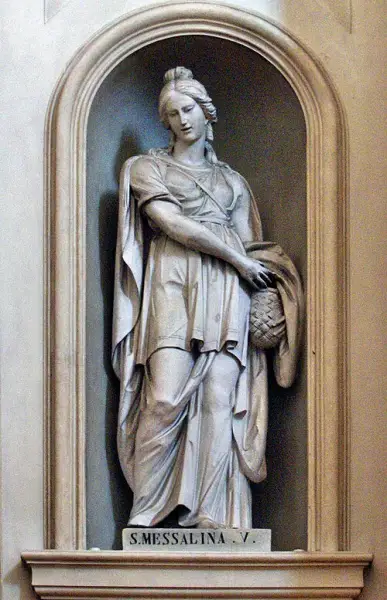
Messalina of Foligno was a third-century Italian Christian, a consecrated virgin and martyr, and a disciple of Felician, bishop of Foligno. Born at Foligno in Umbria in the year 235, she received the veil from Bishop Felician upon taking vows of celibacy and chastity, binding her life to the church of her native city in the consecrated state of virginity. When Emperor Decius unleashed his persecution of Christians, Felician was arrested, and Messalina showed her constancy by visiting him in prison. She was then denounced as a Christian herself; brought before the authorities, she refused to offer sacrifice to the Roman gods, and for this refusal she was clubbed to death on 23 January 249, dying a virgin and martyr at about the age of fourteen. She is venerated as a saint in both the Catholic Church and the Eastern Orthodox Church, which keep her memory on 23 January and 19 January respectively. Her major shrine is at Foligno Cathedral, where a statue of the saint stands, and she is honored as a patroness of the city of Foligno, whose cathedral is dedicated to her mentor and fellow martyr Felician.
The Complete Life
The Veil from Bishop Felician
Messalina was a Christian woman of Foligno in the third century, born in the year 235 into a church that lived quietly under Roman rule in the Umbrian valley. The formative relationship of her life was with Felician, bishop of Foligno, one of the great figures of early Umbrian Christianity. From his hands she received the veil, the visible sign of her consecration, upon taking vows of celibacy and chastity. In the church of that era such a consecration set a woman apart in a distinctive way: a virgin by deliberate choice, she belonged to no husband and to no earthly household, but to Christ and to the community of the faithful, which looked to its consecrated virgins as living witnesses of the resurrection life. Her discipleship to Felician joined her personal vocation to the fortunes of the Folignate church; when the bishop himself would be swept into persecution, she would be found at his side. The veil she received from him proved to be, in effect, the first promise of her martyrdom: the virginity she vowed to Christ was the very allegiance her judges would demand she renounce.
§ Biography
Persecution, Prison, and the Final Refusal
The storm broke with the persecution of Christians ordered by Emperor Decius, which required sacrifice to the Roman gods and struck first at the leaders of the church. Bishop Felician of Foligno was arrested, and Messalina went to visit him in prison — an act of loyalty that, in a time of persecution, amounted to a public declaration of her own faith. She was denounced as a Christian, and the machinery of the trial moved against her. The issue was put to her in the terms Rome always used: offer sacrifice to the Roman gods and live. She refused. For that refusal she was clubbed to death, beaten down before her judges on 23 January 249. She was fourteen years old, a consecrated virgin who had received the veil from the imprisoned bishop she had refused to abandon. Her death on the same day as her mentor's feast bound the two martyrs together in the memory of the Folignate church: the disciple who had knelt to receive the veil from Felician followed him through prison to the glory of martyrdom, sealing with her blood the vows she had taken.
§ Biography
Memory in Foligno and Beyond
Messalina is venerated as a saint in both the Catholic Church and the Eastern Orthodox Church, one of the early martyrs whose cult predates the official canonization processes and belongs to the whole undivided church of the first millennium. The two traditions keep her feast on different days: the Catholic Church on 23 January, the anniversary of her martyrdom, and the Eastern Orthodox Church on 19 January. Her major shrine is at Foligno Cathedral, the cathedral of her native city, where a statue of the saint stands — the virgin of Foligno honored in the very church raised over the memory of her bishop. The cathedral itself is dedicated to Saint Feliciano, so that martyr and mentor remain united in the sacred geography of the city. She is honored as a patroness of Foligno, invoked by the people of the city whose church she served. Her story, though preserved in the briefest of outlines, has remained in the calendars of both East and West for seventeen centuries — a witness that in the third century the faith of Umbria was strong enough to claim the life of a consecrated girl, and precious enough to be remembered forever.
§ Biography
Timeline
- 235
Born at Foligno in Roman Italy.
§ Biography
- 23 Jan 249
Beaten to death after refusing to sacrifice to the Roman gods during the persecution of Christians under Emperor Decius.
§ Biography
The Record
- Patron of
- Foligno
- Canonization
- Pre-congregation — venerated as a saint since antiquity in the Catholic Church and the Eastern Orthodox Church.
Prayer
Bibliography
Show 4 sources
- "St. Messalina - Saints & Angels - Catholic Online". catholic.org. Retrieved 2024-12-04.
- Saint of the Day, January 24: Felician of Foligno & Messalina. SaintPatrickDC.org. Retrieved 2012-03-08.
- "January 19". Latin Saints of the Orthodox Patriarchate of Rome.
- "Cathedral of Saint Feliciano". Divina Foligno. Retrieved 2024-12-04.
Profile text adapted from the Wikipedia article, licensed CC BY-SA 4.0.
Pray with this saint every day
Save St. Messalina of Foligno to your favorites, read the full profile, and get feast-day reminders in the Saints app.
Get the Saints AppFree on the App Store for iPhone and iPad