
c. 788/800 – 847·Feast June 14
St. Methodios I of Constantinople
Patriarch who restored the icons and ended Iconoclasm
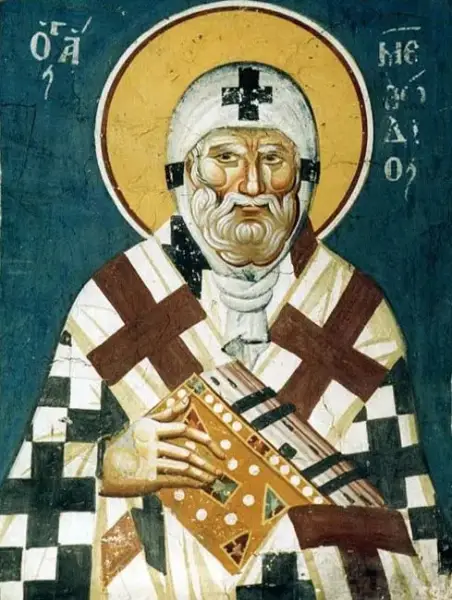
Overview
Methodios I held the patriarchal throne of Constantinople from 11 March 843 until he died on 14 June 847, and is best remembered as the patriarch who restored the veneration of icons to the Byzantine Church, ending the second period of Byzantine Iconoclasm. Born to a wealthy family at Syracuse in Sicily around the end of the eighth century, he was sent to Constantinople to pursue education and a court career, but chose instead the monastic life in Bithynia, where he became an abbot. When the Iconoclast persecution broke out again under Emperor Leo V in 815, Methodius traveled to Rome, perhaps as envoy of the deposed Patriarch Nicephorus I. Arrested on his return in 821, he was exiled by the regime of Michael II; under Theophilos he was imprisoned again, escaped, and was hidden by friends, yet his defense of the icons before the emperor helped soften the persecution. After Theophilos died in 842, the empress-regent Theodora permitted the restoration, the Iconoclast patriarch John VII was deposed, and Methodius was elevated to the patriarchal throne. A week after his installation he led the triumphal procession that returned the icons to Hagia Sophia on 11 March 843 — the origin of the Feast of the Triumph of Orthodoxy.
The Complete Life
From Syracuse to the Cloister
Methodius was born to wealthy parents at Syracuse, in the Byzantine Theme of Sicily, around the years 788 to 800 — a generation that would see the whole eastern church convulsed over the question of sacred images. His family's means opened the road of advancement: as a young man he was sent to Constantinople to continue his education, with the expectation that he might attain an appointment at the imperial court. The capital offered him exactly the career his parents had hoped for, and he turned away from it. Instead of the palace he chose the monastery, entering a house in Bithynia, the region south of the capital rich in monastic communities. There he advanced not by favor but by the monastic virtues, eventually becoming abbot of his community. The formation was decisive for what followed: he acquired the learning that would later mark him as a writer of polemics, sermons, and poetry, and he acquired at the same time the habits of discipline and obedience that would sustain him through two persecutions, an exile, and an imprisonment before the church of Constantinople finally called him to its highest office.
§ Life
Envoy, Exile, and Prisoner for the Icons
Under Emperor Leo V the Armenian the Iconoclast persecution broke out for the second time, and the veneration of icons became, once more, a matter of arrest and exile. Methodius committed himself to the iconodule cause at its moment of defeat. In 815 he journeyed to Rome, quite possibly as the representative of Nicephorus I, the patriarch deposed at Constantinople, carrying the cause of the persecuted church of the East to the apostolic see in the West. He was away for years; when he returned in 821, the regime of Emperor Michael II arrested him and exiled him as an iconodule. Under Michael's son and successor Theophilos, who continued his father's policies, he was seized once more and locked up; he got away, and friends sheltered him. The emperor, seeing that punishment could not break him, tried instead to overcome him by argument — a debate between the most learned defender of Iconoclasm and the monk who would not yield. The result was remarkable: Methodius to some extent persuaded the emperor, and the persecutions relaxed as the reign drew toward its close. Theophilos died in 842, and the way to the restoration of the icons lay open.
§ Life
The Restoration of the Icons
Soon after the emperor's death, in 843, Theoktistos, the powerful minister, brought the empress mother Theodora — governing for her toddler son Michael III — to allow the icons' return. Theoktistos then pushed out John VII, the Iconoclast patriarch of Constantinople, and had Methodius named in his place, the act that brought the iconoclast controversy to its end. A week after his installation, and following the Council of Constantinople of 843, Methodius led the ceremony that the Byzantine world never forgot. Accompanied by Theodora, Michael III, and Theoktistos, he walked at the head of a victory march from Blachernae to Hagia Sophia on 11 March 843, and the icons came back into the Great Church. The event heralded the restoration of Christian orthodoxy itself and became a permanent holiday of the Byzantine Church, celebrated every year on the First Sunday of Great Lent under the name Triumph of Orthodoxy. The persecuted monk of Bithynia, twice arrested and once hunted, now walked at the head of emperor and empress to undo in a single afternoon the policy of a century of icon-breaking emperors.
§ Life
A Shepherd of Reconciliation
The final years of Methodius passed peacefully after the triumph of 843. He toiled much and wisely guided the church and his flock through the delicate years that follow a religious revolution. Throughout his short patriarchate he pursued a moderate line of accommodation toward members of the clergy who had formerly been iconoclasts — a policy of mercy in a church where the vanquished party might have expected deposition and punishment. His instinct was administrative as much as conciliatory: the restoration had been accomplished by a mere handful of decisions at court, and it fell to the patriarch to make it real in parishes and monasteries across the empire, receiving back into communion the clergy of the defeated faction while securing the irreversibility of the Church's teaching on the holy images. He was not granted long to complete the work. Methodius died in Constantinople on 14 June 847, a little more than four years after his installation, leaving as successor Ignatius of Constantinople. The peace he had made held: the Byzantine Church never returned to Iconoclasm, and the moderation of the restoration became one of the reasons it endured.
§ Life
Saint of the Undivided Church
Both the Orthodox East and the Catholic West honor Methodius as a saint — the two heirs of the undivided Christendom he served. His feast is kept on 14 June, the anniversary of his death in 847. His glorification belongs to the era before formal canonical processes: the churches honored him as a confessor who had suffered exile and imprisonment for the truth, and as the patriarch who had presided over the return of the icons, one of the defining acts of orthodox faith in the Byzantine tradition. In the Orthodox Church his memory is inseparable from the annual celebration of the Triumph of Orthodoxy on the First Sunday of Great Lent, which commemorates the procession he led to Hagia Sophia in March 843 and, through it, the victory of the veneration of images over the last imperial Iconoclasm. In the West, his life was recorded with respect by medieval historians, and the Catholic Encyclopedia preserved his story for modern readers. Devotional calendars in both traditions — from the Orthodox Church in America to the FaithND saint-of-the-day archive — continue to tell his story on his feast day.
§ Life
Writer, Peacemaker, and the Triumph of Orthodoxy
Methodius left the mark of a cultivated mind as well as a confessor's constancy. He was well educated and engaged in both the copying and the writing of manuscripts, keeping alive the literary culture of a capital recently delivered from religious war. His individual works included polemical pieces, hagiographical and liturgical compositions, sermons, and poetry — a range that reflects both the pastoral needs of his patriarchate and the personal breadth of a monk trained in Constantinople's schools. But his principal monument is liturgical rather than literary. The procession of 11 March 843 became a holiday of the Byzantine Church, the Triumph of Orthodoxy, celebrated every year on the First Sunday of Great Lent, and with it the annual reaffirmation of the church's teaching on the holy icons, which Methodius restored in person. His moderation toward former iconoclasts became the model for how the Byzantine church healed after division. A twelfth-century miniature in the Manasses Chronicle shows him in discussion with Emperor Theophilos, fixing in the visual memory of later generations the debate in which a monk's arguments softened an emperor's persecution. Four years of patriarchate — and a millennium and more of Orthodoxy shaped by them.
§ Life
Timeline
- 815
Went to Rome after the outbreak of the second Iconoclast persecution under Emperor Leo V, perhaps as envoy of the deposed Patriarch Nicephorus I.
§ Life
- 821
Seized on his way back from Rome and banished as an icon-venerater by the regime of Emperor Michael II.
§ Life
- 828
Went back to Constantinople once Michael II, shortly before dying, eased the persecution and declared a general amnesty.
§ Life
- 842
Emperor Theophilos, whose persecution Methodius had endured and argued against, died.
§ Life
- 843
The minister Theoktistos persuaded Empress Mother Theodora to permit the restoration of icons, and the Iconoclast Patriarch John VII was deposed.
§ Life
- 11 Mar 843
Took the patriarchal throne and headed the victorious march from Blachernae to Hagia Sophia that returned the icons.
§ Life
- 14 Jun 847
Died in Constantinople, ending a patriarchate of just over four years.
§ Life
The Record
- Major works
- Polemical writings·Hagiographical works·Liturgical works·Sermons·Poetry
- Canonization
- Pre-congregation — venerated as a saint since antiquity in the Eastern Orthodox Church and the Catholic Church.
Prayer
Bibliography
Show 7 sources
- "St. Methodius I of Constantinople". FaithND. Retrieved 4 August 2026.
- Fortescue, Adrian (1910). "Methodius I". The Catholic Encyclopedia. Vol. 9. New York: Robert Appleton Company.
- Treadgold, Warren (1997). A History of the Byzantine State and Society. Stanford University Press. p. 446.
- Gregory, Timothy E. (2010). A History of Byzantium. Blackwell Publishing. p. 227.
- Merriam-Webster's Encyclopedia of World Religions. Merriam-Webster. 2000. p. 231. ISBN 0877790442.
- "Saint Methodius the Patriarch of Constantinople". Orthodox Church in America. Retrieved 4 August 2026.
- The Oxford Dictionary of Byzantium. Oxford University Press. 1991.
Profile text adapted from the Wikipedia article, licensed CC BY-SA 4.0.
Pray with this saint every day
Save St. Methodios I of Constantinople to your favorites, read the full profile, and get feast-day reminders in the Saints app.
Get the Saints AppFree on the App Store for iPhone and iPad