
died c. 311·Feast June 20
St. Methodius of Olympus
Bishop, martyr and opponent of Origen
Overview
Methodius of Olympus was an early Christian bishop, prolific author and martyr who died around 311. Writing in Greek during the closing decades of the third century, he earned a place in theological history as the first systematic critic of Origen, taking aim especially at the claim that the risen body differs from the earthly body and at the notion that the world has always existed. Like the Alexandrian he opposed, he was steeped in Platonic thought and read Scripture allegorically, yet he deployed that learning in defense of a more concrete Christian hope. His surviving masterpiece, the Symposium or On Virginity, dresses a celebration of consecrated virginity in the form of a Platonic dialogue and closes with a hymn to Christ the Bridegroom. He also composed dialogues on free will and on the resurrection, commentaries, and a large work against the Neoplatonist Porphyry. Where exactly he exercised his episcopacy remains disputed, with Olympus in Lycia the usual answer and Philippi in Macedonia a rival claim. Jerome reports that he was put to death at Chalcis in Greece as the great persecution ended. His feast is kept on June 20.
The Complete Life
A Bishop of Disputed See
Almost nothing is recorded of Methodius's origins; even the city where he served as bishop has become a question for scholarly argument. His own writings repeatedly reveal a Lycian background, and Jerome described him as bishop of Olympus in Lycia and afterwards of Tyre, a verdict widely accepted since scholars such as Theodor Zahn endorsed Olympus as historically correct. The episcopacy in Tyre, however, is more than doubtful, for only Jerome mentions it, the episcopal list of Tyre leaves no room for him, and changing sees was unusual in that era. A tradition naming him bishop of Patara, the Lycian capital, first surfaces only in the late sixth century. Franz Diekamp advanced a different case altogether: several manuscripts call Methodius bishop of Philippi in Macedonia, John of Antioch, writing in 435, placed Methodius within the episcopal rank of Greece and Illyria; moreover, it is questionable whether Olympus possessed a bishop at all when he died. Diekamp also observed that Jerome's placement of the martyrdom at Chalcis in Greece fits a Macedonian bishop better than a Lycian one. Whatever the truth, his consecration to episcopal office amid a confessing church is not in doubt.
§ Life
First Foe of Origenism
Methodius gave his literary career a clear direction: the patient refutation of Origen's most speculative teachings. He assailed Origen's teaching that the rising body is other than the one carried through earthly life, insisting instead that this same mortal frame is destined to wake to incorruptibility. He likewise rejected the claim that the world is eternal, opposing it in the dialogue Xenon. These contests gave him the distinction of being the first systematic opponent of Origen, and they likely explain a curious silence: Eusebius, the great historian of the early church, never mentions him in his Church History, probably because of his opposition to various Origenist theories. Jerome therefore supplies the earliest surviving accounts of his life. Methodius did not confine himself to one opponent. There followed a lengthy reply to the Neoplatonist Porphyry, whose pen had attacked the Christian faith, a treatise on the Pythonissa aimed at Origen, and commentaries on Genesis and the Song of Songs. The Byzantine encyclopedia Suda praised his splendid and well-composed discourses and noted that his many works were frequently read. In all this he wrote as a Greek who had mastered the pagan schools and turned their armor against them, a bishop whose polemic was carried by the quality of its prose as much as by its argument.
§ Works
Teaching and Vision
The spirituality that emerges from Methodius's writings joins Platonic form to Christian conviction. In the Symposium he taught that Christ himself remained virgin throughout his life, adorning his flesh with incorruption as an example of chastity for believers who would come to the likeness of God. In the same dialogue he commended prayer facing the East, in keeping with apostolic tradition, imagining the virgins hastening toward the Bridegroom with lamps in hand. His On the Resurrection offered a striking account of mortality: God pronounced man mortal, clothing him with the coats of skins, so that sin might be destroyed from its very roots and humanity would not become an undying evil. Against those who expected the world's annihilation, he insisted that the coming conflagration serves purification and renewal, not destruction; the creation, restored to a better state, will rejoice over the children of God, freed from corruption and made subject to righteousness. God, he argued, had not founded the world merely to see it destroyed. Following Plato and Origen in method, he read Scripture allegorically, finding mystical meaning in the food laws, the red cow of Leviticus, the leper's rite, and the leech of Proverbs, always pressing the text toward hope in the life to come.
§ Doctrines
Martyrdom at Chalcis
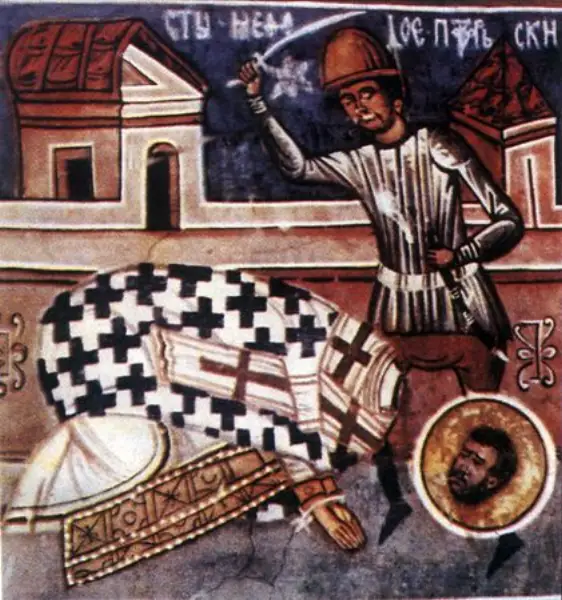
The last days of Methodius's life coincide with the last great assault of the Roman state on the church. Jerome records that the persecution's final wave claimed his life at Chalcis, in the days of Diocletian, Galerius or Maximinus Daia, early in the fourth century. Jerome adds the caveat that some assert the death took place under Decius and Valerian, yet he himself introduces that alternative as uncertain, and it is judged unlikely on chronological grounds: Methodius wrote against Porphyry, who lived until 305, so his literary career ran on into the very years when the young Porphyry's attack on Christianity was fresh. The location of his death, Chalcis in Greece, has even been pressed into service in the argument over his see, since a Macedonian bishop would fit a Greek martyrdom more naturally than one from distant Lycia. What the sources agree upon is the manner of his ending: a bishop who had spent his strength in books and controversy sealed his teaching with blood when the persecution reached him. The seventeenth century would later depict that martyrdom in paint, preserving the memory of his final witness.
§ Life
Honored Among the Fathers
Methodius was never canonized by any formal process; the church honored him as a saint from the earliest centuries, long before such procedures existed. He is venerated today in the Catholic Church, the Eastern Orthodox Church and the Oriental Orthodox Church alike, and the Catholic Church keeps his feast on June 20. His standing rests not on a cult promoted by any single see but on his inclusion among the Church Fathers, the company of bishops, theologians and martyrs whose witness the undivided church received. His reputation, however, attracted writings that were never his. The seventh-century Apocalypse of Pseudo-Methodius, a work of prophetic fiction, owes its circulation entirely to his name though it is not his; the same holds for the Oration on Simeon and Anna, a product of the fifth or sixth century sometimes wrongly cited as evidence of early Marian devotion. Such borrowings of his authority are themselves a tribute: later generations wanted his name on their books. The sober account of his life rests on Jerome's notices and on his own works, through which the church has remembered him as martyr, bishop and father.
§ Introduction
A Living Body of Work
Methodius's literary legacy has survived in fragments and translations that testify to how widely his books were read. Of his many writings only the Symposium on virginity comes down complete in Greek; a papyrus of its eighth oration, copied in the fifth or sixth century and now in the library of Montserrat Abbey, is the earliest known manuscript of any of his works. Larger Greek fragments preserve the dialogues on free will and on the resurrection, while four shorter treatises on life, food, leprosy and the leech survive only in Slavonic versions, some abbreviated. Editors from the Renaissance onward gathered what remained: the texts printed in the Patrologia Graeca, Jahn's 1865 edition styling him a Platonizer, and Bonwetsch's critical Leipzig volume of 1891. His influence reached beyond theology into the history of mysticism, for William Ralph Inge, in his Bampton Lectures on Christian mysticism, presented Methodius as an early inspiration for Master Eckhart and Johannes Tauler. A modern scholar could still devote a monograph to his account of divine sovereignty, human freedom and life in Christ, and a 2017 volume could gather new perspectives on his thought, proof that the bishop of disputed see still commands attention.
§ Works
In Their Own Words
What then did the Lord, the Truth and the Light, accomplish on coming down to the world? He preserved His flesh incorrupt in virginity with which he had adorned it.
For this is what was meant by the coats of skins, in order that, by the dissolution of the body, sin might be altogether destroyed from the very roots.
From the height of heaven, O virgins, the sound of a voice makes itself heard, awakening the dead: toward the Bridegroom, it says, let us all go in haste, clad in our white garments, our lamps in our hands, to the East.
The Record
- Major works
- Symposium, or on Virginity·On the Resurrection·On Free Will·De vita (On Life and Rational Action)·De cibis (On the Jewish Dietary Laws)·De lepra (On Leprosy)·De sanguisuga (On the Leech)·A voluminous work against Porphyry·A treatise on the Pythonissa against Origen·Commentaries on Genesis and the Song of Songs·On the Martyrs·The dialogue Xenon, against Origen's eternity of the world
- Canonization
- Pre-congregation; honored as a saint and Church Father from earliest Christian memory, with a June 20 feast
Prayer
Bibliography
Show 6 sources
- F. Diekamp, "Ueber den Bischofssitz des hl. Märtyrers und Kirchenvaters Methodius", Theologische Quartalsschrift 109 (1928), 285-308
- Theodor Zahn, "Studien zu Justinus Martyr. Exkurs: Ueber den Bischofssitz des Methodius", Zeitschrift für Kirchengeschichte VIII (1885/86), 15-20
- G. S., "Methodius", in W. Smith and H. Wace, eds., A Dictionary of Christian Biography, Literature, Sects and Doctrines During the First Eight Centuries (London, 1882), vol. III, p. 909
- Katharina Bracht (ed.), Methodius of Olympus: State of the Art and New Perspectives, Berlin, Walter de Gruyter, 2017
- L. G. Patterson, Methodius of Olympus: Divine Sovereignty, Human Freedom, and Life in Christ, Washington: Catholic University of America Press, 1997
- Brice C. Jones (22 May 2018), "The Earliest Manuscript of Methodius of Olympus and an Unattested Saying about the Nile"
Profile text adapted from the Wikipedia article, licensed CC BY-SA 4.0.
Pray with this saint every day
Save St. Methodius of Olympus to your favorites, read the full profile, and get feast-day reminders in the Saints app.
Get the Saints AppFree on the App Store for iPhone and iPad