
died 314·Feast June 4
St. Metrophanes of Byzantium
Bishop of Byzantium at the dawn of Constantinople
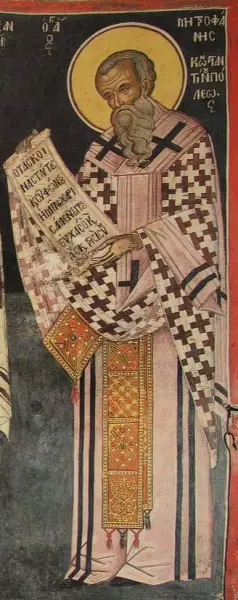
Overview
Metrophanes of Byzantium, who died in 314, was bishop of the ancient city of Byzantium from about 306 to 314. Tradition counts him the twenty-sixth occupant of that see, and history gives him a quieter but weightier distinction: he is the first Byzantine bishop of whom contemporary sources speak at all, and the written record names no organized Christian congregation in the city at any point before his episcopate. He came from a family already woven into both church and empire, as the son of Bishop Dometius, the nephew of the emperor Probus, and the brother of Probus of Byzantium, his two predecessors on the episcopal throne. Tradition holds that Constantine the Great conferred on him the honorary title of Patriarch, though the city did not become the imperial capital until 330 and its see was not raised to a patriarchate until 451. A later tradition preserved by Gelasius of Cyzicus has him living, aged and infirm, at the time of the First Council of Nicaea, sending the deacon of his heart, Alexander, in his place. He was canonized in both East and West, and his feast is kept on June 4.
The Complete Life
A Family of Bishops
Metrophanes belonged to one of the most remarkable families of the early Byzantine church. His father was Dometius of Byzantium, himself a bishop of the city, and his uncle was none other than the Roman emperor Probus, who ruled in the late third century. His brother bore their uncle's name, Probus of Byzantium, and like their father he too was appointed bishop of Byzantium before Metrophanes took up the office. A household in which a father and then a son occupied the episcopal throne, while a kinsman sat on the imperial throne, points to a Christian family of standing in the city on the Bosporus, one that the empire both permitted and honored even in eras of tension between church and state. Beyond these kinships the sources are silent about his birth, his upbringing and his formation; no date of birth is recorded, and no contemporary writer describes his early years. Whatever the details, the family pattern made his own path almost inevitable. When the episcopal succession reached him, he was not an outsider raised to the office but the third of his line to shepherd the flock of Byzantium, inheriting both the burden and the continuity of his father and brother.
§ Introduction
The Twenty-Sixth Bishop
Metrophanes became bishop of Byzantium around the year 306, at a moment when the ancient city was still a provincial town of the Roman Empire, decades before it would be reborn as a capital. The traditional catalog of the church of Byzantium counts him as its twenty-sixth bishop, heir to a line that reached back through his father Dometius and brother Probus to apostolic names such as Stachys and Onesimus. Yet his position in the historical record is unlike that of the long chain of predecessors before him. He is the first bishop of Byzantium whom contemporary sources mention, and in fact the records of his own day preserve no trace of any Christian congregation in Byzantium before he took office. Whatever came before him belongs to tradition; with him, the see of Byzantium steps into the light of documented history. For eight years he held the office, from about 306 to 314, shepherding a community whose very existence previous centuries cannot document. In that sense his vocation marks a threshold: he stands at the point where the legend of Byzantium's apostolic origins and the verifiable history of its church meet and pass the episcopal staff from one to the other.
§ Introduction
Age, Council, and Succession
The closing chapter of Metrophanes' life is preserved in traditions that must be weighed carefully. Gelasius of Cyzicus preserves a tradition that places Metrophanes, by then aged and frail, among the living at the First Council of Nicaea in 325, kept from its sessions by infirmity; he therefore sent Alexander of Constantinople in his place, the man he had already destined as his successor. Most scholars judge, however, that Metrophanes was most likely already dead by the time the council assembled. The chronology of the succession bears that judgment out: Socrates of Constantinople sets Alexander's arrival on the throne of Constantinople at a point before 319, years ahead of the council. The sources agree on the essential figure in the story even where they differ on its timing. In Alexander, the aging bishop found the heir he wanted, and it was Alexander, not Metrophanes, who would lead the church of the imperial capital into the age of the great doctrinal councils. Metrophanes himself died in 314, by the received dating, having led his flock out of the era of undocumented tradition and up to the edge of Constantinian Christianity without crossing into it himself.
§ Introduction
Saint of the Undivided Church
Both the Eastern Orthodox Church and the Catholic Church number Metrophanes among their canonized saints, a shared commemoration of a bishop who served before the great divisions of Christian history. His feast day is kept on June 4 in the Eastern Orthodox liturgical tradition. No formal canonization process stands behind his cult; he belongs to the generation of saints whose veneration grew naturally from the memory of the church, as with the long line of bishops of Byzantium who preceded the age of patriarchs. The church that honors him looks back across seventeen centuries to a shepherd about whom little can be said beyond his dates, his family and his place in the succession, and it honors him precisely for that place: he stands at the head of the documented history of one of Christianity's greatest sees. Among the Orthodox he is remembered liturgically as the first patriarch of Constantinople, a title of honor rather than of law for his own lifetime, yet one that the tradition has gladly given him. Both East and West thus keep the memory of a bishop whose fame rests not on writings or miracles but on fidelity at the fountainhead.
§ Introduction
Memory and the Patriarchal Title
The most celebrated element of Metrophanes' legacy is a title. Tradition tells that Constantine the Great granted him the honorary rank of Patriarch, and Orthodox memory has ever afterward spoken of him as the first patriarch of Constantinople. The tradition, however, requires historical qualification: the city rose to imperial capital and the name Constantinople only in 330, and the see waited until 451 for elevation to a patriarchate. Whatever honor Constantine may have paid the aging bishop, it anticipated by generations the legal rank his successors would come to hold. Metrophanes' truer legacy lies elsewhere. He is the first bishop of his city whom contemporary sources mention, the point at which the church of Byzantium becomes visible to history, and the link in the episcopal chain that joins the apostolic legendary list to the documented archbishops of Constantinople. The later catalog of the see, running from Andrew the Apostle through the bishops of the Roman period and on through fifteen centuries of patriarchs, preserves his name in its place between his brother Probus and Alexander. Popular devotion continues through shrines that style him the first patriarch of Constantinople.
§ Introduction
Timeline
- 306
Is installed as bishop of Byzantium, succeeding his brother Probus
§ Introduction
- 314
Ends his term as bishop of Byzantium with his death
§ Introduction
- 319
By this time Alexander of Constantinople has succeeded Metrophanes as bishop, according to Socrates of Constantinople
§ Introduction
- 325
According to Gelasius of Cyzicus, is alive at the First Council of Nicaea but unable to attend due to age and ill health, sending Alexander in his place
§ Introduction
- 330
Byzantium becomes the capital of the Roman Empire and is renamed Constantinople, long after his episcopate
§ Introduction
- 451
The see he once led is elevated to a patriarchate, more than a century after his death
§ Introduction
The Record
- Canonization
- Pre-congregation; canonized saint revered in both the Eastern Orthodox and Catholic Churches
Prayer
Bibliography
Show 7 sources
- "Κατάλογος Οικουμενικών Πατριαρχών - Οικουμενικό Πατριαρχείο" [List of Ecumenical Patriarchs] (in Greek), 2019
- Dvornik, Francis (1958). The Idea of Apostolicity in Byzantium and the Legend of the Apostle Andrew. Harvard University Press
- Limberis, Vasiliki (2002). Divine Heiress - The Virgin Mary and the Making of Christian Constantinople. Routledge
- Walter, Christopher (1970). "The Names of the Council Fathers at Saint Sozomenus, Cyprus". Revue des études byzantines 28 (1): 189-206
- Graindor, Paul; Grégoire, Henri (1944). Byzantion - Revue des études byzantines. Vol. 16. Fondation Byzantine, p. 25
- Socrates of Constantinople, Historia Ecclesiastica, I, 37
- "Bishops/Patriarchs of Constantinople", Byzantine Studies Page, Fordham University
Profile text adapted from the Wikipedia article, licensed CC BY-SA 4.0.
Pray with this saint every day
Save St. Metrophanes of Byzantium to your favorites, read the full profile, and get feast-day reminders in the Saints app.
Get the Saints AppFree on the App Store for iPhone and iPad