
died 992·Feast June 15 and September 30
St. Michael I of Kiev
First Metropolitan of Kiev and all Rus'
Overview
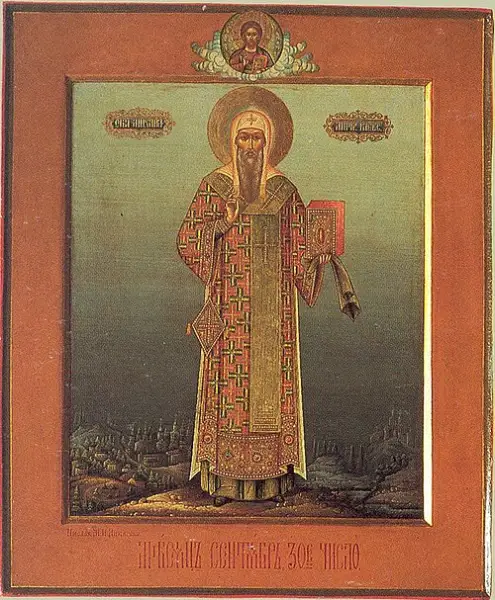
Michael I of Kiev, who died on June 15, 992, is honored as the first Metropolitan of Kiev and all Rus', holding that office from 988 until his death. The sources disagree about his origins, some calling him Assyrian and others Bulgarian, but they agree in placing him at the head of the newly founded metropolis at the very moment the lands of the Rus' received Christianity. Tradition ascribes to him the founding of two houses of prayer in that same founding year: the monastery of St. Michael's Golden-Domed in Kiev itself, and the Mezhyhirskyi Monastery near Vyshhorod, established with Greek monks whose learning helped root the new faith in Slavic soil. He died in Kiev in 992 and was succeeded by Leontiy of Kiev. His remains rested first in the Church of the Tithes, then found a home in the Near Caves of the Kiev Pechersk Lavra, and lie today in the lavra's Dormition Cathedral. The Russian Orthodox Church canonized him in the 18th century, and his memory is kept on June 15, the day of his death, and on September 30, the day of the translation of his relics.
The Complete Life
A Stranger at the Head of a New Church
The man who would become the first hierarch of the Rus' church arrived, as far as the sources can tell, from far away. Different historical accounts describe him as either Assyrian or Bulgarian, and nothing is recorded of his birth, his formation or the path that carried him toward the Dnieper. What is certain is his place in history: when the metropolis of Kiev and all Rus' was established in 988, in the wake of the baptism of the Rus', Michael stood at its head as the first Metropolitan of Kiev and all Rus', an office he held until his death in 992. The arrangement reflected the practice of the Ecumenical Patriarchate of Constantinople, which governed the new metropolis and supplied it with hierarchs, often Greeks, in its earliest generations. To place a foreign-born metropolitan over a freshly baptized people was to entrust him with everything at once: the organization of parishes, the formation of clergy, the teaching of the faith in a language and culture not his own. The four years of his episcopate were brief, but they set the pattern for the long line of metropolitans of Kiev who followed him in the centuries after his death.
§ Introduction
Planting Monasteries on the Dnieper
Tradition credits Michael with two foundations that shaped the monastic landscape of the young Rus' church. The first is St. Michael's Golden-Domed Monastery in Kiev itself, which he is traditionally accounted as founding; its gilded church would become one of the great landmarks of the city, standing above the Dnieper as a sign of the new Christian order. The second is the Mezhyhirskyi Monastery near Vyshhorod, which he founded together with Greek monks in 988. The Greek companions matter: the Christianity that came to the Rus' arrived from Byzantium, in the Greek rite and eventually in Slavonic translation, and the monks who came with the first metropolitan embodied that living connection with Constantinople. In the founding year of 988, with the baptism of the people still fresh, the establishment of two monastic houses within reach of the princely capital gave the new church roots as well as branches. Monasteries would prove decisive for the Christianization of the Rus' lands, providing centers of prayer, literacy and art, and the later glory of the Kiev Pechersk Lavra would grow from the same impulse that Michael's foundations represent: the conviction that a people's conversion must be anchored in communities of unceasing worship.
§ Biography
Death in Kiev
Michael's service as the first metropolitan came to an end in Kiev, where he died on June 15, 992. The records of his last years are sparse; no account survives of his final illness, his words or the circumstances of his passing, only the date that his church would later fix as his principal feast. He had held the metropolis for roughly four years, long enough to organize its beginning but not to see its maturity, and the succession passed to Leontiy of Kiev, remembered in the early lists as the next occupant of the see. The city in which he died was itself a building site of the new faith, its first stone churches rising, its clergy still learning the rites of Constantinople. In that sense his death closes the apostolic moment of the Rus' church: the first hierarch, the first foundations, the first generation, all gathered into a beginning that others would carry forward. The day of his death, June 15, became the day of his annual commemoration, observed in the Eastern Orthodox Church from the time of his glorification onward, the calendar converting the end of his labor into the perpetual memory of it.
§ Introduction
Glory and Commemoration
Michael was canonized a saint in the 18th century at Kiev by the Most Holy Governing Synod, the governing body of the Russian Orthodox Church in the imperial era. His veneration, however, is richer than a single decree. The Eastern Orthodox Church keeps his memory on two principal days: June 15, the anniversary of his death, and September 30, the feast of the translation of his relics. An older tradition, recorded in the calendars, formerly celebrated him together with Anthony of Kiev and Theodosius of Kiev, the founders of the Caves monastery, on September 2, placing the first metropolitan in the company of the fathers of Rus' monasticism whose way of life his own foundations had anticipated. Greek synaxaria honor him in the same terms, styling him the holy first metropolitan of Kiev and all Russia and recounting his feast on both June 15 and September 30. The double commemoration tells its own story: the church remembers both the man who served and the remains it still treasures, joining his death day and the day his relics found their rest in one continuous act of thanksgiving for the beginning of the faith among the Rus'.
§ Veneration and relics
Relics and Shrine
The bodily memory of the first metropolitan has itself had a long history. His remains were first enshrined in the Church of the Tithes, the earliest stone church of Kiev, raised in the generation of the baptism; there the first hierarch lay at the heart of the community he had led. Afterwards they were translated to the Near Caves of the Kiev Pechersk Lavra, that house of the Caves whose saints had formerly shared a feast day with him, joining the long procession of wonderworking remains for which the lavra is renowned. Today his relics are located in the Dormition Cathedral of the lavra, and the Kiev Monastery of the Caves is honored as his major shrine. Each stage of that journey, from the Church of the Tithes to the Near Caves to the Dormition Cathedral, marks a chapter in the history of Kiev's sanctity, and the feast of September 30 commemorates the translation that brought him to the Caves. He stands first in the calendar of metropolitans of Kiev and all Rus', the head of a line that ran under the Ecumenical Patriarchate for centuries, and his memory anchors the claim of that ancient metropolis to an apostle-like beginning.
§ Veneration and relics
Timeline
- 988
Becomes the first Metropolitan of Kiev and all Rus' at the baptism of the Rus' lands
§ Introduction
- 988
Traditionally founds St. Michael's Golden-Domed Monastery in Kiev
§ Biography
- 988
Founds the Mezhyhirskyi Monastery near Vyshhorod together with Greek monks
§ Biography
- 15 Jun 992
Dies in Kiev and is succeeded by Leontiy of Kiev
§ Introduction
The Record
- Major works
- Foundation of St. Michael's Golden-Domed Monastery in Kiev·Foundation of the Mezhyhirskyi Monastery near Vyshhorod
- Canonization
- Canonized in the 18th century at Kiev by the Most Holy Governing Synod of the Russian Orthodox Church
Prayer
Bibliography
Show 5 sources
- Great Synaxaristes (in Greek): Ὁ Ἅγιος Μιχαὴλ ὁ πρῶτος Μητροπολίτης Κιέβου καὶ πάσης Ρωσίας. 15 Ιουνίου. ΜΕΓΑΣ ΣΥΝΑΞΑΡΙΣΤΗΣ
- "June 15/28", Orthodox Calendar (Pravoslavie.ru)
- Great Synaxaristes (in Greek): Ὁ Ἅγιος Μιχαὴλ ὁ Θαυματουργός πρῶτος Μητροπολίτης Κιέβου καὶ πάσης Ρωσίας. 30 Σεπτεμβρίου. ΜΕΓΑΣ ΣΥΝΑΞΑΡΙΣΤΗΣ
- "September 30/October 13", Orthodox Calendar (Pravoslavie.ru)
- "2022", calendar.rop.ru, retrieved 2022-02-16
Profile text adapted from the Wikipedia article, licensed CC BY-SA 4.0.
Pray with this saint every day
Save St. Michael I of Kiev to your favorites, read the full profile, and get feast-day reminders in the Saints app.
Get the Saints AppFree on the App Store for iPhone and iPad