
5th – 6th century·Feast Thursday before Whitsunday
St. Meubred
Cornish hermit and beheaded martyr of Cardinham
Overview
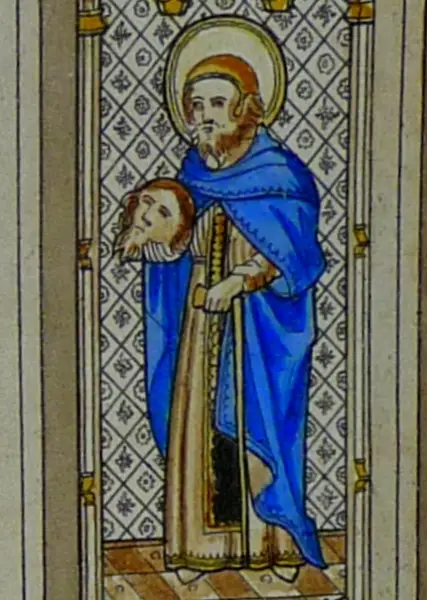
Meubred, whose name appears in the forms Mybbard, Mewbred and Mebbred and who is known also by the Latinized Calrogus, lived as a hermit in the sixth century and ranks among the local saints of Cornwall. Tradition makes him the son of a King of Ireland, and later writers re-imagined him as an Irish prince who left his father's court to live as a hermit in Cornwall; in William Worcester's record he is an Irish king's son who took up the hermit's life in Cornwall, a contemporary of St Mannacus and St Wyllow. Very little else is known of his life, but his death is fixed by local memory: he suffered beheading alongside two companions at the hands of the pagan ruler Melyn ys Kynrede, on ground that now belongs to the parish of Lanteglos-by-Fowey hard by Fowey in Cornwall. His companion Mancus, and the martyr Wyllow, were killed at the same time, and all three are commemorated together on the Thursday next before Whitsunday. Meubred is said to lie within the shrine of the Church of St Meubred at Cardinham, of which he is regarded as the patron saint, the only dedication in his name. In medieval art he appears as a cephalophore, carrying his severed head, in the stained glass of the church of St Neot.
The Complete Life
An Irish Prince in Tradition
The man Cornish memory calls Meubred is wrapped in the uncertainty that surrounds nearly all the saints of the early Celtic West. His names alone tell a story of layered tradition: Mybbard, Mewbred, Mebbred, and the Latinized Calrogus all attach to the same figure, evidence of devotion that circulated in more than one language and generation. The oldest strand of tradition describes him as the son of a King of Ireland, born in Ireland in the 5th century, and William Worcester, the fifteenth-century antiquary, preserves the fuller legend of an Irish king's son who forsook his father's court for a hermit's cell in Cornwall. Historians observe that a later age re-invented him as an Irish prince, the familiar pattern by which Celtic saints of obscure origin were furnished with royal blood and romantic careers. Whatever the truth of his lineage, the tradition is unanimous in placing his origins across the Irish Sea, among the streams of Irish monks and solitaries who carried Christianity into Cornwall in the fifth and sixth centuries. In that company a king's son who abandoned rank for a hermit's life would have been unremarkable; Ireland's monastic world was full of princes who had exchanged thrones for cells.
§ Meubred
Hermit in Cornwall
Meubred's vocation, so far as it can be recovered, was the eremitical life of the early Cornish church. He crossed from Ireland to Cornwall, where he lived as a hermit, one of the solitaries who settled the peninsula's remote valleys and coastal places in the 6th century. The tradition links him with two other figures of the same generation: he was a contemporary of St Mannacus and St Wyllow, and his companion Mancus, himself a hermit, is perhaps the same man as Manaccus, the 6th-century Welsh monk who was abbot at Caer Gybi on Anglesey and worked with Saint Cybi of Caernarvon. Whether the Cornish hermit and the Anglesey abbot were one person or two, the association places Meubred within the network of Celtic monasticism that stretched from Ireland through Wales into Devon and Cornwall. A hermit's life in that world meant not ease but exposure: the solitary preached by the mere fact of his presence, instructed the countryside around his cell, and stood as a visible sign of the Christian faith among communities only lately converted and still surrounded by older ways. It was in such a posture, living and laboring at the edge of the Christian world, that Meubred drew the hostility that would end his life.
§ Meubred
Martyrdom by the Fowey
The death of Meubred is the one event of his life that tradition preserves with precision of place. He and two others were put to the sword by the pagan ruler Melyn ys Kynrede, on ground now forming the parish of Lanteglos-by-Fowey beside the town of Fowey in Cornwall. The killed were three in number, and medieval memory grouped them as a band of brother martyrs: Meubred, his companion the hermit Mancus, and St Wyllow, beheaded at the same hour. William of Worcester, in setting the story down, opened his account of the three martyrs with a striking legend, telling of three brothers who bore the name of St. Genesius, each of whom carried his head, one of them an archbishop of Lismore. The tale belongs to the cephalophore tradition, in which martyrs are pictured carrying their severed heads, and it fixed the image of Meubred in Cornish art: the stained glass of the church of St Neot shows him with an extra head held in his hands, beside St Mabyn. As for Mancus, Robert Bracey's authority places his burial in the church of Lanreath, a couple of miles from Fowey, while the canons of Launceston contend that his grave lies within the parish of Lanteglos.
§ Manaccus
Saint of the Old Memory
Meubred belongs entirely to the age before formal canonization; he was canonized by the pre-congregational acclamation of the local church, the way in which martyrs were honored from the earliest Christian centuries. No pope ever examined his cause and no decree ever numbered him among the saints, yet Cornwall kept his memory as it kept the memory of its other hermits and martyrs, by naming churches for him and observing his feast. That feast falls on the Thursday next before Whitsunday, the movable day before Pentecost, and on it Meubred is commemorated together with his fellow martyrs Mancus and Wyllow, who were beheaded at the same time. The joint commemoration binds the three victims of Melyn ys Kynrede into a single liturgical memory, celebrated year by year as Pentecost approaches. His veneration centered on Cardinham, where tradition locates his burial within the shrine of the church that bears his name, and where he has always been regarded as the patron saint. Through centuries in which formal hagiography passed him by, the parish of Cardinham preserved what the universal church now receives: the memory of an Irish king's son who died a martyr's death in a Cornish field.
§ Meubred
Cardinham and the Glass of St Neot
Meubred's legacy on earth is small, single and enduring: one dedication. There is a single church in his name, the church of St Meubred at Cardinham in the Diocese of Truro, and within it the tradition locates his burial, saying that he lies within the shrine of that church. The parish took him as its patron, and the dedication alone has carried his name through the Reformation and the centuries since, so that a saint otherwise known only from medieval legend is still named over a working parish church on the edge of Bodmin Moor. His image survives in another form: the stained glass window of the church of St Neot pictures him holding an extra head in his hands, set beside St Mabyn, one of the rare medieval representations of the Cornish cephalophore saints. Scholars of Cornish hagiography have kept his memory in their turn, from Gilbert Hunter Doble's history of the church and parish of St Meubred, Cardinham, to studies of pre-Reformation saints' cults in Cornwall and of the St Neot windows. His companion Mancus left his own trace, in the parish of Manaccan, named for Manaccus, whose separate feast falls on October 14.
§ Manaccus
The Record
- Patron of
- Patron saint of Cardinham, Cornwall
- Symbols
- Carrying his severed head·Depicted in the St Neot stained glass alongside St Mabyn
- Canonization
- Pre-congregation; venerated as a local Cornish saint since the earliest Christian memory of Cornwall
Prayer
Bibliography
Show 7 sources
- Farmer, David Hugh (1978). The Oxford Dictionary of Saints. Oxford: Oxford University Press
- Doble, Gilbert Hunter (1939). A History of the Church and Parish of St. Meubred, Cardynham. Shipston on Stour: King's Stone Press
- Thacker, Alan; Sharpe, Richard (2002). Local Saints and Local Churches in the Early Medieval West. Oxford University Press
- Mattingly, Joanna (2003). "Pre-Reformation Saints' Cults in Cornwall - with Particular Reference to the St Neot Windows", in Celtic Hagiography and Saints' Cults, Cardiff: University of Wales Press
- Taylor, Thomas. The Celtic Christianity of Cornwall: Divers Sketches and Studies. Longmans, Green and Co.
- "Cardinham, St Meubred", Cornish Historic Churches Trust
- Chisholm, Hugh, ed. (1911). "William Worcester". Encyclopædia Britannica, 28 (11th ed.). Cambridge University Press
Profile text adapted from the Wikipedia article, licensed CC BY-SA 4.0.
Pray with this saint every day
Save St. Meubred to your favorites, read the full profile, and get feast-day reminders in the Saints app.
Get the Saints AppFree on the App Store for iPhone and iPad