
attested from the 3rd century BC·Feast September 29
St. Michael the Archangel
Prince of the Heavenly Host and Guardian of the Church
Overview
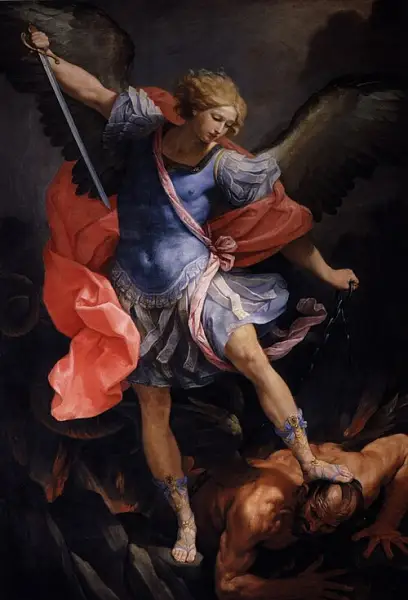
Michael, whose Hebrew name means 'Who is like God?', is the archangel and warrior of God venerated in Judaism, Christianity, Islam, and the Bahá'í Faith, and honoured as a saint in several Christian traditions. The earliest surviving mentions of his name appear in Jewish apocalyptic writings of the third and second centuries BC, where he stands as chief of the angels and guardian prince of Israel. The Book of Daniel calls him the great prince who protects God's people, and the Book of Enoch counts him first among the seven archangels. Christianity inherited nearly all of these traditions and added its own: the Book of Revelation shows him commanding the angelic armies and casting Satan out of heaven, while the Epistle of Jude depicts him disputing with the devil over the body of Moses. Across the centuries his cult grew at great sanctuaries — Chonae in Asia Minor, Monte Gargano in Italy, Mont Saint-Michel in Normandy — and the Church assigned him four offices: leader of God's armies against Hell, escort of the souls of the dead, weigher of souls at judgment, and Guardian of the Church. He is the patron of soldiers, police, the dying, and countless cities and nations, and his feast of Michaelmas on 29 September has marked the Christian year for well over a millennium.
The Complete Life
Before All Ages: Michael in Scripture
Michael enters the record not through a birth but through a name, and his name is a question: in Hebrew, 'Who is like God?'. The earliest surviving writings to mention him are Jewish works of the third and second centuries before Christ, often apocalyptic in character, and there he already holds the first place among angels and archangels. Israel's guardian prince, he was entrusted with the Israelites' care, and the Book of Daniel shows a mysterious figure in linen speaking of 'Michael, your prince' locked in struggle with the prince of Persia, and promising that at the end of days the great prince who protects Daniel's people will arise. The Book of Enoch sets him at the head of the seven archangels — Uriel, Raguel, Raphael, Sariel, Gabriel, and Remiel among them — who stand ready before the glory of the Lord. Christianity preserved nearly everything Jewish tradition said of him and added decisive scenes. The Revelation to John portrays the war in heaven, in which Michael and his angels battle the dragon and cast Satan down, ending his access to God as accuser. The Epistle of Jude recalls his restraint in disputing with the devil over Moses' body, when he would say only, 'The Lord rebuke you.'
§ Old Testament and Deuterocanon
Advocate and Defender in Israel
Rabbinic tradition gave Michael a sustained office on Israel's behalf: he was the nation's advocate in the heavenly court, at times contending with the angelic princes of other nations and above all with Samael, Israel's accuser. Their hostility was ancient, dating to the day Samael was cast out of heaven and sought to pull Michael down after him, until God's own hand was needed to end the struggle. The scribes of the tradition carried Michael's defence back into the age of the patriarchs. Rabbi Eliezer ben Jacob taught that it was Michael who rescued Abraham from the furnace into which Nimrod had cast him. Other midrashim made him the messenger who warned Abraham of Lot's captivity, the protector of Sarah from Abimelech, the angel who substituted the ram that spared Isaac, and the defender of Jacob from Samael in the womb and later from Laban's hostility. The Exodus Rabbah ascribes to him the destruction of Sennacherib's army. So firmly did the conviction of his advocacy take hold that, despite rabbinical prohibitions on appealing to angels as intermediaries, Michael held a place in the Jewish liturgy — remembered precisely by the caution that a man in need must pray directly to God, neither to Michael nor to Gabriel.
§ Judaism
Commander of the Heavenly Host on Earth
From the second century onward, Christians gave Michael a visible mission on earth, and sanctuaries gathered around it. Byzantine tradition credited Constantine with two Bosporus churches in his honour, at Hestia/Anaplous and at Sosthenion, the latter a magnificent Michaelion that became the model for hundreds of Eastern churches and spread his devotion. When Constantine triumphed over Licinius not far from that church in 324, an image of the archangel piercing a serpent became its prized possession, fixing forever the picture of Michael as the warrior saint mastering the dragon. His healing power drew equally ancient reverence: in Phrygia he was associated with pre-Christian healing springs, his chief shrine standing at Chonae, where the Miracle at Chonae legend relates how the archangel, appearing as a blazing pillar, cleft the rock open and drew a diverted river into a fresh channel, sparing a church his fame had made a target. In Rome his care took another form: during a plague under Gregory the Great, the archangel was seen above the mausoleum of Hadrian, and the pope renamed the fortress Castel Sant'Angelo in thanksgiving. Basil the Great ranked him over all angels, herald to the heavenly hosts, and the West marked his glory with feasts recorded from the sixth century onward.
§ Early Christian views and devotions
The Four Offices and the Life of Prayer
Roman Catholic teaching assigns Michael four offices, and they shape a complete spirituality. First he leads the army of God, the celestial commander whose triumph over the powers of Hell models the virtues of the spiritual warrior, his combat with evil read as the battle within every believer. Second and third belong to death: he is the angel who carries the souls of Christians to heaven, and he is the weigher of souls on perfectly balanced scales, the instrument so often placed in his hands by painters. Fourth, once the special patron of the Chosen People, he stands as Guardian of the Church. The East accords him the title Archistrategos, Supreme Commander of the Heavenly Hosts, and honours him above all angels in hymns, icons, and feasts throughout the year; most Russian cities keep a church in his name, and Kyiv, Alexandria, and Belgrade claim him as protector. Coptic Christians celebrate him liturgically on the twelfth of every month, remembering his presentation of the prayers of the just and his escort of the dead. The faithful approach him through the Prayer to Saint Michael and the ninefold Chaplet, whose salutations honour each of the nine angelic choirs, while medieval knights, military orders, and the dying alike have all lived under his defence.
§ Catholicism
Feasts, Orders, and the Long Memory of Christendom
Few figures of faith have stamped themselves so deeply upon the geography and calendar of the world. Michaelmas, the feast of 29 September, is kept across the Roman Catholic, Anglican, and Lutheran calendars, while the Orthodox keep the Synaxis of the archangel and the Bodiless Powers on 8 November, and the Coptic Church repeats his monthly celebration. Mountains, stripped of their pagan dedications after the evangelisation of Germany, were recommissioned to the archangel in chapels scattered across that country, and his line of shrines runs from Monte Gargano to Mont Saint-Michel, Skellig Michael, and Sacra di San Michele. Kingship took him as emblem: the Order of Saint Michael of 1469 became the first chivalric order of France, and the British Order of St Michael and St George followed in 1818. Since the Battle of Lechfeld in 955 he has been patron of the Holy Roman Empire and the Germans; Brussels, Kyiv, Dumfries, and Arkhangelsk — the city itself named for him — all stand under his patronage, and paratroopers of many nations wear his sign. Poets and composers returned to him constantly, from Milton's Paradise Lost to Bach's Michaelmas cantatas, and sculptors from Epstein to Verschaffelt still show him triumphant, sword drawn, over the defeated dragon.
§ Patronages and orders
Timeline
- 324
Following Constantine's nearby triumph over Licinius, an image of the archangel piercing a serpent became the Michaelion's principal artwork.
§ Early Christian views and devotions
- 492
The archangel was believed to have appeared in a hilltop cave on Monte Gargano in Italy, giving rise to a major shrine.
§ Legends
- 590
During a devastating Roman plague, the archangel was seen sheathing a flaming sword over Hadrian's mausoleum, thereafter called Castel Sant'Angelo.
§ Legends
- 663
The Lombards of Manfredonia attributed their victory over the Greek Neapolitans on 8 May to the archangel's aid.
§ Feasts
- 708
The archangel appeared to Aubert, bishop of Avranches, instructing him to raise a church on the rocky islet that today bears the name Mont Saint-Michel.
§ Legends
- 955
Following the victorious Battle of Lechfeld against the Hungarians, Michael became patron of the Holy Roman Empire and of the Germans.
§ Patronages and orders
- 960
The Duke of Normandy commissioned a Benedictine abbey on Mont Saint-Michel, which remains a major pilgrimage site.
§ Legends
- 1134
St Michael's Parish Church was first built at Linlithgow, Scotland, where he has been town patron since the thirteenth century.
§ Patronages and orders
- 1469
France instituted the Order of Saint Michael, its first chivalric order, under the archangel's patronage.
§ Patronages and orders
- 1724
Bach's Michaelmas cantata BWV 130, set to the chorale 'Herr Gott, dich loben alle wir', was composed for the festive Lutheran service.
§ Protestantism
- 1851
Pope Pius IX approved the Chaplet of Saint Michael, rooted in a 1751 private revelation reported by a Carmelite nun.
§ Legends
- 1897
The Congregation of Saint Michael the Archangel, known as the Michaelite Fathers, was founded within the Roman Catholic Church.
§ Patronages and orders
- 1961
Four young schoolgirls began reporting apparitions of the archangel at Garabandal, Spain, continuing through 1965.
§ Legends
In Their Own Words
Saint Michael the Archangel, defend us in battle. Be our protection against the wickedness and snares of the Devil. May God rebuke him, we humbly pray, and do thou, O Prince of the heavenly hosts, by the power of God, thrust into hell Satan, and all the evil spirits, who prowl about the world seeking the ruin of souls.
The Record
- Major works
- Prayer to Saint Michael (Leonine Prayers)·Chaplet of Saint Michael·Scapular of St. Michael the Archangel
- Patron of
- Guardian of the Catholic Church·Vatican City and Rome·Germany·France and Normandy·Kyiv and Ukraine·Brussels·police officers and paratroopers·the military and chivalry·mariners·the dying and poor souls·bankers and grocers
- Symbols
- banner·scales for weighing souls·sword·slaying Satan or a dragon·armor and helmet
- Canonization
- Not canonized by any earthly authority; venerated as an archangel in Judaism, Christianity, and Islam from earliest antiquity
Prayer
Bibliography
Show 8 sources
- Butler, Alban (1821), The Lives of the Fathers, Martyrs, and Other Principal Saints, in twelve volumes, B. Dornin, p. 117
- Johnson, Richard Freeman (2005), Saint Michael the Archangel in Medieval English Legend, ISBN 1-84383-128-7, pp. 33-34, 68, 141-147
- Farmer, David (2011), The Oxford Dictionary of Saints, 5th rev. ed., Oxford University Press, p. 309, ISBN 978-0-19-959660-7
- Ball, Ann (2003), Encyclopedia of Catholic Devotions and Practices, Our Sunday Visitor, ISBN 0-87973-910-X
- "Benedict XVI joins Pope Francis in consecrating Vatican to St Michael Archangel", news.va, retrieved 2013-07-05
- "St. Michael, the Archangel – Saints & Angels", Catholic.org, retrieved 2012-12-27
- "Catholic Encyclopedia: St. Michael the Archangel", www.newadvent.org
- Hannah, Darrell D. (2011), Michael and Christ: Michael Tradition and Angel Christology, Wipf and Stock, ISBN 9781610971539
Profile text adapted from the Wikipedia article, licensed CC BY-SA 4.0.
Pray with this saint every day
Save St. Michael the Archangel to your favorites, read the full profile, and get feast-day reminders in the Saints app.
Get the Saints AppFree on the App Store for iPhone and iPad