
1591 – 1625·Feast April 10
St. Michael de Sanctis
Discalced Trinitarian mystic of the Eucharist
Overview
Michael de Sanctis, born Michael Argemir and in Catalan called Miquel dels Sants, was a Discalced Trinitarian religious whose short life of thirty-three years became one of the great examples of Eucharistic devotion in early modern Spain. Orphaned young in the Catalan city of Vic and apprenticed to a merchant, he sought the cloister as a boy of twelve, asking admission to the Trinitarians at Barcelona. After his novitiate he professed vows at his order's monastery of St. Lambert in Zaragoza in 1607. Encountering the Discalced Trinitarians, whose reform demanded a harsher austerity, he obtained permission to transfer, entering their congregation at Madrid as a novice. Studies at Seville and Salamanca followed, then profession at Alcalá and ordination to the priesthood. Twice elected superior of the Discalced Trinitarian house at Valladolid, he governed while living a life of intense prayer and mortification. His contemporaries testified that during the Consecration at Mass he was raised into ecstasies on several occasions. He died at Valladolid on 10 April 1625, was beatified in 1779 by Pope Pius VI, and was canonized by Pope Pius IX on 8 June 1862; the Roman Martyrology praises his innocence of life, penitence, and love of God.
The Complete Life
An Orphan of Vic
Michael Argemir was born at Vic, an ancient cathedral city of Catalonia, on 29 September 1591, and the name by which history knows him — Michael de Sanctis, Michael of the Saints — was still far ahead of him. His childhood was marked early by loss: his parents died while he was still a boy, and the orphan was apprenticed to a merchant, set on the ordinary path of trade that his circumstances prescribed. The call he heard, however, belonged to a different economy. At twelve he made his way south to Barcelona, the great port, and begged the Trinitarians of that city to admit him, an ancient order given over to ransoming Christian captives. The community accepted the child, and for three years he lived as a novice in their discipline, learning prayer, obedience, and the order's peculiar chariot of charity. In 1607, still in his mid-teens, he professed his vows at the Trinitarian monastery of St. Lambert in Zaragoza, formally binding himself to the religious life. The merchant's apprentice had become a friar before most boys of his age had finished their schooling, and the rest of his life would unfold inside the cloister.
§ Life
The Turn to the Discalced Life
Vows professed did not mean the search concluded. One day Michael met a Discalced Trinitarian, a member of the reformed branch of his order whose followers embraced a more austere lifestyle — bare feet, stricter fasting, a harsher imitation of the poverty of Christ. Something in that encounter captured him. After much deliberation, and with the permission of his superior, he made the decisive transfer: he entered the congregation of the Discalced Trinitarians at Madrid as a novice, beginning again the life he had already embraced once, this time under a rule that asked more. His superiors directed his studies to Seville and Salamanca, the great intellectual centres of Castile, where he pursued the formation of a religious cleric. At Alcalá he took his vows in the reformed congregation, and in due course he was raised to the priesthood. The pattern of his vocation is striking: a boy who gave himself early, and then, having given himself, gave himself again — freely choosing the harder road when the easier one lay open behind him. It was this second, deliberate consecration that bore fruit in the sanctity for which the Church would later honour him.
§ Life
Prayer, Mortification, and Ecstasy at the Altar
The heart of Michael's sanctity was his devotion to the Holy Eucharist. His life was one of prayer and mortification, disciplined by the austere rule he had freely chosen, but everything in it converged upon the altar. His contemporaries testified that during the Consecration of the Mass he was several times raised into ecstasies — carried beyond ordinary consciousness by the reality he held in his hands. In this he belongs to the great family of Spanish Eucharistic mystics of his era, for whom the Real Presence was not a doctrine merely but an encounter. Yet the ecstasies were the flowering of an ordinary fidelity: years of choir, penance, and hidden self-denial prepared the ground. His brethren twice entrusted him with the office of superior of the monastery at Valladolid, a sign that his mystical life did not dissolve his competence but confirmed it; he governed the community he had served, and there he died. The Roman Martyrology would later distil his character into one line — a life of striking innocence, penitence beyond ordinary measure, and love for God — innocence as the beginning, penance as the discipline, and love as the soul of everything between.
§ Life
Raised to the Altars
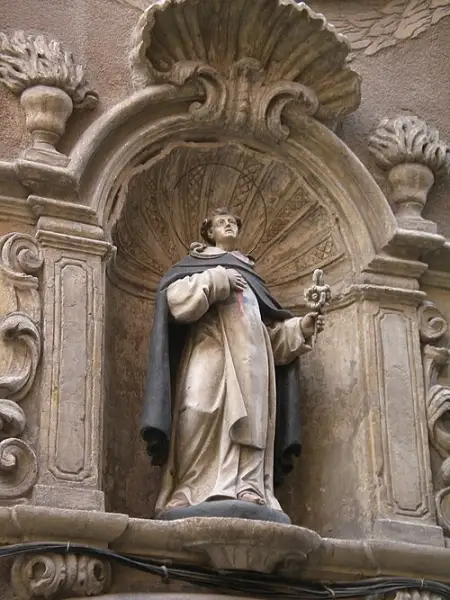
Michael died at Valladolid on 10 April 1625, thirty-three years old — the very age of Christ at his Passion, a coincidence his early devotees could not fail to notice. The reputation for holiness he left in Castile did not dissipate; it consolidated. The cause advanced through the papal courts of the eighteenth century, and on 24 May 1779, in Rome, Pope Pius VI declared him blessed, affirming the cultus that had grown around his memory in Valladolid and Catalonia. Nearly a century of further veneration followed before, on 8 June 1862, Pope Pius IX — the great canonizer of the nineteenth century, who in that same season raised many of Spain's noblest religious to the altars — enrolled Michael de Sanctis among the saints of the universal Church. His feast was fixed on 10 April, the anniversary of his death, and his cultus settled around two natural centres: his native Vic, where his birth house became a chapel and an eighteenth-century sculpture of the saint still stands, and Valladolid, where his grave lies in the Trinitarian church of the city that first venerated him.
§ Life
Patron of the Suffering and of Vic
The saint of Vic has become a particular intercessor for those who suffer as the dying Christ suffered: Michael de Sanctis is invoked as patron of cancer patients, and his tender, sacramental spirituality speaks naturally to those whose bodies bear the cost of illness. His own city claims him with pride, keeping his feast and treasuring the chapel that was once his family home, while Valladolid guards his tomb. His memory has travelled astonishingly far from Catalonia: the municipality of Saint-Michel-des-Saints in Quebec, Canada, bears his name, translated into French, so that a small town on a North American lake honours a Catalan Trinitarian mystic of the seventeenth century. In sacred art he is shown in the posture that summarises his life — at prayer before an altar where the consecrated Host stands exposed, absorbed in the Presence that transfixed him at the Consecration. Nearly four centuries after his canonization, the Discalced Trinitarians continue his chariot of redemptive love, and the Church remembers each 10 April a man whose innocence, penitence, and love for God the Roman Martyrology set before every generation of the faithful.
§ Life
Timeline
- 29 Sep 1591
Born Michael Argemir at Vic in Catalonia.
§ Life
- 1607
After a three-year novitiate he professed vows with the Trinitarians at their monastery of St. Lambert in Zaragoza.
§ Life
- 10 Apr 1625
Died at Valladolid while serving as superior of the Discalced Trinitarian monastery there.
§ Life
- 24 May 1779
Beatified in Rome by Pope Pius VI.
§ Life
- 8 Jun 1862
Canonized in Rome by Pope Pius IX.
§ Life
In Their Own Words
remarkable for innocence of life, wonderful penitence, and love for God
The Record
- Major works
- Monastery of the Discalced Trinitarians at Valladolid (twice its superior)
- Patron of
- cancer patients·the city of Vic
- Symbols
- kneeling before an altar where the Blessed Sacrament is exposed
- Canonization
- Beatified by Pope Pius VI on 24 May 1779; canonized by Pope Pius IX on 8 June 1862, both in Rome
Prayer
Bibliography
Show 5 sources
- Virola, Madonna T., "St Michael de Sanctis", Radio Veritas Asia, April 14, 2024
- "St. Michael de Sanctis", FaithND
- Ott, Michael, "St. Michael de Sanctis", The Catholic Encyclopedia, Vol. 10, New York: Robert Appleton Company, 1911
- "St. Michael de Sanctis", Catholic Review, Archdiocese of Baltimore, April 10, 2006
- "Saint-Michel-des-Saints (Municipalité)", Commission de toponymie du Québec, retrieved 2009-11-30 (in French)
Profile text adapted from the Wikipedia article, licensed CC BY-SA 4.0.
Pray with this saint every day
Save St. Michael de Sanctis to your favorites, read the full profile, and get feast-day reminders in the Saints app.
Get the Saints AppFree on the App Store for iPhone and iPad