
c. 1808-1857·Feast May 22
St. Michael Hồ Đình Hy
Layman and Martyr
Overview
Michael Hồ Đình Hy, born about 1808 to Christian parents in Cochinchina, made his fortune as a silk trader and spent thirty-one years in the emperor's service, rising from a fifth-order mandarin in charge of the royal silk mills to a grand mandarin of the third order and steward of the royal household, trusted with trading voyages to Singapore and Malaysia. Married, with two sons and three daughters, he held the faith privately for most of his life while quietly protecting it: he moved French and Portuguese missionaries along the waterways disguised as official business, kept their records safe, showed clemency when robbers raided the silk mills, and sent his eldest son to the Dutch East Indies to study for the priesthood. Only late did he profess Christianity openly, becoming protector of the community and incurring the envy of fellow officials. A magistrate he had denied entry to the silk mills petitioned for his arrest. Tortured in prison, he signed a confession linking himself to the French, gambling that fear of French guns would spare his fellow Christians, and repented of it when his bishop objected, amending the text, though the correction never reached court. Condemned by Tự Đức, he was beheaded on 22 May 1857 in his robes of office, the last high-ranking official the dynasty would execute.
The Complete Life
Early Life
Michael Hồ Đình Hy was born about 1808 at Cochinchina to a Christian family; of twelve children born to his parents, five survived, and he was the youngest. He was by profession a wealthy silk trader, and he married a Christian of another family; two sons and three daughters were born to them. Like other Christians of the mandarinate at the time, the household practiced its faith in private — a tolerated hypocrisy that the court preferred to open apostasy from office. His career was in fact exceptional: at twenty-one he received a fifth-order mandarinate and was named Superintendent of the royal silk mills; across thirty-one years in the emperor's service he rose to grand mandarin of the third order and steward of the royal household, one of the few trusted officials who traveled abroad on trading missions to Singapore and Malaysia.
§ Life
Hidden Protector of the Church
Throughout his rise, Hy quietly protected the persecuted church. He moved French and Portuguese missionaries along the waterways of the south disguised as official business, and kept their records safe — services for which a mandarin's junk and a mandarin's word were the perfect cover. He showed clemency when robbers raided the silk mills under his charge, an incident that his fellow Christians read as the mark of a man whose power was not his god. When his eldest son asked to become a priest, Hy arranged for him to study in the Dutch East Indies rather than risk a seminary at home. Only late in life did he profess Christianity openly, becoming known as a protector of the community — and incurring the envy of fellow officials, one of whom, a magistrate he had denied entry to the silk mills, petitioned for his arrest.
§ Life
Arrest and Execution
Denounced in 1857, in the tightening persecution under Emperor Tự Đức, Hy was arrested and tortured in prison. Under torture he signed a confession linking himself to the French — a calculated gamble, on his part, that the court's fear of French guns would spare his fellow Christians from sharing his fate — and then repented of it, retracting the signature and accepting the consequences. He was condemned by decree of Tự Đức and beheaded on 22 May 1857, wearing his official robe: the grand mandarin of the third order dying in the dress of the court that killed him. He was about forty-nine.
§ Arrest
Canonization
Hy was beatified by Pope Leo XIII on 5 July 1900, among the early groups of Vietnamese martyrs recognized by Rome. Pope John Paul II canonized him on 19 June 1988 with the 117 Martyrs of Vietnam. He is one of the small number of the 117 drawn from the high officialdom of the empire — the great majority were villagers, catechists, and priests — and his cause presented the Church with the awkward witness of a man who had spent his career serving the very state that killed him.
§ Introduction
Legacy
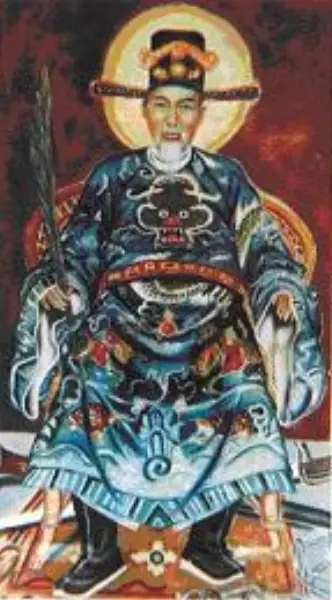
Michael Hồ Đình Hy is the patron saint, in effect, of Catholics caught between office and faith. His life poses in its sharpest form the question the Vietnamese church asked for a century: whether a Christian could serve the emperor honestly, and his answer — decades of concealed protection of missionaries and of the community, an open profession only when concealment failed, and a final public retraction of a forced confession — has been read both as prudence and as compromise, before his blood ended the argument. He is honored on 22 May, and his iconography shows him in Vietnamese official dress. Vietnamese Catholics, and the church of the diaspora, invoke him as a model for public figures who must serve institutions not their own.
§ External links
Timeline
- 1808
Born to Christian parents in Cochinchina, the youngest of five surviving children.
§ Life
- 1829
At twenty-one he is made a fifth-order mandarin and Superintendent of the royal silk mills.
§ Life
- 1857
A disgruntled magistrate petitions the emperor to arrest him over his Christian activities.
§ Arrest
- 1857
In prison he signs, then retracts, a confession tying himself to the French government.
§ Arrest
- 22 May 1857
Beheaded under Emperor Tự Đức's decree after public humiliation, wearing his official robe; buried at the Basilica of Phú Cam.
§ Death
- 1867
Louis Pallard of the Paris Foreign Missions Society petitions the Vatican for his sainthood.
§ Canonisation
- 5 Jul 1900
Beatified by Pope Leo XIII in St. Peter's Basilica.
§ Introduction
- 19 Jun 1988
Canonized by Pope John Paul II in St. Peter's Basilica along with 116 other Vietnamese Martyrs.
§ Introduction
The Record
- Patron of
- Vietnam
- Symbols
- Vietnamese court dress·Phốc Đầu headwear·Martyr's palm·Dadao (sword)
- Canonization
- Beatified by Pope Leo XIII on 5 July 1900; canonized by Pope John Paul II on 19 June 1988 with the 117 Martyrs of Vietnam
Prayer
Bibliography
Show 6 sources
- ↑ Jacob Ramsay Mandarins and Martyrs: The Church and the Nguyen dynasty in Early Nineteenth-Century Vietnam Stanford University Press, 2008. Page 137 "Nevertheless, personal compromise of one's religious beliefs in carrying out official dut
- ↑ Alban Butler Butler's Lives of the Saints : February – Paul Burns 1998 Page 27 "... and Jean Hoan (1861); a catechist, Andre Nam-Thung (1855); and a high-ranking official, Michel Ho-Dinh-Hy (1857). "
- ↑ Đình Đóa Hồ Thánh tử vì đạo Micae Hồ Đình Hy: quan Thái Bộc triều Nguyễn 2010
- ↑ Phát Huồn Phan Việt-Nam giáo-sử 1962 Volume 1 - Page 422 "Hồ-đình-Hy đi vòng quanh thành-nội 3 ngày, mỗi ngấy một lần lúc đến các chọ' và các nơi công-cộng phãi rao cho đân chủng hiết rằng: Hồ-đình-Hy đã phạm tội theo tẵ-đạo, nỏ là một kẽ
- ↑ Nguyẽ̂n Văn Kiệm Góp phà̂n tìm hiẻ̂u một só̂ vá̂n đè̂ lịch sử cận đại Việt Nam 2003 Page 227 "Để tỏ rõ sự nghiêm khắc của chính sách cấm đạo Thiên Chúa này, cuối năm 1856, sau vụ tàu Capricieuse đến gây rối ở Cửa Hàn, Tự Đức đã hạ lệnh bắ
- ↑ Annals of the Propagation of the Faith Society for the Propagation of the Faith Volumes 19 à 20 1858- Page 286 "In the beginning of the month of May, the king approved the sentence, and added the following note in reference to Michael: Ho
Profile text adapted from the Wikipedia article, licensed CC BY-SA 4.0.
Pray with this saint every day
Save St. Michael Hồ Đình Hy to your favorites, read the full profile, and get feast-day reminders in the Saints app.
Get the Saints AppFree on the App Store for iPhone and iPad