
c. 894 – 961·Feast July 12
St. Michael Maleinos
Byzantine monk and founder of Kyminas monasticism
Overview
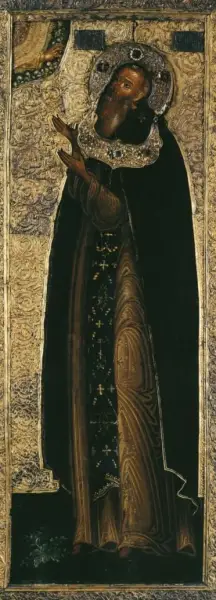
Michael Maleinos was a Byzantine monk of the tenth century who won profound respect among the Christians of Asia Minor. Born Manuel Maleinos around 894 into one of Cappadocia's wealthy land-owning families, he passed his youth at the imperial court of Leo the Wise before renouncing privilege at eighteen and withdrawing to Bithynia as a monk. Under the elder John Heladites he took the name Michael, was ordained a priest, and embraced a rigorous ascetic life, spending five days of each week in solitary prayer in a cave. His holiness drew followers: he founded a monastery at a desolate place called Dry Lake, gave it a strict rule, and then withdrew again to found another, until the slopes of Kumineia Mountain — Mount Kyminas — were covered with monastic communities. He was the brother of the general Constantine Maleinos and the uncle of Nikephoros Phokas, who as emperor Nikephoros II deeply felt his influence, and he also shaped the young Athanasius the Athonite, who later modelled the Great Lavra of Mount Athos on Michael's foundation. Michael died at Mount Kyminas on 12 July 961, and his memory was honoured for centuries, notably by the Romanov dynasty of Russia.
The Complete Life
Born to the Anatolian Aristocracy
The man the Church would remember as Michael Maleinos entered the world around 894 under the baptismal name Manuel, a child of the great Cappadocian landowners. His family stood at the very summit of Anatolian military society. Both of his grandfathers had commanded armies and risen to the rank of patrikios, and his father Eudokimos held the same dignity. His mother Anastaso counted the emperor Romanos I Lekapenos among her relatives, so that imperial and military power met in the boy's own household. He had at least one brother, Constantine Maleinos, who would himself become a general, and a sister whose name has not survived but whose marriage to Bardas Phokas the Elder wove the Maleinoi into the fabric of the Phokades, the most formidable military clan of tenth-century Byzantium. Manuel's youth was spent not in Cappadocia but at the court of Emperor Leo the Wise, who was a kinsman. There, amid the ceremonial and refinement of Constantinople, the future ascetic learned firsthand exactly what the world could offer a man of his birth — the very treasures he would one day walk away from in the name of Christ.
§ Life
Renunciation and the Ascent of Kyminas
At eighteen Manuel relinquished everything his station promised, forsaking worldly pleasures for Bithynia — the mountainous country south of the Sea of Marmara that had long sheltered Byzantine monks, and there he put himself under the direction of the elder John Heladites, taking the religious name Michael. Under this guidance he established a lavra that won a high reputation, and in time he was ordained to the priesthood. Those who remembered him spoke of a man compassionate and kindly toward all who came to him. His discipline, however, was severe. With his elder's blessing Michael embraced the eremitic life in a cave, devoting five days of every week to unbroken prayerful concentration and descending to the monastery only on Saturday and Sunday, that he might take part in the Divine services and receive communion with the brethren. This rhythm — a week hidden with God, a weekend restored to the common prayer of the Church — became the pattern of his interior life, joining the solitude of the desert fathers to the communion of the monastery and marking him out as a master of both ways.
§ Life
A Mountain Covered with Monasteries
Holiness gathered companions, and Michael's solitude could not remain solitary. Drawn by his example, disciples came seeking a father, and in a desolate place known as Dry Lake the Monk Michael founded a monastery. Into it he implanted a strict ustav — a monastic rule that disciplined the life of the community in prayer and labour. Yet founding was never for him a terminus. Once the Dry Lake house stood secure, Michael pressed onward to a still more remote site and raised there another monastery, retreating always toward greater silence while leaving behind him communities that endured. By his efforts, over the course of years, Kumineia Mountain — the Mount Kyminas where he would die — came to be covered with monastic settlements, a whole spiritual landscape shaped by one man's fidelity. The influence of his houses reached far beyond Bithynia. About the year 953 a young monk named Athanasius began his monastic life at Michael's monastery, and he afterwards modelled the Great Lavra of Mount Athos — the greatest monastic foundation of the Orthodox world — upon what he had learned under Michael. The general Nikephoros Phokas, Michael's own nephew, likewise bowed to his uncle's counsel and character.
§ Life
The Saint as Father of Emperors and Monks
Michael's authority flowed not from office but from the weight of a life, and it fell upon the most powerful men of his age. His nephew Nikephoros Phokas, the great general of the wars against the Arabs, came under his influence so deeply that when Nikephoros seized the imperial throne in 963 — two years after the monk's death — he ruled as a man formed in part by his uncle's counsel, and chroniclers remembered Michael as one of the shaping spirits of his reign. The other heir of his spirit was Athanasius the Athonite, who carried the discipline of Kyminas to the Holy Mountain and there founded the Great Lavra upon the pattern of Michael's establishment, transplanting the Bithynian elder's rule into the soil from which Athonite monasticism would flower for a millennium. Michael himself embodied the double inheritance of Byzantine holiness: the communal order of the lavra and the hidden warfare of the cave. His kindness to persons joined to his severity toward self made him a model of the abba — approachable, compassionate, yet unsparing in his own asceticism — and the monks of Asia Minor ranked him among the greatest of their fathers.
§ Life
From Bithynia to the Romanovs
Michael died at Mount Kyminas on 12 July 961, and the date became his feast throughout the Eastern Orthodox Church. His memory did not fade with the Byzantine world that first honoured him. Seven centuries later, when Mikhail Feodorovich mounted the Russian throne as the first of the Romanov tsars, he took the Byzantine monk as his patron saint — Michael being his own name-saint — and under that imperial favour the veneration of Maleinos flourished across Russia. Throughout the first half of the seventeenth century many chapels were raised in his honour there, so that a Cappadocian ascetic of the tenth century came to be invoked in the churches of Muscovy. Scholars, too, have kept his memory: the Oxford Dictionary of Byzantium and the Prosopographie der mittelbyzantinischen Zeit both devote entries to him, and modern historians have studied his relationship with Nikephoros Phokas as a rare window into the spiritual formation of a Byzantine emperor. His lasting monument remains quieter but deeper — the Athonite Great Lavra, conceived on the model of his monastery, which still carries the discipline of Kyminas into the daily life of Mount Athos.
§ Veneration
Timeline
- 894
Born with the name Manuel Maleinos to a rich Cappadocian family of landowners.
§ Life
- 953
Athanasius, later the Athonite, began his monastic life at Michael's monastery.
§ Life
- 12 Jul 961
Died at Mount Kyminas in Bithynia.
§ Life
- 963
His nephew Nikephoros II Phokas, whom Michael had deeply influenced, became Byzantine emperor.
§ Life
The Record
- Major works
- Monastery at Dry Lake on Mount Kyminas·Strict monastic rule (ustav) for his monastery
- Patron of
- patron saint of Tsar Mikhail Feodorovich and the Romanov dynasty
- Canonization
- Pre-congregation canonization; venerated by the Eastern Orthodox Church from ancient times
Prayer
Bibliography
Show 5 sources
- Kazhdan, Alexander, ed. (1991), "Maleinos", The Oxford Dictionary of Byzantium, Oxford and New York: Oxford University Press, pp. 1276-1277, ISBN 0-19-504652-8
- Laiou, Angeliki E. (1998), "The General and the Saint: Michael Maleinos and Nikephoros Phokas", ΕΥΨΥΧΙΑ. Mélanges offerts à Hélène Ahrweiler, Paris: Éditions de la Sorbonne, pp. 399-412, ISBN 9782859448301
- Lilie, Ralph-Johannes; Ludwig, Claudia; Pratsch, Thomas; Zielke, Beate (2013), Prosopographie der mittelbyzantinischen Zeit Online, Berlin-Brandenburgische Akademie der Wissenschaften, Berlin and Boston: De Gruyter
- "The Monk Michael Maleinos", St. Luke Orthodox Church
- "Venerable Michael of Maleinus", Orthodox Church in America
Profile text adapted from the Wikipedia article, licensed CC BY-SA 4.0.
Pray with this saint every day
Save St. Michael Maleinos to your favorites, read the full profile, and get feast-day reminders in the Saints app.
Get the Saints AppFree on the App Store for iPhone and iPad