
c. 1185 – 1246·Feast September 20
St. Michael of Chernigov
Grand Prince of Kiev and Mongol-era martyr
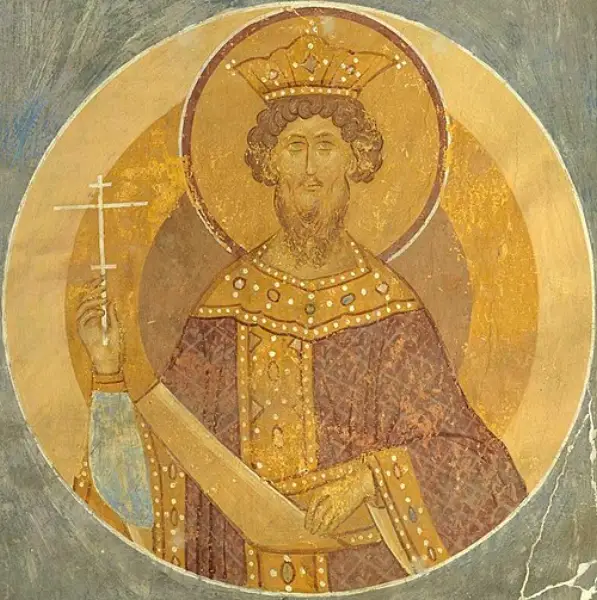
Overview
Michael of Chernigov, born Mikhail Vsevolodovich around 1185, was a prince of the Olgovichi dynasty whose career spanned nearly every throne of a fractured Kievan Rus': Prince of Pereyaslavl, Novgorod-Seversk, Chernigov, Novgorod, Halych, and finally Grand Prince of Kiev. Archaeology shows that the towns of his Chernigov principality enjoyed unprecedented prosperity under his rule, for he promoted trade, negotiated treaties with Poles and Hungarians, and eased the burdens of the Novgorodians. The Mongol catastrophe of 1237–1242 swept his world away: driven from Kiev, he fled to Hungary, returned, and finally applied to the Mongol khan for the yarlyk confirming his rule. At the Horde's capital of Saray in 1246, Batu Khan demanded that he pass between two fires and bow before the image of Genghis Khan. Michael answered that he would gladly honour the khan but could not, as a Christian, worship a dead man's image, and he chose death over apostasy. He was beaten and beheaded on 20 September 1246, together with his loyal boyar Theodore. Both were soon venerated as martyrs, canonized before 1271, and their relics lie today in Moscow's Cathedral of the Archangel.
The Complete Life
A Prince of the Olgovichi
Mikhail Vsevolodovich was born around 1185 into the Olgovichi, the dynasty that had ruled Chernigov for generations, and his inheritance was a world of competing principalities and shifting thrones. His father was Vsevolod the Red, grand prince of Kiev, and through his mother Anastasia he descended from the Piast dukes of Poland, a lineage that would matter in his later diplomacy. His public career began young: in 1206 he held the principality of Pereyaslavl, and from 1219 to 1226 he ruled Novgorod-Seversk. The decisive upheaval of his early reign came in 1223, when he fought in the Battle of Kalka against the Tatars — the first great collision between the princes of Rus and the armies of the steppe — and in that same year he became Prince of Chernigov, the seat of his dynasty. In 1210 or 1211 he had married Elena Romanovna, daughter of Roman Mstislavich of Halych, binding his house to the princes of the west. When Mstislav the Brave died in 1228, Michael pressed claims to the throne of Galicia-Volhynia through that connection, which brought him into protracted rivalry with Daniel and Vasylko — Roman the Great's sons — and their ally Vladimir Rurikovich.
§ Biography
Ruling for Prosperity
The record of Michael's rule is unusually tangible, because archaeology has confirmed what the chronicles suggest: the towns of Chernigov enjoyed a degree of prosperity under his government that the land had never known before. Trade was plainly his priority. Halych and Kiev, which he seized and held at different moments, mattered to him partly as trade corridors — the routes along which wares from the Rhine valley and Hungary travelled on their way to Chernigov — and whoever held them commanded the wealth of the middle Dnieper. He proved as much diplomat as warrior, concluding trade agreements and political compacts with Poland and Hungary, and turning his maternal Polish descent into living partnership. In Novgorod, where he ruled twice, his instinct was the opposite of coercion: he reduced the taxes the Novgorodians owed and gave their boyars wider political liberty from princely control, a rare concession in an age when princes treated cities as spoils. He moved through the principalities of Rus — Pereyaslavl, Novgorod-Seversk, Chernigov, Novgorod, Halych — and twice sat as Grand Prince of Kiev, a career that made him one of the last great rulers of a united Kievan world before the Mongols ended it.
§ Biography
Exile, Yarlyk, and the Road to Saray
The Mongol invasion of Kievan Rus' between 1237 and 1242 destroyed the political order Michael had spent his life navigating. Flight became unavoidable in 1239, and he found asylum in Hungary, at a western court his family alliances had made familiar. He returned to hold Kiev briefly, but the city of the grand princes had been broken, and the future of every Russian throne now lay with the Horde. Michael accepted the new reality so far as a Christian prince could: he petitioned the Mongol khan for a yarlyk — the charter confirming his hold on Chernigov beneath Mongol supremacy. What the application cost him was decided at Saray, near modern Astrakhan. The papal legate Giovanni da Pian del Carpine, travelling through the ruined lands in the late 1240s, recorded what happened: the Tartars required Michael to pass between two fires, according to ancient Turco-Mongol purification ritual, and then to bow southward before the image of Chingis Khan. Through his son Yaroslav they urged him again and again. He refused. On 20 September 1246, by Batu Khan's order, the prince was stabbed, trampled to death, and beheaded; his boyar Theodore, faithful to the end, died with him.
§ Carpine account
Martyr of Saray
The Church judged the prince's death without delay. Michael and his counsellor Theodore were honoured as holy martyrs — the Orthodox tradition styles them Hieromartyrs and Wonderworkers — and Michael's canonization at Rostov took place before 1271, within a single generation of the execution. The date of his passion, 20 September, became the feast on which both saints are kept, venerated by the Eastern Orthodox Church and the Roman Catholic Church alike. Their remains were buried in Chernigov's Transfiguration Cathedral, the great church of Michael's own dynasty, and there the pilgrimage began. Around 1580 Tsar Ivan the Terrible ordered the relics removed, and they were transported to Moscow's Cathedral of the Archangel, where they remain to the present day. The major shrine of the saints, however, is still counted as the Holy Trinity Cathedral of Chernihiv, the city whose name Michael carries and where his memory took root first. The choice he made at Saray — that a Christian may honour an earthly sovereign but may not worship a dead man's image — became the defining testimony of his cult, read as martyrdom rather than mere political misfortune from the earliest accounts onward.
§ Saints Michael and Theodore of Chernigov
The Vita and the Bloodline
Michael's death generated a literature. A hagiographic vita was composed after the Mongol census of Suzdalia and Novgorod in 1257–59, framing his execution as martyrdom, though its date and historical reliability remain debated; the Older Recension of the Novgorod First Chronicle, the Laurentian Codex, and the Hypatian Codex all mention his death briefly, while the Younger Recension, compiled around 1450, preserves the full narrative, adding that the bodies thrown to the dogs were left unmolested with pillars of fire hovering over them. The Nikon Chronicle of about 1550 enlarged the story further. In the early eighteenth century Demetrius Tuptalo wrote a new hagiography in the ornamented Baroque manner, presenting Michael not as a passive victim of persecution but as a conscious missionary of the Christian faith who gave his life for it deliberately, on the model of the Passion narratives and the saints Boris and Gleb. His blood proved as durable as his fame: the Upper Oka Principalities of the fourteenth and fifteenth centuries were ruled by princes descended from him, and in the later nineteenth century his line flourished across Russia in the Baryatinsky, Gorchakovy, Dolgorukie, Obolenskie, Odoevskie, Shcherbatovy, and other great families.
§ Vita of Michael of Chernigov
Timeline
- 1185
Born Mikhail Vsevolodovich, son of Prince Vsevolod the Red of the Olgovichi clan.
§ Biography
- 1206
Held his first recorded throne as Prince of Pereyaslavl.
§ Biography
- 1210
Married Elena Romanovna, daughter of Prince Roman Mstislavich of Halych.
§ Marriage and children
- 1219
Began his reign as Prince of Novgorod-Seversk, which lasted until 1226.
§ Biography
- 1223
Fought in the Battle of Kalka against the Tatars and became Prince of Chernigov.
§ Biography
- 1228
After the death of Mstislav the Brave, pressed claims to the throne of Galicia-Volhynia, entering conflict with Daniel and Vasylko.
§ Biography
- 1235
Took control of Halych, holding it as prince until 1236.
§ Biography
- 1236
Became Grand Prince of Kiev for the first time.
§ Biography
- 1239
Forced to flee the Mongol invasion of Kievan Rus', taking refuge in Hungary.
§ Biography
- 1241
Regained Kiev, ruling as Grand Prince until 1243.
§ Biography
- 20 Sep 1246
Executed at Saray on the orders of Batu Khan for refusing to bow to Genghis Khan's image, dying with his boyar Theodore.
§ Carpine account
- 1271
Canonized as a martyr at Rostov no later than this year, together with Theodore.
§ Saints Michael and Theodore of Chernigov
- 1580
Around this year Ivan the Terrible ordered the saints' relics moved from Chernigov to Moscow's Cathedral of the Archangel.
§ Biography
In Their Own Words
I would gladly bow to Bati and his servants but not to the image of a dead man because this is improper for a Christian.
Be strong because your punishment will not last long and then at once eternal joy will follow.
The Record
- Major works
- Commerce treaties and political alliances with Poland and Hungary
- Canonization
- Canonized as a martyr before 1271 at Rostov, together with his boyar Theodore
Prayer
Bibliography
Show 7 sources
- Dimnik, Martin, Mikhail, Prince of Chernigov and Grand Prince of Kiev, 1224–1246 (1981), Turnhout: Brepols Publishers, pp. 215, ISBN 978-0888440525
- Dimnik, Martin, The Dynasty of Chernigov, 1146–1246 (2003), Cambridge: Cambridge University Press, ISBN 978-0-521-03981-9
- Halperin, Charles J. (1987), Russia and the Golden Horde: The Mongol Impact on Medieval Russian History, Indiana University, p. 222, ISBN 9781850430575
- Martin, Janet (2007), Medieval Russia: 980–1584, Second Edition, Cambridge: Cambridge University Press, ISBN 978-0-511-36800-4
- Vernadsky, George, Kievan Russia, New Haven and London: Yale University Press, 1948, ISBN 0-300-01647-6
- Giovanni da Pian del Carpine, Ystoria Mongalorum (1240s); modern edition: The Story of the Mongols whom We Call the Tartars, trans. Erik Hildinger, Boston: Branden Publishing Company, 1996, ISBN 0-8283-2017-9
- Енциклопедія українознавства. Словникова частина (ЕУ-II), Vol. 4, 1994, p. 1561
Profile text adapted from the Wikipedia article, licensed CC BY-SA 4.0.
Pray with this saint every day
Save St. Michael of Chernigov to your favorites, read the full profile, and get feast-day reminders in the Saints app.
Get the Saints AppFree on the App Store for iPhone and iPad