
died 1456·Feast January 11
St. Michael of Klopsk
Fool for Christ of Novgorod's Klopsky Monastery
Overview
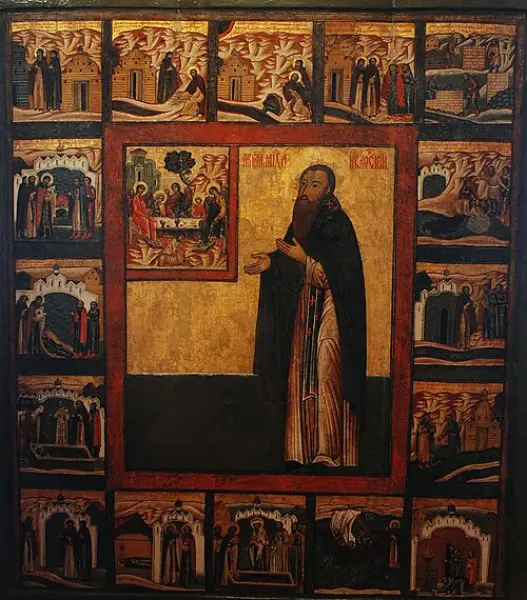
Michael of Klopsk lived as a monk of the Russian Orthodox Church and a fool for Christ; his concealed life at the Klopsky Monastery of the Holy Trinity, near Novgorod on the river Veryazha, made him one of medieval Russia's most beloved saints. Born into the highest aristocracy of Muscovy — according to the archaeologist Valentin Yanin he was a son or a grandson of Dmitry Mikhailovich Volyn-Bobrok, who fought as a champion at Kulikovo, and of Anna Ivanovna, herself a daughter of Grand Prince Ivan II of Moscow — he abandoned his identity entirely. During the era of the Muscovite–Lithuanian Wars a mysterious ascetic appeared at the Monastery of the Holy Trinity, nameless even to the brethren who received him. Only in 1413, when Prince Konstantin Dmitrievich visited the monastery with his wife, was the stranger recognised as 'our Mikhail' of the princely house. The vita tells of robbers converted by his presence, one of whom entered the cloister as the monk Dorofey, of a fountain that never ran dry, of forecasts of the weather, and of many deeds of clairvoyance and prophecy. He died in 1456, was canonized in 1547, and his relics are venerated at the Klopsky Monastery; the Church keeps his memory on 11 January.
The Complete Life
Born to the Blood of Princes
Behind the ragged figure whom Novgorod venerated lay one of the noblest pedigrees in Rus. The historian and archaeologist Valentin Yanin identified the saint as the son or grandson of Dmitry Mikhailovich Volyn-Bobrok — 'Little Beaver' — the volyn boyar and voivode who won renown as a champion at the battle of Kulikovo, the celebrated victory of 1380 over the Mongols. By his marriage, Bobrok belonged to the dynasty itself, for his wife Anna Ivanovna was the daughter of Grand Prince Ivan II of Moscow and sister of Dmitry Donskoy, the prince who led Rus at Kulikovo. If Yanin's identification holds, Michael of Klopsk grew up in the innermost circle of the house of Moscow, cousin to its grand princes and heir to the memory of its greatest battle. Nothing else of his childhood or youth has survived — which is precisely what he intended. The man who appeared at a Novgorod monastery in the early fifteenth century brought no name, no titles, and no history with him; he carried instead the voluntary poverty and apparent madness of the holy fool, exchanging a lineage of heroes and princes for the anonymity in which he would spend the rest of his life.
§ Biography
The Nameless Stranger at the Holy Trinity
Michael's vocation announced itself as an arrival without explanation. In the years of the Muscovite–Lithuanian Wars, when Novgorod's world was being pulled between great powers, a mysterious fool-for-Christ's-sake appeared at the Monastery of the Holy Trinity on the river Veryazha. The brethren accepted him, and he lived among them — but to his fellow monks he remained nameless. This was the substance of his asceticism: he had not merely embraced poverty, he had erased himself, refusing the identity that the world counts most precious. The secret held until 1413, when Prince Konstantin Dmitrievich — son of Dmitry Donskoy and therefore of the saint's own kin — visited the monastery together with his wife. The prince recognised the nameless ascetic at once as 'our Mikhail', one of their own house, and the revelation fixed the one firm date in the saint's hidden biography. Michael, it appears, did not return to the world his family offered him. He remained at Klopsk in the disguise of holy folly, and the monastery that had taken in a stranger found itself sheltering a prince of the blood who wanted only to be a fool for Christ.
§ Biography
Prophecy, Fountains, and Converted Robbers
The hagiography written after Michael's death, folklorish as it is, preserves the shape of the sanctity Novgorod saw in him. It is the spirituality of the yurodivy — the fool for Christ — in which prophetic power is joined to self-abasement, and miracle to moral confrontation. Among the wonders attributed to him is the conversion of a band of robbers, one of whom was so transformed that he joined the monastery himself as the monk Dorofey: the saint's presence turned predators into penitents. Another tradition tells of the discovery of an inexhaustible fountain, water given where none had been, an emblem of the grace that flowed through a man who claimed nothing for himself. He predicted the weather, and the vita fills out his portrait with various other acts of clairvoyance and prophecy — knowledge of things hidden, spoken with the directness that holy folly permitted. Underneath the marvels stands the discipline of a monk of the Holy Trinity: a life hidden with Christ in God, stripped of name, rank, and comfort. For the monks who recorded him, the miracles were not the point but the evidence — the outward signs that the nameless stranger was truly what the prince had said, one of their own sanctified.
§ Biography
Canon of 1547
Michael died in 1456 at the monastery where he had spent his hidden decades, and the brethren who buried him knew they had buried a saint. The formal recognition of the Russian Orthodox Church followed a century later: in 1547 — the great year of Metropolitan Macarius's canonizations, when the Russian Church enrolled a host of its medieval saints at the councils of that era — Michael of Klopsk was canonized. His feast was fixed on 11 January, the day on which the Eastern Orthodox Church still commemorates him. The literary side of his canon was prepared by the hagiography composed in 1478–1479, within a generation of his death, subsequently revised in the 1490s and once more in 1537 as devotion spread; whatever its folklore, it stands as the earliest literary witness to his activity in the monastery. His body, honoured as relics, is venerated at the Klopsky Monastery itself, the community of the Holy Trinity that had once received a nameless stranger and discovered too late that it had housed a prince — and all along, a saint.
§ Biography
Memory at Novgorod and Beyond
Michael's legacy lives wherever the Russian tradition remembers the holy fools — the ascetics who bore public ridicule as a species of martyrdom and used the freedom of folly to speak truth to the powerful. The Klopsky Monastery of the Holy Trinity, the scene of his hidden life on the river Veryazha near Novgorod, kept his relics as the centre of his cultus, and the Orthodox Church keeps his memory every 11 January. His story has also attracted the attention of modern scholarship: Valentin Yanin's investigation into the saint's origins, published in the annual of archaeographic studies for 1978, argued from the sources for his descent from the Volyn-Bobrok line and thereby restored to the nameless fool a family, a history, and a place among the kin of the princes of Moscow. The hagiographic tradition that grew from the vita of 1478–1479 carried his miracles — the robbers converted, the fountain without end, the prophecies fulfilled — into the literary memory of Russia, redacted across three centuries. Nine centuries after Kulikovo and more than five after his death, the fool of Klopsk remains a patron of the anonymous, the poor in spirit, and all who trade the world's regard for the Kingdom.
§ Biography
Timeline
- 1413
Recognised at the monastery by Prince Konstantin Dmitrievich, visiting with his wife, as 'our Mikhail' of the princely family.
§ Biography
- 1456
Died at the Klopsky Monastery of the Holy Trinity near Novgorod.
§ Biography
- 1478
A hagiography of the saint was written, later redacted again in the 1490s and in 1537.
§ Biography
- 1537
His vita received a further redaction, preserving the literary memory of his life.
§ Biography
- 1547
Canonized by the Russian Orthodox Church, a century after his death.
§ Biography
The Record
- Major works
- Klopsky Monastery of the Holy Trinity (associated ascetic and wonderworker)
- Canonization
- Canonized by the Russian Orthodox Church in 1547
Prayer
Bibliography
Show 5 sources
- Yanin, V. L., "K voprosu o proiskhozhdenii Mikhaila Klopskogo", Arkheografichesky ezhegodnik za 1978 g., Moscow: Nauka, 1979, pp. 52-61 (in Russian)
- "Saint Michael of Klopsk, the Fool for Christ", retrieved 2024-09-20
- "Свято-Троицкий Михайло-Клопский мужской монастырь", Klopsky.ru, retrieved 2015-03-02
- "Venerable Michael the Fool-for-Christ of the Klops Monastery, Novgorod", Orthodox Church in America, retrieved 2015-03-02
- "Ivan II | biography - Russian prince", Encyclopædia Britannica, retrieved 2015-03-02
Profile text adapted from the Wikipedia article, licensed CC BY-SA 4.0.
Pray with this saint every day
Save St. Michael of Klopsk to your favorites, read the full profile, and get feast-day reminders in the Saints app.
Get the Saints AppFree on the App Store for iPhone and iPad