
1300 – 1356·Feast June 20
St. Michelina of Pesaro
Franciscan tertiary and foundress of the Annunciation
Overview
Michelina Metelli, known as Michelina of Pesaro, was an Italian Franciscan tertiary whose path ran from noble luxury to radical poverty. Born in 1300 at Farneto in the Papal States to a wealthy family, she was married at twelve into the noble Malatesta house and widowed before she was twenty. For a season she lived for parties and luxury, until the death of her only son shattered that world: she saw him in a vision of heaven, and the vision turned her life toward God. She joined the Third Order of Saint Francis, gave away all her belongings and property, and with Francis Zanferdini founded the Confraternity of the Annunciation, a brotherhood devoted to caring for the poor, nursing the sick, and burying the dead. Her family, judging such renunciation madness, had her locked up; once freed, she undertook a penitential pilgrimage to the Holy Land in satisfaction for her sins; tradition holds that she received the stigmata along the way. She returned to Pesaro, where she died at her home on 19 June 1356. Pope Clement XII beatified her on 13 April 1737, and her feast is kept on 20 June.
The Complete Life
A Bride of the Malatesta
Michelina Metelli was born in 1300 at Farneto, in the hills above Perugia, into a family of wealth and standing in the Papal States. Her childhood was cut short by the custom of her class: at the age of twelve she was married into the Malatesta family, the great noble house whose name dominated the cities of the Marches and Romagna, and so she passed from one rich household into another. Her youth followed the pattern of an aristocratic lady of the fourteenth century — the article of her life records a round of parties and luxury, a world of display in which faith was inherited rather than lived. Fate then stripped the glittering arrangement quickly. By the age of twenty she was a widow, left with her young son and the full weight of the Malatesta estates and expectations. For a time she continued as the world expected a young noblewoman to continue, rich and sociable and unreflective. Nothing yet in her biography suggested that this fashionable widow would one day be venerated at the altars of the Church; the change, when it came, came not through argument but through grief, and through a vision in which her dead child showed her where true riches lie.
§ Biography
The Vision of Her Son
The turning point of Michelina's life was the death of her only son. Whatever arrangements wealth could make for mourning were made, but the mother's sorrow could not be consoled by them — until, as she believed, heaven itself intervened. She experienced a vision of her son in heaven, alive in the presence of God, and the sight remade her understanding of everything she possessed. If her child was there, then the world she had lived for was not the final country, and its treasures were not the true ones. In the wake of that vision she sought the form of life that best embodied evangelical poverty and penance, and found it in the Third Order of Saint Francis, the great fraternity of lay men and women who lived the Gospel in the world under the Franciscan rule. The transformation was total and immediate. She began to give away her belongings and her property, distributing to the poor what she had worn and hoarded for herself, until a noblewoman of the Malatesta house stood effectively dispossessed by her own choice — a scandal to her relatives, who would soon conclude that no sane woman renounced so much so fast.
§ Biography
The Confraternity of the Annunciation
Michelina's conversion produced not a hermit but a work of organized charity. Together with Francis Zanferdini she founded the Confraternity of the Annunciation at Pesaro, a brotherhood with a threefold charge: to care for the poor, to nurse the sick, and to bury the dead. The triple mission was the mercy of the Gospel rendered institutional — food and aid for those who had nothing, tenderness for those whom illness had isolated, and a dignified burial for those who would otherwise have gone to the grave alone. In the Italy of the fourteenth century, battered by plague and famine, such confraternities became the sinews of civic charity, and Michelina's foundation put a noblewoman's fortune and energy behind the neediest of her city. Her family responded with the era's severest diagnosis: convinced that she had lost her mind, they had her locked up. Confinement could not unmake what the vision had made. Upon her release she resumed her penitential course, and the work endured. The gesture of her life — a rich widow made poor for the sake of the poor — remained visible in Pesaro in the continuing service of the Confraternity she had left behind.
§ Biography
Pilgrimage, Stigmata, and a Quiet Death
Freed from confinement, Michelina turned her penance outward upon the longest road a penitent of her age could walk. She made a pilgrimage to the Holy Land, traversing the sea and the eastern Mediterranean in the cause of visiting the places of Christ's passion — and framing the journey expressly as satisfaction for her sins. Devotion remembered more: it is believed that in the course of this pilgrimage she received the stigmata, the marks of Christ's wounds impressed upon her own body, joining her to the Franciscan tradition of Francis of Assisi himself. Whether witnessed by crowds or hidden in her flesh, the grace marked her as one whose penance had passed into union. She came home to Pesaro and lived out her final years in the Franciscan tertiary's habit of humility, still bound to the poor she served. On 19 June 1356 she died at her own home, of natural causes, at about fifty-six years of age — the quiet end of a life that had been three lives in one: the noble child, the gay widow, and the penitent mother of mercy. The city that had thought her mad now began to call her blessed.
§ Biography
Raised to the Altars
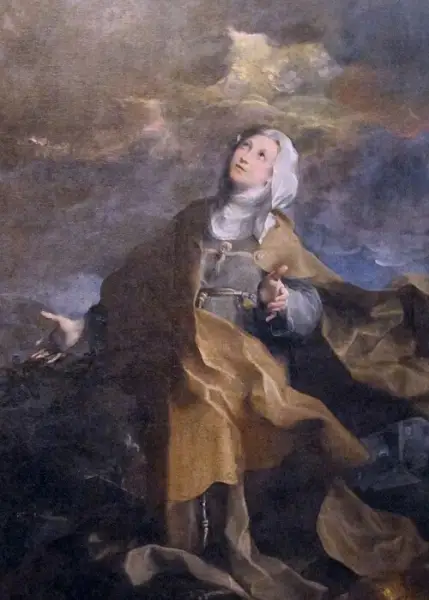
Michelina's cultus endured in Pesaro for nearly four centuries before the Holy See gave it formal recognition. On 13 April 1737, in Rome, Pope Clement XII beatified her, approving the public veneration that the Franciscan order and the people of the Marches had maintained since her death. Her feast was assigned to 20 June, the day after the anniversary of her death, and artists took up her story — most memorably Federico Barocci, whose painting of the blessed Michelina carried her serene, penitent face into the visual tradition of the Counter-Reformation. She remains a beata rather than a canonized saint, her cause resting at the dignity to which Clement XII raised it, but the substance of her witness required no further process: a woman of wealth who chose poverty, a grieving mother who converted grief into charity, a penitent whose pilgrimage left upon her the marks of the Crucified. In her own city and in the Franciscan family of the Third Order she is remembered each June as an intercessor for the poor, the sick, and the dead — the very works her Confraternity of the Annunciation was founded to perform.
§ Beatification
Timeline
- 1300
Born Michelina Metelli at Farneto in the Papal States to a wealthy family.
§ Biography
- 1312
Given in marriage at twelve to the noble house of Malatesta.
§ Biography
- 1320
Widowed by the age of twenty.
§ Biography
- 19 Jun 1356
Died at her home in Pesaro of natural causes.
§ Biography
- 13 Apr 1737
Beatified in Rome by Pope Clement XII.
§ Beatification
The Record
- Major works
- Confraternity of the Annunciation, co-founded with Francis Zanferdini
- Canonization
- Beatified by Pope Clement XII on 13 April 1737 in Rome
Prayer
Bibliography
Show 2 sources
- "Blessed Michelina (Metelli Malatesta) of Pesaro"
- "Blessed Michelina of Pesaro"
Profile text adapted from the Wikipedia article, licensed CC BY-SA 4.0.
Pray with this saint every day
Save St. Michelina of Pesaro to your favorites, read the full profile, and get feast-day reminders in the Saints app.
Get the Saints AppFree on the App Store for iPhone and iPad