
1271 – 1318·Feast 22 November
St. Mikhail of Tver
Grand Prince of Vladimir and martyred prince of Tver
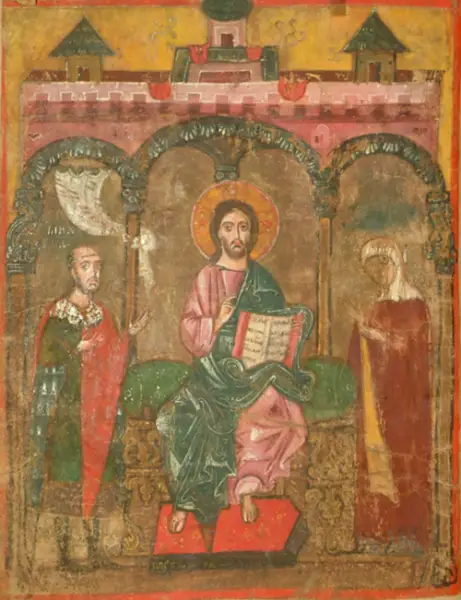
Overview
Mikhail Yaroslavich was born in 1271 into the Rurikid dynasty, the second son of Yaroslav III of Tver, whose brother was Aleksandr Nevsky. On his elder brother's death in 1285 he took the throne of Tver, and when Andrei Aleksandrovich died in 1304 he claimed the grand principality of Vladimir in keeping with the traditional order of succession, receiving confirmation from Khan Tokhta of the Golden Horde. His tenure was troubled from the start: he quarreled with Novgorod, whose grain shipments he cut off in 1312, he lost influence at the Horde to Yury of Moscow, and he earned the lasting opposition of Metropolitan Petr, who sided with the Muscovite princes. After defeating Yury at Bortenevo in December 1317, he was blamed for the death of the khan's sister, who had been taken captive and died in his custody. Summoned to the Horde knowing that death awaited him, he obeyed and was executed at Sarai on 22 November 1318. The Russian Orthodox Church later enrolled him among its saints, moved by the piety of his final journey and by the incorrupt condition of his remains when they were carried back to Tver.
The Complete Life
A Prince of the Rurikid House
Mikhail Yaroslavich was born in 1271, a son of the Rurikid dynasty that ruled the Russian lands in the generations after the Mongol conquest. His father, Yaroslav III Yaroslavich, held the throne of Tver and had also sat as Grand Prince of Vladimir; through him the boy descended from Aleksandr Nevsky, whose kin dominated the politics of north-eastern Rus. His mother, Xenia of Tarusa, was Yaroslav's second spouse, and she too would come to be honored by the Church as a saint. As the second son, Mikhail could not expect the Tver throne at once, but the death of his elder brother Yaroslav in 1285 left the principality to him while he was still young. He grew to manhood in a world where Russian princes governed only at the pleasure of the khans of the Golden Horde, traveling to Sarai for their patents of office and competing for a favor that could shift without warning. That formative discipline, reverence toward the Horde joined to loyalty toward his own land, shaped his whole public career and prepared the long struggle with Moscow that would end his life.
§ Family and children
Heir to the Grand Principality
When Andrei Aleksandrovich, son of Aleksandr Nevsky, died in 1304, the succession pointed to Mikhail, and he accordingly took up the grand principality of Vladimir. The claim rested on the traditional order by which the throne passed among the Rurikid princes, and it was sealed from Sarai: Khan Tokhta confirmed him in office, granting the new grand prince the legitimacy that Mongol patronage alone could confer. For a decade he stood at the summit of the Russian princes, holding Tver, his since 1285, together with the senior title of Vladimir. Yet the honor carried heavy burdens. The grand prince answered for tribute owed to the Horde, kept order among jealous kinsmen, and was expected to hold some authority over Novgorod the Great, a city fiercely protective of its independence. In 1309 Mikhail was accepted as Prince of Novgorod the Great, as many of his predecessors had been, but the partnership quickly soured. Within a few years the city defied him, the khan's favor drifted toward Moscow, and the office he had inherited began to slip from his family's grasp for good.
§ Reign
Governing Between Novgorod and the Horde
Mikhail's public work unfolded chiefly in his dealings with Novgorod and the Golden Horde. Accepted as the city's prince in 1309, he soon quarreled with it so sharply that in 1312 he withdrew his lieutenants and cut off the grain shipments on which it depended, a conflict in which Archbishop David, appointed by Metropolitan Petr, played a part through the arguments he pressed. His standing with the Horde at first remained strong. When Uzbeg Khan took the throne in 1313, Mikhail traveled to pay homage and stayed at Sarai until 1315. That long absence gave Yury of Moscow his opening, for the Muscovite prince gathered supporters in Novgorod throughout the grand prince's long stay at the Horde. Mikhail brought the city back under his rule in 1316 with Mongol help, yet the advantage did not hold. The following year Uzbeg transferred the yarlik, the patent of the grand principality, to Yury, who confirmed the alliance by marrying the khan's sister. As early as 1314 the Novgorodians had demanded that Yury replace Mikhail in the grand principality, and churchmen sympathetic to Moscow lent that demand their weight at every turn.
§ Reign
Piety Tested by the Church Itself
Some of Mikhail's bitterest wounds came not on the battlefield but in his dealings with the Church. When Metropolitan Maksim died in 1305, Mikhail put forward his own candidate for the see, but the Patriarch of Constantinople consecrated Petr instead. Petr aligned himself with Moscow and opposed the prince of Tver on several occasions; his appointment of David to the Novgorod cathedra fed the quarrel that ended in the withdrawal of Mikhail's lieutenants, and in 1314 the alignment of churchmen with Yury of Moscow lent weight to the demand for his deposition. For much of his life, then, the leading hierarch of the Russian Church stood against him. Later generations judged him differently. What they remembered was the manner of his end: when the khan summoned him to the Horde, Mikhail understood that he was going to certain death, and he went anyway, submitting to the outcome with prayerful steadiness rather than fleeing or taking up arms against his overlord. The Church pointed also to his relics, found incorrupt when they were carried back to his own city. On these grounds the Russian Orthodox Church enrolled him among its saints, honoring a prince slighted in life and glorified after death.
§ Relations with the Church
Bortenevo and the Road to Sarai
The end came quickly after the reversals of 1317. Holding the grand princely patent and married to the khan's sister, Yury of Moscow marched against Tver supported by a Mongol army under the general Kavgadii. On 22 December 1317 Mikhail met him near the village of Bortenevo, some forty kilometres from Tver, and won a decisive victory, taking Yury's wife, the khan's own sister, captive. The triumph proved fatal. The captive princess died in Mikhail's custody, and though he could hardly have hoped to profit from such a deed, the blame settled on him all the same. Kavgadii he set free; back at Sarai the general denounced him to the khan for murdering the princess, for withholding tribute, and for making war on his Mongol overlord. Uzbeg summoned Mikhail to the Horde to answer the charges. Knowing what the summons meant, he set out regardless, leaving Tver for the last time. At Sarai, on 22 November 1318, the grand prince was put to death. His remains were afterwards brought home to Tver, where those who received them found them incorrupt, a sign that fixed his memory among the holy.
§ Reign
Glorified by the Church He Had Served
Mikhail's rise to the altar came not through any formal process in his lifetime but through the judgment of the Russian Orthodox Church after his death. Two considerations carried decisive weight. The first was his conduct at the end: summoned by the khan to the Horde in circumstances that promised certain death, he obeyed without flight or resistance, and his pious bearing before that journey gave his end the character of a martyr's witness, the prince who accepted destruction rather than betray his trust. The second was the testimony of his remains. When his relics were transported to his hometown, they were discovered to be incorrupt, and in the tradition of Russian sanctity such preservation was read as a divine seal upon the man's holiness. The favor his contemporaries had withheld, the goodwill of hierarchs and the blessing of the Church, was granted in full to his memory, and he took his place among the princes of Rus venerated as saints. His wife's later glorification would confirm the family's standing in the calendar, and the Tver church kept his feast with the confidence of a city that had given Russia both a ruler and a martyr.
§ Relations with the Church
A House Tested and a Family of Saints
Mikhail's descendants carried his line forward, though not to the triumph he had sought. His sons Dmitry and Alexander both enjoyed favor at the Horde, Alexander's own son Mikhail likewise, and for a time the family recovered the grand princely office, Alexander holding it in 1326 and 1327 and his son Mikhail more than forty years later. But the house never regained what was lost when its founder failed to defeat Yury of Moscow, and Alexander's part, whether real or only perceived, in the Tver uprising of 1327 finished the contest: the khans withdrew their favor from the Tver branch, and the Muscovite princes held the grand principality for all but two years after 1317. His wife Anna outlived him by half a century. Taking the veil at the nunnery of Kashin, she died there on 2 October 1368 and was herself canonized in 1677, commemorated by the Church as Anna of Kashin. Husband and wife thus stand together among the saints of Rus, the prince who died at Sarai and the princess who ended her days in prayer, keeping alive the memory of a house that once contended for the leadership of all the Russian lands.
§ Family and children
Timeline
- 1271
Born into the Rurikid house, second son of Yaroslav III of Tver and Xenia of Tarusa.
§ Family and children
- 1285
Succeeded his elder brother Yaroslav as Prince of Tver.
§ Reign
- 1294
Married Princess Anna of Rostov, daughter of Dimitry of Rostov.
§ Family and children
- 1304
Became Grand Prince of Vladimir on the death of Andrei Aleksandrovich and was confirmed in office by Khan Tokhta.
§ Reign
- 1305
Nominated his own candidate for metropolitan after Maksim's death, but Petr was consecrated by the Patriarch of Constantinople.
§ Relations with the Church
- 1309
Accepted as Prince of Novgorod the Great.
§ Reign
- 1312
Pulled his lieutenants out of Novgorod and blocked grain from reaching the city.
§ Reign
- 1313
Paid homage to Uzbeg Khan on his accession and remained at Sarai until 1315.
§ Reign
- 1314
Novgorod called on Yury of Moscow to be named grand prince and demanded Mikhail's deposition.
§ Relations with the Church
- 1316
Regained control of Novgorod with Mongol aid.
§ Reign
- 1317
Uzbeg Khan granted the yarlik of Grand Prince of Vladimir to Yury, who also married the khan's sister.
§ Reign
- 22 Dec 1317
Defeated Yury of Moscow at Bortenevo near Tver and captured the khan's sister.
§ Reign
- 22 Nov 1318
Executed at Sarai after being summoned to the Horde to answer Kavgadii's accusations.
§ Reign
The Record
- Canonization
- Canonized by the Russian Orthodox Church; date not recorded
Prayer
Bibliography
Show 4 sources
- Janet Martin, Medieval Russia 980-1584 (Cambridge: Cambridge University Press, 1995).
- Michael C. Paul, "Was the Prince of Novgorod a 'Third-Rate Bureaucrat' after 1136?" Jahrbücher für Geschichte Osteuropas 56, No. 1 (Spring 2008): 72-113.
- John Fennell, "Princely Executions in the Horde 1308-1339," Forschungen zur Osteuropäischen Geschichte 38 (1988), 9-19.
- "Святой благоверный великий князь Михаил Ярославич, Тверской чудотворец", Православный Церковный календарь, Pravoslavie.Ru, retrieved 12 June 2017.
Profile text adapted from the Wikipedia article, licensed CC BY-SA 4.0.
Pray with this saint every day
Save St. Mikhail of Tver to your favorites, read the full profile, and get feast-day reminders in the Saints app.
Get the Saints AppFree on the App Store for iPhone and iPad