
died 23 February 727·Feast February 23
St. Mildburh
Benedictine abbess of Wenlock and wonder-worker of Shropshire
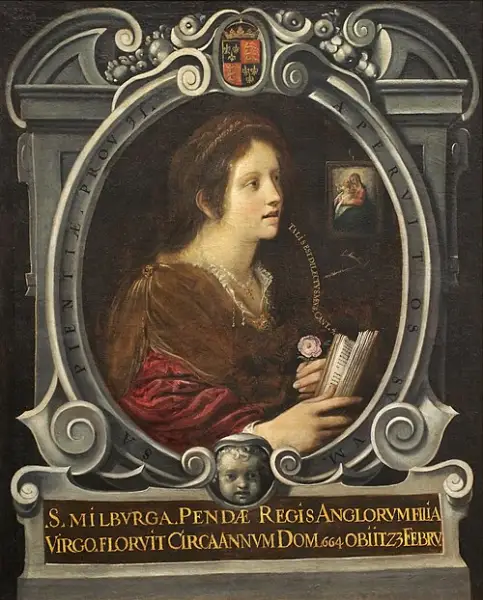
Overview
Mildburh, also called Milburga or Milburgh, was a Benedictine abbess of Wenlock Priory in Shropshire who died on 23 February 727. Her father was Merewalh, who ruled the Mercian sub-kingdom of the Magonsaete, and her mother was Domne Eafe; together they belonged to a kindred celebrated for its holiness; her sisters were Mildrith and Mildgytha, and later writers likened the three to faith, hope, and charity. Educated in France, she entered the Benedictine monastery at Wenlock, a nunnery endowed by her father and her uncle Wulfhere of Mercia and first directed by the French abbess Liobinde of Chelles. Mildburh succeeded Liobinde and was installed as abbess by Theodore. Known for humility, she was credited with opening the eyes of the blind, with spreading the faith and organizing pastoral care across south Shropshire, and with a strange authority over birds, which left the standing crops untouched at her word; tales were also told of a spring raised at her prayer and of barley that grew beyond nature. Her tomb was venerated until Danes destroyed the abbey. In 1101 Cluniac monks identified her relics and made Wenlock a pilgrimage destination, and her feast on 23 February is now kept as Shropshire Day.
The Complete Life
A Daughter of Mercia and Kent
Mildburh belonged to the royal world of the late seventh century. Her father, Merewalh, ruled the sub-kingdom of the Magonsaete in the Mercian border country, and her mother was Domne Eafe, herself remembered among the holy women of Kent. With her two sisters, Mildrith and Mildgytha, she formed a family whose sanctity became proverbial; later writers likened the three sisters to the theological virtues, giving Milburh the place of faith, Mildgytha that of hope, and Mildrith that of charity. The comparison shows how deeply the cults of the holy kindred took root on both sides of the Mercian border, binding the memory of one family to the devotion of two kingdoms. Little else is recorded of her childhood, for the stories that gathered around her concern her years as a nun, and they open with a contest. A neighboring prince wanted her for his wife and was determined to take her, even if force were needed. Her escape became the first of her wonders: in the telling, the river that barred her pursuer's way rose so suddenly that he could not ford it, and the young woman passed beyond his reach into the religious life.
§ Life
The Cloister at Wenlock
Mildburh's path led to the Benedictine monastery at Wenlock in Shropshire, the house now remembered as Much Wenlock. Its foundation owed much to her own kindred: her father and her uncle Wulfhere of Mercia endowed the nunnery, and it was placed under the direction of a French abbess, Liobinde of Chelles. Mildburh herself was educated in France, in the tradition of the Frankish religious houses from which the English Church drew so much of its monastic discipline, and in due time she succeeded Liobinde as head of the community, installed in the office of abbess by Theodore. The choice of a royal daughter for the government of a royally endowed house suggests the esteem her character had already won, and under her leadership Wenlock stood among the principal religious communities of Mercia. She remained abbess for the rest of her life, holding the monastery through the generations in which Christianity matured in the border country, and tying the nunnery to the network of Frankish and English houses from which her own formation had come. The cloister, not the court, became the field of her achievement, and she governed it with the same quiet authority the stories attribute to her wonders.
§ Life
Healing and the Care of South Shropshire
Popular memory gave Mildburh a ministry of healing and of care for the countryside around her abbey. Stories credited her with the gift of healing and with restoring sight to the blind, and she was remembered for spreading the faith through south Shropshire and arranging for the care of its souls, extending the work of the Church through the villages and settlements of the border country where her father had ruled. Her wonders belonged to the everyday world of an agricultural people. The birds, it was said, obeyed her request and left the standing crops alone; to her were likewise credited a newly made spring and barley that sprang up beyond nature, water and bread, as it were, for a farming people. In one story she slept past dawn and awoke with the sunlight already upon her; her veil slipped, but rather than dropping to the floor it hung in mid-air on a beam of light until she reached out and took it back. However quaint such stories now sound, they mark a saint remembered as a protector of fields, flocks, and the ordinary needs of the poor, a worker of small mercies rather than public spectacles.
§ Life
Humility and the Guarding of the Fields
The virtue most consistently attributed to Mildburh is humility. The stories rarely present her as a wonder-worker by ambition; the miracles happen around her while she appears in modest, almost domestic postures, waking late, gathering a veil that rests on a sunbeam, asking the birds to spare the harvest. Later writers found in her cult an older stratum of devotion: the scholar Pamela Berger has suggested that in Shropshire it was this saint who stepped into the part of grain guardian once the old pagan protectress was no longer honored. If that reading is right, the community transferred to a Christian abbess the duties of a guardian of the growing fields, and her gentleness toward the crops and the birds became her defining mark. Her compassion extended likewise to the sick, in the healings ascribed to her, and to the blind, whose sight she was said to restore. Faith, in the likeness assigned to her among the three sisters, meant this settled confidence that God governs the small things, weather and grain and birds, as surely as he governs the fates of kingdoms, and that a soul surrendered to him becomes an instrument of his care for the world.
§ Life
Death and a Silent Shrine
Mildburh died at Wenlock on 23 February 727, after a long tenure as abbess, and was buried there. The date passed into her feast day, kept on 23 February by the churches that honor her memory, Roman Catholic, Orthodox, and Anglican alike, and the same day is now observed more widely as Shropshire Day, a county celebration that still carries her name. Her tomb was long venerated at Wenlock until invading Danes destroyed the abbey, and for a time the cult fell quiet with the ruin of its shrine. The place of her burial, however, was not forgotten by the people among whom she had lived. When monks returned to Wenlock after the Norman Conquest and built a new monastery on the site, whose ruins still stand at Much Wenlock, the memory of the holy abbess was waiting for them, and the discovery of her bones became the occasion of a renewed flowering of her veneration. She had lived and died in a quiet corner of Mercia, yet the stories of the abbess who commanded birds and guarded the barley outlived the destruction of her monastery by more than three centuries.
§ Life
Rediscovery and the Written Lives
Mildburh's afterlife in English religion began anew in 1101, when Cluniac monks who had come from France to Wenlock discovered what they believed to be her bones and set about establishing the relics as a pilgrimage destination for lepers. The project was unpopular with many of the local English, but it successfully attracted pilgrims from France and Wales and set off a flurry of new writing about her life and miracles. The document known as the Miracula Inventionis Beatae Mylburge Virginis came from this period, and perhaps shortly after it Goscelin, the celebrated hagiographer, produced his Vita Mildburga, folding into it an earlier text, 'Mildburh's Testimony', presented as the abbess telling her own story. Her name likewise appears in the genealogies of the Kentish Royal Legend, material that draws on Anglo-Saxon sources though no surviving manuscript copies predate the eleventh century, and in the Secgan, the eleventh-century Old English list of the resting-places of the saints, where she stands among eighty-nine named holy men and women with their locations. Few Anglo-Saxon religious women can claim so continuous a record, from royal daughter and abbess to the subject of Latin lives within a generation of the Norman settlement.
§ Norman discovery
Timeline
- 23 Feb 727
Died at Wenlock; the date passed into her feast day, kept on 23 February.
§ Life
- 1101
Cluniac monks uncovered bones held to be hers and set out to make her relics a place of healing pilgrimage for lepers.
§ Norman discovery
The Record
- Patron of
- birds
- Canonization
- Pre-congregation; venerated from antiquity by the Church in England
Prayer
Bibliography
Show 7 sources
- O.S.B., "Saint Mildred and her Kinsfolk", Virgin Saints of the Benedictine Order, Catholic Truth Society, London, 1903.
- "St. Milburga", Diocese of Shrewsbury.
- Burne, Charlotte Sophia (1973). Shropshire folk-lore, a sheaf of gleanings. Wakefield. ISBN 9780854098507.
- "Shropshire Day celebrates saint, tourism and beer". BBC News. BBC. 23 February 2024.
- Berger, Pamela (1985). The Goddess Obscured: Transformation of the Grain Protectress from Goddess to Saint. Boston: Beacon Press. ISBN 9780807067239.
- Yarrow, Simon (2013). "The Invention of St Mildburg of Wenlock: Community and Cult in an Anglo-Norman Shropshire Town". Midland History. 38 (1, Spring): 1-15. doi:10.1179/0047729X13Z.00000000014.
- Liebermann, Felix (1889). Die Heiligen Englands: Angelsächsisch und Lateinisch. Hanover.
Profile text adapted from the Wikipedia article, licensed CC BY-SA 4.0.
Pray with this saint every day
Save St. Mildburh to your favorites, read the full profile, and get feast-day reminders in the Saints app.
Get the Saints AppFree on the App Store for iPhone and iPad