
c. 660 – after 732·Feast July 13
St. Mildrith
Abbess of Minster-in-Thanet and beloved patron of Kent
Overview
Mildrith, also called Mildred, was an Anglo-Saxon abbess of the abbey at Minster-in-Thanet in Kent, born around 660 and died some time after 732. She was the daughter of King Merewalh of Magonsaete, a sub-kingdom of Mercia comparable to present-day Herefordshire, and of Domne Eafe, a great-granddaughter of Æthelberht of Kent who appears in the Kentish Royal Legend. Her sisters Milburga of Much Wenlock and Mildgyth were likewise honored as saints. Tradition gives her schooling to the royal Merovingian abbey of Chelles; from there she came to the monastery her mother had founded at Minster-in-Thanet and governed it as abbess by 694. Dedications to her survive in the Pas-de-Calais, testimony to lasting ties with Gaul. She died at Minster-in-Thanet and was buried in the abbey church of St Mary. Her shrine drew pilgrims from all the country round, and after her death she was declared a saint, Pope Urban VI inscribing her name among the canonized in 1388. In 1030, despite fierce local opposition, her remains were translated to St Augustine's Abbey in Canterbury, and her cult endures in Kent to this day.
The Complete Life
A Royal Kindred of Kent and Mercia
Mildrith was born around 660 into the intertwined royal houses of Kent and Mercia. Her father, Merewalh, ruled the Magonsaete, a sub-kingdom of Mercia in the country that resembles present-day Herefordshire. Her mother, Domne Eafe, sometimes named as Saint Eormenburga, was a great-granddaughter of Æthelberht of Kent and appears in the cycle of stories known as the Kentish Royal Legend, itself sometimes called the Mildrith Legend. The family's Christian character was remarkable: her sisters Milburga of Much Wenlock and Mildgyth were both considered saints, and Mildrith with her extended family stands at the heart of one of Anglo-Saxon England's great hagiographic traditions. On her mother's side the family had close ties with the Merovingian rulers of Gaul, connections of a kind that shaped the religious possibilities open to a noble daughter. In the eleventh century Goscelin produced the Vita Mildrethae, a hagiography of Mildrith, while the Nova Legenda Anglie, printed in 1516, tells her story at length, keeping alive the memory of a girl born to two royal lines whose greatness would be measured not in crowns but in the government of a Kentish abbey.
§ Life and family
Chelles and the Cloister of Her Mother
Mildrith's formation in the religious life followed the path of her family's continental connections. Her mother's family kept up intimate ties with the Merovingian court in Gaul, and it was there, tradition says, that Mildrith received her schooling at the royal abbey of Chelles, one of the great double monasteries of the Frankish church, where women of royal blood studied Scripture and governed great communities. She then came back to Kent and took the veil at Minster-in-Thanet, the monastery her own mother had planted on the island of Thanet. There her abilities and her birth converged on a single office: she became abbess of the house by 694, still a young woman by modern reckoning, charged with a monastery founded by her mother and rooted in the traditions she had learned at Chelles. Under her government the abbey kept its ties across the Channel, for several churches across the water in the Pas-de-Calais honor her, one at Millam among them, proof that the links with Gaul lived on long after her youth. Her vocation thus joined the monastic inheritance of two kingdoms, Frankish learning and Kentish devotion, under one abbess's crozier.
§ Life and family
Governing Minster-in-Thanet
As abbess of Minster-in-Thanet, Mildrith directed one of the principal religious houses of Kent through the closing years of the seventh century and the first decades of the eighth. The abbey her mother had founded stood on Thanet, the island that had first received Augustine of Canterbury, and it drew its membership and patronage from the royal and noble families of the kingdom. Her long tenure, attested from 694, gave the community continuity across a generation in which the English church was taking its settled form. The bonds she kept with the continent were not merely sentimental: several churches across the water in the Pas-de-Calais honor her, one at Millam among them, evidence of a living devotional exchange between Thanet and northern Gaul, carried by travelers, letters, and shared prayer. After her death the house continued to flourish under her successor Eadburg, herself a correspondent of Saint Boniface, who built a new abbey church dedicated to Ss Peter and Paul and enshrined Mildrith's remains there. The mission of a lifetime thus bore fruit beyond it: a monastery strong enough to send learned women into the wider church, and a founder-figure whose memory anchored its identity.
§ Life and family
Death and First Burial
The death of Mildrith came at Minster-in-Thanet, some years after 732, when she was an old woman who had governed the abbey for close to four decades. She was buried there in the Abbey Church of St Mary, the house she had entered as a young woman trained at Chelles and had ruled since 694. Her death did not end her presence in the community. Within a generation her successor Eadburg, continuing the abbey's growth, raised a new church dedicated to Ss Peter and Paul and translated the remains there not later than 748, giving the saint a shrine worthy of her memory at the heart of the monastic complex. The shrine became a popular place of local pilgrimage, and Mildrith took her place as a much-loved local patron saint of the Thanet countryside. For nearly three centuries her body rested in the island abbey, honored by the people of east Kent, until the Viking age broke the community's life and set in train the removal of her relics to Canterbury. Her last years, like her whole career, were marked by stability, family, and the quiet authority of a long-tenured abbess among her own people.
§ Life and family
From Local Veneration to Papal Canonization
Mildrith was first honored as a saint by the affection of the people among whom she had lived and died. The shrine at Minster-in-Thanet drew local pilgrims, her name entered the Kentish Royal Legend and the hagiography of Goscelin, and her cult spread along the old lines of communication to Gaul, where churches in the Pas-de-Calais took her as patron. The formal recognition of her sanctity came much later: in 1388 Pope Urban VI declared her a saint, enrolling a devotion already ancient in the registers of the papacy. Her cult survived even the disasters that overtook its first home. After the abbey's abandonment, her relics were translated to St Augustine's Abbey in Canterbury in 1030, an event commemorated each year on 18 May, and the medieval church of St Mildred in Canterbury, within the town walls, dates from that time. When the feast of St Mildred fell out of use, Pope Leo XIII officially reinstated it in 1881, and with the return of Benedictine nuns to Minster in Thanet in the following decade her veneration came home to the island where she had governed, prayed, and died more than a thousand years before.
§ Relic remains
Relics Restored and a Living Community
The story of Mildrith's relics is a chronicle of her enduring hold on Kent. Carried from the Abbey Church of St Mary to the new church of Ss Peter and Paul before 748, her remains remained at Minster until the eleventh century, when the last abbess, Leofruna, was captured by Danes in 1011 and the abbey was abandoned, its church downgraded to a parish. In 1030, over fierce local opposition, her remains were translated to St Augustine's Abbey in Canterbury, where St Mildred's Church within the town walls preserves the memory of the removal. Some relics were given in the eleventh century to a church at Deventer in the Netherlands, carrying her cult abroad. Modern times brought a restoration: after Pope Leo XIII reinstated her feast in 1881, and following a refounding of Benedictine monastic life at Minster in Thanet, nuns petitioned the Archbishop of Utrecht and regained the site in 1882. In 1937 Benedictine nuns from St Walburga's Abbey in Eichstätt in Bavaria, driven out by persecution, bought the house, and in 1953 one of her relics came there too, restoring the saint to the island of her abbey.
§ Relic remains
Timeline
- 660
Born into the Kentish royal circle, daughter of King Merewalh of Magonsaete and Domne Eafe.
§ Life and family
- 694
Ruled as abbess of the abbey at Minster-in-Thanet, established by her mother.
§ Life and family
- 732
Died at Minster-in-Thanet some time after this year and was buried in the Abbey Church of St Mary.
§ Life and family
- 748
Her successor Eadburg built a new abbey church dedicated to Ss Peter and Paul and translated her remains there by this date.
§ Relic remains
- 1011
Leofruna, the last abbess of Minster-in-Thanet, was captured by Danes and the abbey was abandoned.
§ Relic remains
- 18 May 1030
Her remains were translated to St Augustine's Abbey, Canterbury, despite fierce local opposition; the event is commemorated on 18 May.
§ Relic remains
- 1388
Formally canonized by Pope Urban VI.
§ Relic remains
- 1516
The Nova Legenda Anglie published an extensive account of her life.
§ Life and family
- 1881
Her feast day was officially reinstated by Pope Leo XIII.
§ Relic remains
- 1882
After a refounding of Benedictine monastic life at Minster in Thanet, the Archbishop of Utrecht granted the nuns' return to Thanet.
§ Relic remains
- 1937
Benedictine nuns from St Walburga's Abbey in Eichstätt, fleeing persecution, purchased the house, which became a dependent priory.
§ Relic remains
- 1953
A relic of St Mildred was brought to the restored abbey at Minster in Thanet.
§ Relic remains
The Record
- Patron of
- local patron saint of Minster-in-Thanet
- Symbols
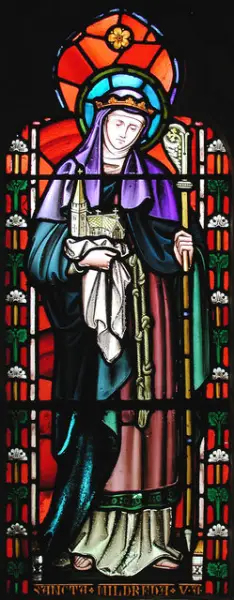
- Princess's crown·Abbess's crozier·Hind
- Canonization
- Canonized in 1388 by Pope Urban VI; feast reinstated by Pope Leo XIII in 1881
Prayer
Bibliography
Show 6 sources
- St. Augustine's Abbey, The Book of Saints, A&C Black, Ltd., London, 1921.
- Hollis, Stephanie (1998). "The Minster-in-Thanet foundation story". Anglo-Saxon England. 27. Cambridge University Press: 41-64. doi:10.1017/S0263675100004798.
- Rollason, David W.: The Mildrith legend. A study in early Medieval hagiography in England. Leicester, 1982.
- minster-in-thanet.org.uk/abbey, accessed 12 October 2014.
- "Saint Mildred and her Kinsfolk", 1903.
- Brooks, Beda: The world of Saint Mildred, c. 660-730. A study of an Anglo-Saxon nun in the golden age of the English Church, Bath, 1996. ISBN 1-898663-08-4.
Profile text adapted from the Wikipedia article, licensed CC BY-SA 4.0.
Pray with this saint every day
Save St. Mildrith to your favorites, read the full profile, and get feast-day reminders in the Saints app.
Get the Saints AppFree on the App Store for iPhone and iPad