
died c. 531·Feast July 24
St. Miliau
Breton prince and cephalophore martyr of the Léon
Overview
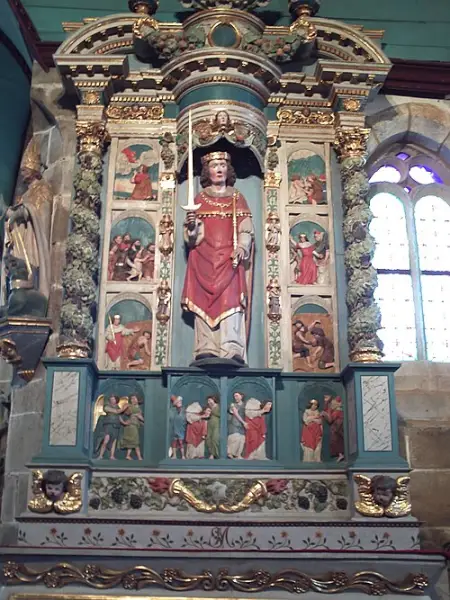
St Miliau, sometimes called Miliav, is a Breton saint who gave his name to the village of Guimiliau, where devotion to him remains especially strong; he cuts a real figure in the cult and legend of Brittany. In Breton storytelling he appears as a good and just prince, born of Budic and descended from Alain le Long, kings of Armorica. When Budic died, Miliau took charge of the chiefdom of Léon, where seven years passed without rain or snow and still the earth gave plenty. He married Haurille, who came from Domnonia, and their son was St Melar. Famous for sheltering and giving to the poor, he is pictured sharing his cloak with a beggar after the pattern of St Martin of Tours. Around 531, on his coming to the throne, his brother Rivod arranged his murder by the sword, and Melar perished in the same manner at Rivod's hand a few years on. Miliau is represented as a cephalophore, holding his own severed head, and dressed in royal garb. He is invoked against rheumatism and is the patron saint of Trébeurden, with his principal shrine at Guimiliau.
The Complete Life
A Prince of Armorica
In the legend retold across Brittany, Miliau was born to rule. He was the son of Budic and the grandson of Alain le Long, kings of Armorica, and his brothers were Theodoric and Rivod. The traditions associate his residence with Plonévez-Porzay near Quimper, in the west of the Breton peninsula. Into this royal house the legend folds the whole drama of a dynasty: when Budic died, Miliau took charge of the chiefdom of Léon, the northern land with which his cult would forever be joined. Even in that office his reign bore the marks of the miraculous favor that Breton storytellers loved to attach to their holy princes, for during his tenure of seven years no rain nor snow fell on the land, and yet the earth yielded abundance all the same, a kingdom sustained by justice rather than weather. He married Haurille, a woman from Domnonia, and their son was Melar, himself numbered among the saints of Brittany. The family into which he was born thus gave the Breton church a father and a son both honored as martyrs, and a memory of kingship measured by goodness rather than conquest.
§ Legend
Protector and Benefactor of the Poor
The virtue for which Miliau was famous was his care for the poor. Breton devotion represents him dividing his cloak with a beggar, in conscious imitation of St Martin of Tours, the soldier-saint whose gesture became the very emblem of Christian charity among the Celtic peoples. The image tells the faithful everything they wished to remember about him: a prince who held power as a trust for the weak, who saw in the beggar at the gate not an embarrassment to royal dignity but an occasion for it, and who counted his own comfort as small beside the need of another. In the hard country of Léon, where the legend says the rains failed for seven years and the harvests came anyway, such generosity read as more than a private virtue; it was the justice by which a Christian people is fed. To this day he is invoked as a good saint in cases of rheumatism, the ailments of the laboring body, and he stands as patron of Trébeurden on the northern coast. A prince remembered for mercy to the poor becomes, in the economy of Breton sanctity, a physician of those whose bodies ache.
§ Legend
The Sword of Rivod
Miliau's death came not from a foreign enemy but from his own house. When he succeeded to the throne, his brother Rivod resolved to take the crown for himself and had him assassinated by decapitation, around the year 531 in the traditional reckoning. A few years later Rivod eliminated Miliau's son Melar in the same manner, so that father and son were joined in martyrdom as closely as in blood. The Breton church made of this atrocity an enduring icon: Miliau is represented as a cephalophore, a saint holding his own severed head, in the tradition of the martyrs whose triumph over death was pictured in their carrying of the instrument of it, and he appears in royal garb, bearing witness that his kingship was not surrendered at the block. The retables of Guimiliau and Lampaul-Guimiliau show the scene in vivid color, the blood gushing from his neck as he holds the severed head in his hands. In the calendar of the Bretons the story is kept on July 24, the feast of a prince who lost his head and kept his crown.
§ Legend
Guimiliau and the dating of a Legend
Miliau's name lives in the very ground of Brittany: the village of Guimiliau bears his name, and there he is particularly venerated, its celebrated church enclosing his cult with retables that show his life and martyrdom in sculpted panels, the saint below holding his own severed head. He holds a solid place in Breton devotion and storytelling, though how much fact lies beneath the legends no one can say. The chronology wavers remarkably. The Alan who truly reigned over Brittany belonged to the ninth century, dying in 907, and history gives him a son named Budic who never took the throne. Read this way, 892 becomes the date some propose for Miliau's death, placing him among the Carolingians instead of the first Merovingians and pulling him more than three hundred years away from St Melar. Who fathered Melar, and even where Melar came from, is contested in its own right, and the tie between the two saints may spring from a simple confusion. Whatever the truth of the dating, the cult stands: invoke him against rheumatism, honor him at Trébeurden, and at Guimiliau the martyr-prince of the Bretons receives his people still.
§ Legend
Timeline
- 531
Succeeded to the throne and was assassinated by decapitation at the orders of his brother Rivod.
§ Legend
- 892
Martyrdom is also dated to this year by a tradition that makes him a contemporary of the Carolingian emperors.
§ Legend
The Record
- Patron of
- against rheumatism·Trébeurden
- Symbols
- Depicted as a cephalophore, holding his own severed head·Royal garb
- Canonization
- Pre-congregation; ancient Breton cult centered at Guimiliau
Prayer
Bibliography
Show 3 sources
- Gostling, Frances Marion. The Bretons at Home. Methuen, 1909.
- Baring-Gould, Sabine. The Lives of the British Saints: The Saints of Wales and Cornwall and Such Irish Saints as Have Dedications in Britain, Vol. 3. C. J. Clark, 1911.
- "Saint Miliau", Nominis.
Profile text adapted from the Wikipedia article, licensed CC BY-SA 4.0.
Pray with this saint every day
Save St. Miliau to your favorites, read the full profile, and get feast-day reminders in the Saints app.
Get the Saints AppFree on the App Store for iPhone and iPad