
died c. 250·Feast October 25
St. Minias
First Martyr of Florence and Cephalophore Prince
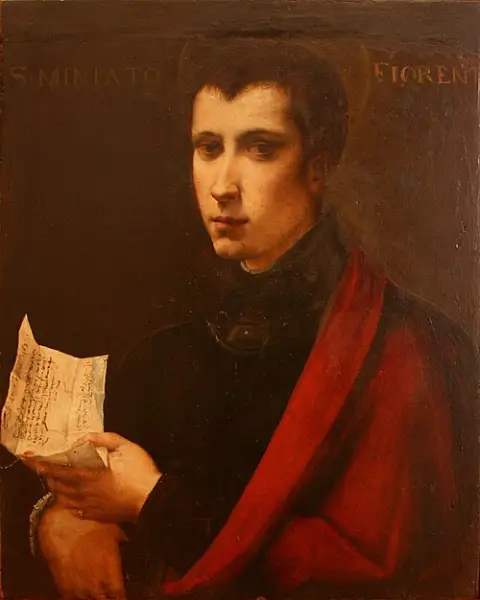
Overview
Minias, honored as the first Christian put to death for the faith at Florence, suffered around 250 AD in the persecution of Emperor Decius. Known also as Minas or Miniatus, he is remembered as an Armenian king or prince who served in the Roman army, or alternatively as a penitential pilgrim making his way to Rome, before withdrawing to live as a hermit in the hills above the Arno. Denounced to the authorities as a Christian, he was brought before Decius and commanded to offer sacrifice to the Roman gods. His refusal opened a chain of torments — fire, a shower of stones, and the wild beasts of the amphitheatre — from which he emerged untouched, until the executioner's blade finally fell near what is now the Piazza della Signoria. Florentine tradition adds one last marvel: the martyr lifted his own severed head, crossed the river, and walked back to his hermitage on the height called Mons Florentinus. His relics are enshrined at San Miniato al Monte, and although the historical record around him is thin, his cult has anchored the Christian memory of Florence for well over a millennium.
The Complete Life
A Prince from Armenia
The traditions surrounding Minias place his origins far from Tuscany, in the Christian lands of the Caucasus. He is consistently described as an Armenian, born in what is present-day Armenia, and remembered as a king or prince of that people. Two strands of the legend explain how this royal figure came to Italy. In the first, he took service as a soldier in the Roman army, and it was within the ranks that his Christian commitment became known. In the second, he had already embraced the ascetic life and was journeying toward Rome as a pilgrim doing penance, far from the throne he might otherwise have occupied. Both accounts agree on the essentials: a man of noble eastern blood, detached from worldly power, who found his way to the neighbourhood of Florence and there resolved to serve God in obscurity. The double memory of crown and hermit's cell shaped his iconography for centuries, so that artists pictured him as a young prince holding a royal crown, the emblem of a dignity he had abandoned for the sake of the Gospel.
§ Saint Minias
The Hermit Above the Arno
Whatever road brought him to Tuscany, the tradition is unanimous that Minias settled as a hermit in the hills near Florence, on the elevation the ancients called Mons Florentinus, the mount of Florence. There he embraced a life of prayer and renunciation, hidden from the city below, in an age when the Church was still emerging from intermittent persecution. The choice of the eremitical life by a man of royal background placed him in a familiar pattern of early sanctity, in which princes exchanged palaces for caves and counted solitude a greater kingdom than any they had inherited. It was from this retreat that he was drawn into the open conflict that would make him a martyr: his presence near the city, and his refusal to conform to the pagan observances of the empire, could not long remain unnoticed. The hill that sheltered him in life received him again in death, and it became, in time, the site of one of the great churches of Tuscany, built over the hermitage and tomb of the soldier-prince who had chosen it. Florentine devotion would later read the whole geography of his life through that hill, so that the place of his prayer and the place of his death became one and the same holy ground.
§ Saint Minias
Trial and Martyrdom under Decius
In the year 250 the emperor Decius had ordered sacrifices to the Roman gods throughout the empire, and Minias was denounced as a Christian and hauled before the emperor himself. Asked to adore the gods of Rome, he refused, and the legend recounts a succession of torments intended to break him. He was cast into a furnace and came out unharmed; he was stoned, and the stones could not kill him; a lion, or perhaps a panther, was loosed upon him in the arena, and the beast spared him. Each failure of the instruments of torture only sharpened the final sentence, and the order went out for beheading. The execution took place near what is now the Piazza della Signoria, in the heart of the city. Here the legend supplies its most famous scene: the martyred prince rose, took up his severed head, crossed the Arno, and climbed to his hermitage on Mons Florentinus, dying at last on the spot he had chosen for prayer. Such tales of cephalophores, saints who carry their own heads, belong to a well-attested hagiographic pattern, and Florence embraced this one as the founding act of its Christian story.
§ Saint Minias
Veneration and the Basilica on the Mount
Minias was never formally canonized by a pope; his cult belongs to the ancient practice of the Church, which honored as saints those who had died confessing the faith. He is venerated in the Roman Catholic Church as a martyr, with his feast kept on 25 October. The center of his cult is the church of San Miniato al Monte, raised on the hill where tradition locates his hermitage and death. The present basilica was begun in 1013 by Alibrando, also called Hildebrand, Bishop of Florence, and it received the patronage of Henry II, Holy Roman Emperor, who endowed the work. Beneath its high altar a crypt preserves the relics of the martyr, making the church both a monument of Romanesque architecture and a place of pilgrimage. From the middle ages onward the image of the saint took fixed forms: a young prince with a crown in his hand, or a figure crowned with a lily, a rod, and the palm of martyrdom, or — most strikingly — a man carrying his own head, the visual sign of the miracle by which Florence explained the sanctity of its hill.
§ Veneration
Memory, Legend, and the Historian's Caution
Modern scholarship has treated the story of Minias with reserve. His historical existence is uncertain, and the sources allow several explanations for the cult. There may indeed have been a martyr of this name put to death near the Arno, whose tomb became a center of devotion. He may have been a soldier executed for spreading Christianity among the troops, a reading that preserves the military color of the legend without its royal trappings. Another hypothesis holds that his cult grew not from a local martyr at all but from a relic brought to Florence from some eastern shrine, perhaps in Egypt, and housed in the church that came to bear the name of San Miniato. Whatever the historical kernel, the legend itself became a force in Florentine identity: the tale of the saint carrying his head across the Arno was first written down by the chronicler Giovanni Villani, and it fixed the image of the cephalophore prince in the city's imagination. Through fire, stone, beast, and blade, the story of Minias has carried the memory of Florence's Christian beginnings for seventeen centuries.
§ Veneration
Timeline
- 250
Denounced as a Christian and brought before Emperor Decius, then persecuting the Church, at Florence.
§ Saint Minias
- 250
Came through a furnace, a stoning, and the beasts of the amphitheatre without injury.
§ Saint Minias
- 250
Beheaded near the present Piazza della Signoria; legend says he carried his own head across the Arno to his hermitage.
§ Saint Minias
- 1013
Bishop Alibrando of Florence began the church of San Miniato al Monte over the saint's crypt, endowed by Emperor Henry II.
§ Veneration
The Record
- Symbols
- depicted as a young prince holding a crown·crowned with a rod and palm·crowned with a lily, rod and palm·carrying his severed head
- Canonization
- Pre-congregation martyr; venerated as the first Christian martyr of Florence from the earliest centuries.
Prayer
Bibliography
Show 4 sources
- Archivio Parrocchia (1 Feb 2001). "San Miniato di Firenze". Santi e beati. Retrieved May 20, 2009.
- "St. Patrick Catholic Church: Saint of the Day". Saint Patrick Catholic Church. n.d. Archived from the original on January 5, 2009. Retrieved May 20, 2009.
- Hare, Augustus John Cuthbert (2002). Florence. Adamant Media Corporation. p. 204. ISBN 1-4021-5933-1.
- Brucker, Gene (1998). Florence: The Golden Age, 1138–1737. University of California Press. p. 194. ISBN 0-520-21522-2.
Profile text adapted from the Wikipedia article, licensed CC BY-SA 4.0.
Pray with this saint every day
Save St. Minias to your favorites, read the full profile, and get feast-day reminders in the Saints app.
Get the Saints AppFree on the App Store for iPhone and iPad