
c. 277 – 361·Feast October 1
St. Mirian III
First Christian King of Iberia and Equal to the Apostles
Overview
Mirian III was king of Iberia, the eastern Georgian kingdom of Kartli, and the founder of its royal Chosroid dynasty. Born in Iran into the great house of Mihran and raised a Zoroastrian, he was placed on the Iberian throne in 284 by the Sasanian king of kings Bahram II, then a child of seven. His long reign, dated 284 to 361 in the chronology of Cyril Toumanoff, carried Iberia from the Iranian sphere of influence into alliance with Rome and, more lastingly, into the Christian world. According to the Georgian annals, Mirian was converted to Christianity through the ministry of Nino, a Cappadocian missionary woman, after a dramatic episode of blindness during a hunt near his capital, Mtskheta. Scholars date his conversion and the Christianization of Iberia to either 319 or 326, leaving Georgia second only to Armenia among the realms that had taken the faith as the law of their land. The king who had risen as a Sasanian client became the architect of a Christian monarchy, requesting clergy and relics from Constantine the Great and building the cathedral of Mtskheta. The Georgian Orthodox Church venerates him as Saint Equal to the Apostles King Mirian; he and his queen Nana lie buried at Samtavro in Mtskheta, where their tombs are still shown.
The Complete Life
A Prince of the House of Mihran
Mirian belonged to the House of Mihran, counted among the Seven Great Houses of Iran, a family seated at Ray in the north whose ancestry reached back to the Arsacid empire that had ruled before the Sasanians. He was born on Iranian soil, around 277 or 278, and reared in the Zoroastrian religion of his fathers. His very name carried the old Iranian world: Mirian is the Georgian form of Mihrān, transliterated into Greek as Mithranes and associated in Georgian memory with Mirdat, meaning given by Mithra, the ancient sun god. The Roman historian Ammianus Marcellinus knew him under the name Meribanes. He was born into a Caucasus that belonged to what the historian Stephen Rapp calls the Iranian Commonwealth, a vast cross-cultural zone stretching from Central Asia to the Balkans, in which Iranian culture and Zoroastrian religion shaped the kingdoms at the foot of the mountains. Nothing in that inheritance suggested the Christian future that awaited him; the boy born in Iran as a worshipper of Mithra would instead become the first Christian king of Iberia and an apostle-figure in Georgian memory.
§ Background and accession
A Throne Arranged by Empires
In 284 the Sasanian king of kings Bahram II secured the throne of Iberia for the seven-year-old Mirian, laying the foundation for Mihranid rule in the country that would endure into the sixth century. The move was strategic: Iberia's capital, Mtskheta, commanded the approaches through the passes of the Caucasus Mountains, and Bahram valued the prize enough to travel in person, so the tradition says, to secure the boy's position. He also dispatched a grandee named Mirvanoz, himself a Mihranid, to serve as the child-king's guardian. Mirian then wed Abeshura, whose father Aspacures had reigned in Iberia before him, tying the new house to the old royal line, and Sasanian power underwrote the arrangement with troops: forty thousand select mounted warriors were stationed across eastern Iberia, Caucasian Albania, and Gugark, while seven thousand cavalry guarded Mtskheta itself. As a young man he inherited the duties of an Iranian client king, taking part in Narseh's war against Rome from 297 to 298. The crushing Sasanian defeat forced Narseh to cede both Armenia and Iberia to the Romans, and Mirian, reading the new balance of power shrewdly, turned to establish close ties with Rome — the realignment that would open the door to his conversion.
§ Early reign
Nino and the Conversion of Iberia
The conversion of Mirian is the hinge of Georgian history. Tradition places the Cappadocian missionary Nino at its center, a woman whose preaching had already brought his second wife, Queen Nana, to the faith before the king himself. The legend tells that Mirian, still a staunch pagan, went hunting in the woods near Mtskheta; darkness fell suddenly upon the land and the king was struck totally blind. No light returned until, in his helplessness, he prayed to Nino's God for aid. Recovering his sight, he summoned Nino to an audience and received baptism soon after. Scholars date the conversion, and with it the Christianization of Iberia, to either 319 or 326, so that Iberia became, after Armenia alone, a kingdom governed by Christian law. The change reached beyond the palace: the Roman historian Rufinus and the Georgian annals alike report that the newly Christian Iberians asked Emperor Constantine for clergymen, and that he responded by sending priests and holy relics to the kingdom. Mirian built a cathedral in Mtskheta at his own behest, and the monarchy and nobility propagated the new faith actively throughout the realm.
§ Conversion to Christianity
Building a Christian Kingdom
Mirian's adoption of Christianity was an act of state as much as of soul, and its consequences reshaped Iberian society. The conversion fostered the growth of a central royal government: properties belonging to pagan temples were confiscated and redistributed to the nobles and the church, binding the new faith to the machinery of the crown. Medieval Georgian sources record how actively the monarchy and its aristocracy spread the Gospel, and equally how stiff was the resistance they met from the mountain folk, whose old allegiances did not yield quickly to the new religion. The king's spiritual sight is pictured in the legend of his blindness on the hunt: a man who could not see until he called upon God, and who thereafter governed by that light. Late in life, tradition relates, he undertook a pilgrimage to Jerusalem, the city of the faith he had embraced in maturity, going there shortly before his death. He chose to be buried among his own people at the Samtavro convent in Mtskheta, beside Queen Nana, leaving behind a kingdom whose identity had been permanently reoriented from the fire temples of Iran toward the Christianity of the Roman world and of Georgia's own future.
§ Conversion to Christianity
The Long Sunset of a Long Reign
Mirian's reign, taken by Toumanoff's chronology to run from 284 to 361, was among the longest any Georgian monarch has known, and its final decades were shared. From 345 the aged king ruled alongside his son Rev II and Salome as co-rulers, preparing the succession of a dynasty he had founded single-handedly. The world around Iberia shifted again in those years: Rome and Iran resumed their contest for the Caucasus, and the emperor Constantius, Constantine's successor, found it necessary in 360 to send embassies bearing costly presents to Arsaces of Armenia and to Meribanes of Iberia — Mirian under his Latin name — to secure their allegiance for the confrontation with Iran. Ammianus Marcellinus, who records the episode, is one of several classical witnesses to the king's long career, alongside the medieval Armenian chronicles. Mirian died in 361 at Mtskheta, aged about eighty-three or eighty-four, having reigned for seventy-seven years by the traditional reckoning. He was laid to rest at Samtavro, and the Georgian tradition preserves the picture of an old king whose last journeys were toward Jerusalem and toward the tomb.
§ Early reign
Equal to the Apostles
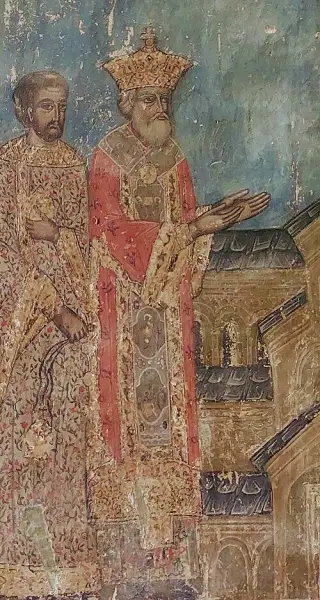
The Georgian Orthodox Church numbers Mirian among its greatest saints, canonizing him under the title Saint Equal to the Apostles King Mirian — in Georgian, Tsminda motsikultastsori mepi Miriani. The title is reserved for those whose work carried the faith to a whole people, and it is precisely what tradition claims for him: through his conversion, Iberia became a Christian kingdom, only the second in the world to make the faith its state religion, and the seedbed of Georgian Christianity ever since. His liturgical memory is kept on October 1, together with that of his queen, Nana, who preceded him into the faith; the Orthodox Church in America commemorates the royal pair jointly as Equals of the Apostles, Emperor Mirian and Empress Nana of Georgia. Their bodies lie at the Samtavro convent in Mtskheta, and their tombs, open to pilgrims' eyes in our own day, keep the convent a place of living devotion rather than a merely historical site. A fresco of King Mirian survives at the Svetitskhoveli Cathedral, the great Mtskheta church of later centuries, where the converter of the kingdom keeps his place among its painted saints.
§ Conversion to Christianity
Founder of a Dynasty and a Debate
Mirian's political legacy was the Chosroid dynasty, of which he became the first head; the Chosroids were a branch of the Mihranid princely family, and their rule in Iberia lasted into the sixth century. Other branches of the same house took thrones elsewhere in the Caucasus, in Gugark and in the Armeno-Albanian principality of Gardman, extending Mihranid influence across the region. His historical legacy has proven more contested. Traditional chronology, following Prince Vakhushti's Description of the Kingdom of Georgia, assigned his reign — reckoned at seventy-seven years — to the dates 268 to 345; the modern scholar Cyril Toumanoff revised these to 284 to 361, and his dating is the one now generally followed. Medieval writers debated his deeds: The Life of the Kings recounts his reign in rich detail, but historians judge some of its claims, such as his supposed pretensions to the Iranian throne or his control of Colchis and Albania, to be fictional embellishments, while accepting the core account of his wars and ambitions in Armenia. He appears under three names in three literatures — Mirian in Georgian, Meribanes in Latin, an unnamed vassal in the Paikuli inscription — a king remembered variously by the empire he served, the empire he deserted, and the church he founded.
§ Mirian III
Timeline
- 277
Born into the Iranian house of Mihran, in Sasanian Iran; surviving chronology gives c. 277 or 278.
§ Background and accession
- 284
Placed on the Iberian throne by the Sasanian shahanshah Bahram II, then only seven years old.
§ Background and accession
- 292
His first wife, Abeshura of the Pharnabazid royal line, died without issue, ending that dynasty's kingship in Iberia.
§ Family
- 297
Fought as a Sasanian vassal in Narseh's war against Rome, which ended in defeat and the loss of Armenia and Iberia to the Romans.
§ Early reign
- 326
Converted to Christianity through the ministry of the Cappadocian missionary Nino; scholars date the conversion to 319 or 326.
§ Conversion to Christianity
- 345
Ruled in his last decades alongside his son Rev II and Salome as co-rulers, in the revised regnal chronology.
§ Mirian III
- 360
Received embassies and costly gifts from Emperor Constantius II, recorded by Ammianus Marcellinus, to secure Iberian allegiance against Iran.
§ Early reign
- 361
Died at Mtskheta aged about eighty-three and was buried at the Samtavro convent, where his tomb remains on public display.
§ Conversion to Christianity
The Record
- Canonization
- Canonized as Saint Equal to the Apostles King Mirian by the Georgian Orthodox Church; feast celebrated October 1.
Prayer
Bibliography
Show 5 sources
- Lang, David Marshall (1956). Lives and Legends of the Georgian Saints. London: Allen & Unwin. pp. 13-39.
- Toumanoff, Cyril (1967). Studies in Christian Caucasian History. Georgetown University Press. pp. 83-84, 377.
- Rapp, Stephen H. (2014). The Sasanian World through Georgian Eyes: Caucasia and the Iranian Commonwealth in Late Antique Georgian Literature. Routledge. ISBN 978-1472425522.
- Thomson, Robert W. (1996). Rewriting Caucasian History. Oxford University Press. pp. 83-90. ISBN 0-19-826373-2.
- "Equals of the Apostles, Emperor Mirian and Empress Nana of Georgia". Orthodox Church in America. Retrieved 2026-05-28.
Profile text adapted from the Wikipedia article, licensed CC BY-SA 4.0.
Pray with this saint every day
Save St. Mirian III to your favorites, read the full profile, and get feast-day reminders in the Saints app.
Get the Saints AppFree on the App Store for iPhone and iPad