
c. 565 – c. 620·Feast September 15
St. Mirin
Irish monk, prior of Bangor, and patron of Paisley
Overview
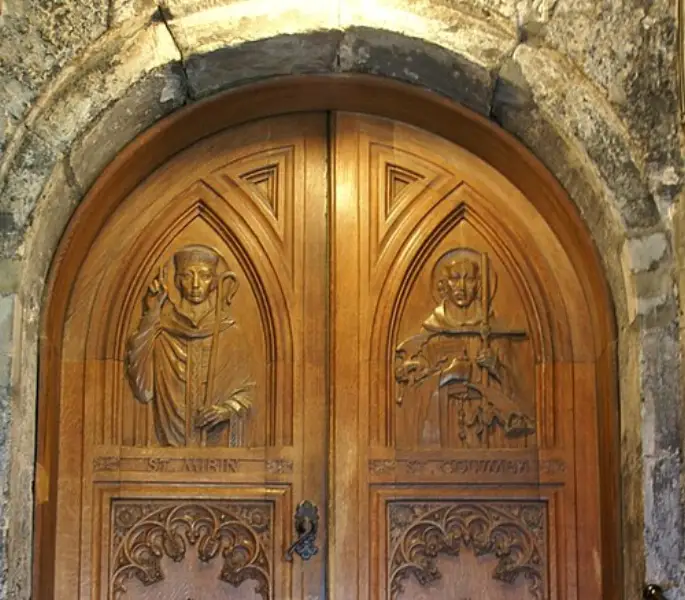
Saint Mirin, also known as Mirren of Benchor, Merinus, Merryn, and Meadhrán, was an Irish monk and missionary of the sixth and seventh centuries who became the patron saint of Paisley in Renfrewshire, Scotland, and of the Roman Catholic diocese of Paisley. Believed to have been of noble birth, his mother brought him as a boy to the abbey of Bangor in County Down, entrusting him to the guidance of Comgall. In time he assumed oversight of the abbey as its prior, welcoming visitors and sojourners, before undertaking a missionary voyage to Scotland. A contemporary of Columba of Iona, he is remembered for preaching before the High King of Ireland, whose first refusal to admit him gave way, so legend tells, to a dramatic reconciliation. About the year 580 he received an appointment to the west of Scotland, and his way there was long and hard before he came to the ground where Paisley would one day stand. A powerful local chieftain granted him a small field near the river, known ever after as St Mirin's Croft, and there he founded the first church of the town, thought to have stood at Seedhill. The religious community he established grew into Paisley Abbey, and his shrine within it drew pilgrims for centuries. He died there around 620, honoured in charters and Papal Bulls as the glorious confessor, Saint Mirin.
The Complete Life
A Boy Given to Bangor
Mirin is believed to have been of noble birth, arriving in about the year 565. While he was still a young boy, his mother brought him to Bangor Abbey in County Down, in the north-east of Ireland, and placed him under the care of Comgall. Bangor stood among the great monastic centres of early Ireland, and under Comgall the child grew up within a discipline of prayer, study, and labour that shaped the whole of his life. In time he came to be identified with the place itself: later tradition remembered him as Mirren of Benchor, the old name for Bangor, and he is also known under the forms Merinus, Merryn, and Meadhrán. His childhood at the abbey bound him permanently to its community and to its founder. When he reached maturity he did not depart for another house but took oversight of the monastery itself, becoming prior of Bangor Abbey. In that office he accepted visitors and sojourners, extending the hospitality of the abbey to the stream of pilgrims and travellers who came to its gates, and preparing for the wider missionary work that would one day carry him across the Irish Sea.
§ History and legend
Prior, Preacher, and Servant of the King's Camp
Mirin's advancement to the office of prior marked him out among Comgall's disciples. As prior he governed the daily life of a major Irish monastery, ordering its prayer and admitting the visitors and sojourners who sought lodging and counsel within its walls. From this position of responsibility he turned to preaching beyond the cloister. He journeyed to the camp of Ireland's High King, hoping to open the Gospel to the warriors there, but the king, warned of his coming, barred him from entering. Legend tells how Mirin prayed that the monarch would suffer the labour pangs of his wife, whose time was near: for three days and nights the king lay in torment, howling with pain. At last, in despair, he sought the monk out and gave him everything he asked, among the rest the freedom to carry the Gospel to the warriors of his camp; at Mirin's intercession he was released from his suffering. The story preserves the memory of a monk who confronted secular power with the confidence of his calling and won the liberty to preach where he had first been turned away.
§ History and legend
Across the Sea to Paisley
Around 580 Mirin was appointed to the west of Scotland. After a long and difficult journey he arrived at the place where the town of Paisley now stands. The district belonged to a powerful local chieftain, who conceived a liking for the wandering monk and granted him a little field by the river on the settlement's southern side. This plot became known as St Mirin's Croft, a name that endured in the town's memory. On this ground Mirin established the first church in Paisley, thought to have stood at Seedhill, and around it gathered the religious community that in time grew into Paisley Abbey. His work thus made him the founding father of Christian life in the locality: a monastic settlement planted beside the river became the seed from which one of Scotland's notable abbeys grew. The church he founded continued after his death to draw the faithful, and the shrine of the saint within the abbey became a centre of pilgrimage, honoured across the west of Scotland and beyond for generation after generation.
§ History and legend
Death at Paisley
Mirin spent the closing span of his life in the community he had planted beside the river at Paisley, and there he died around the year 620, at about fifty-four years of age. The Aberdeen Breviary marked his passing with a solemn sentence, recording that, full of sanctity and miracles at the last, he slept in the Lord at Paisley. He was buried where he had laboured, and his grave became the shrine that fixed his name upon the town. Pilgrims came to pray at the tomb of the confessor, and the devotion that gathered around it outlasted the centuries, outliving even the monastic house itself in the affection of the local church. Through those generations of pilgrimage the founder's memory was kept alive: the field granted to him, the first church at Seedhill, and the abbey that rose from his settlement all remained joined to his name. His death did not end his presence in Paisley; in a real sense it began it, for the resting place of the dying monk became the heart of the town's spiritual life.
§ History and legend
The Glorious Confessor
Mirin was never formally canonized by a pope; he belongs to the company of early saints whose cult was established by longstanding acclaim among clergy and people. Across the centuries the official documents of church and crown styled him the glorious confessor, Saint Mirin, a title found in various charters and Papal Bulls concerning Paisley. The seal of the abbey engraved his image, clothing him in the vestments of a bishop, and around it ran the prayer, O Mirin, pray for your servants — an official invocation of his intercession at the very heart of the religious house he founded. Royal authority echoed the church's esteem: when James IV's charter of 1488 elevated Paisley into a burgh of barony, the crown's particular esteem for the glorious confessor stood first among the reasons it gave. His feast is kept on 15 September. In 2003 the town raised a pedestal of blond sandstone opposite St Mirin's Cathedral, designed by the landscape architect Daniel McKendry and bearing an inscription drawn from the Aberdeen Breviary, and on the saint's day in 2007 a bronze statue of Mirin by the sculptor Norman Galbraith was unveiled there by the Provost of Renfrewshire in the presence of the Bishop of Paisley.
§ History and legend
The Saint's Name upon the Land
Paisley remains saturated with the memory of its founding saint. Paisley Abbey houses a chapel in Mirin's honour, its sculptured stone frieze carrying scenes from his life; the Roman Catholic cathedral of St Mirin's bears his name, and so does St Mirren F.C., the club of the town. The burn called for St Mirin joins the White Cart Water near the heart of the town, and St Mirren Street runs from Paisley Cross down to Causeyside Street. After the closure of St Mirin's and St Margaret's High School, once known as St Mirin's Academy, in 2001, the town itself was left without a school dedicated to the saint, though a St Mirin's Primary School stands in the Simshill area of neighbouring Glasgow. Beyond Paisley the saint's name marks the landscape: the island of Inchmurrin, meaning Mirin's Island, in Loch Lomond, a farm called Knockmurran, meaning Mirin's Hill, near Coylton in Ayrshire, and St Mirin's Well near Kilsyth in Stirlingshire all testify to the reach of his cult across western Scotland.
§ Mirin in modern Scotland
Timeline
- 565
Born, according to tradition, of noble birth.
§ History and legend
- 580
Sent to labour in the west of Scotland; reached the site of Paisley after a long, hard road.
§ History and legend
- 1488
James IV's charter cited esteem for the glorious confessor when raising Paisley to a burgh of barony.
§ History and legend
- 2003
Sandstone pedestal bearing an Aberdeen Breviary inscription erected opposite St Mirin's Cathedral.
§ Statue
- 15 Sep 2007
Bronze statue of the saint, sculpted by Norman Galbraith, unveiled on his feast day.
§ Statue
In Their Own Words
O Mirin, pray for your servants
the singular respect we have for the glorious confessor, Saint Mirin
At Length Full of Sanctity and Miracles, Mirin Slept in the Lord at Paisley
The Record
- Major works
- Religious community at Paisley, which grew into Paisley Abbey·First church in Paisley, thought to have stood at Seedhill
- Patron of
- patron of Paisley, Renfrewshire·patron of the Roman Catholic diocese of Paisley
- Symbols
- depicted in the vestments of a bishop
- Canonization
- Pre-congregation; honoured in charters and Papal Bulls as the glorious confessor, Saint Mirin.
Prayer
Bibliography
Show 4 sources
- Brown, Isaac. Renfrewshire Characters and Scenery. 1824, pp. 42–49.
- Lees, J. Cameron. The Abbey of Paisley. 1878.
- Aberdeen Breviary. 1484.
- Black, C. Stewart. The History of Paisley. 1948.
Profile text adapted from the Wikipedia article, licensed CC BY-SA 4.0.
Pray with this saint every day
Save St. Mirin to your favorites, read the full profile, and get feast-day reminders in the Saints app.
Get the Saints AppFree on the App Store for iPhone and iPad