
died c. 316·Feast December 3
St. Mirocles
Bishop of Milan in the Age of Constantine
Overview
Mirocles, sometimes Latinized as Merocles, was Bishop of Milan from some year before 313 until about 316, and the Catholic Church numbers him among her saints. Almost nothing of his life is recorded; he is thought to have come perhaps from a family of Pavia, the city that would later give the Church Epiphanius. What survives of him belongs to the pivotal years in which the Roman Empire turned from persecutor to patron of Christianity. He led the church of Milan when Constantine and Licinius issued the Edict of Milan in 313, proclaiming religious toleration throughout the empire, and he answered the new freedom with building, beginning the basilica vetus, the first cathedral of Milan, on the ground where the present cathedral stands. He was present at the Lateran council of October 313 under Pope Miltiades, which condemned Donatus Magnus in the Donatist controversy, and at the great council of all the Western bishops held at Arles on August 1, 314, which confirmed that condemnation and ruled on canon law. He is also credited with founding the church of San Vittore al Corpo in honour of the martyr Victor Maurus. He died on November 30, around 316, and was buried in that church; his feast is kept on December 3.
The Complete Life
Obscure Origins in a Changing Empire
The sources preserve almost nothing of Mirocles' life before he became bishop of the largest see in northern Italy. He was born at some point in the third century, in the generations that endured the great persecutions under Decius, Valerian, and Diocletian, and tradition surmises that he came from a family of Pavia — the city on the Ticino that would later produce another famous churchman, Epiphanius. Beyond that conjecture, the record is silent about his upbringing, his education, and the path that carried him from whatever station he occupied to the leadership of the Milanese church. That silence is itself instructive: he belongs to the class of bishops whose careers were remembered not for what they wrote or suffered but for what they oversaw. He came to office in the years when the church of Milan was emerging from the shadow of the last and fiercest of the persecutions, the edict of Diocletian, which had ravaged the Italian churches in the opening years of the fourth century. Whatever trials had shaped him, he was judged fit to guide a community preparing, though it could not yet know it, for the most sudden reversal in the history of Roman Christianity.
§ Life
Bishop of Milan
Mirocles took up the see of Milan at some date before 313, following Monas in a line of bishops that the city traced back to the apostolic age, and he governed the see until about 316, when he was followed by Maternus. His episcopate was brief, but it fell exactly across the hinge of imperial history. In 313 the emperors Constantine I and Licinius met and issued the Edict of Milan, the decree that proclaimed religious toleration throughout the Roman Empire and returned to the churches the property and peace they had lost. Milan, as the seat of that decree, became a visible emblem of the new order, and its bishop became one of the first in the Latin West to lead a church passing from danger to favour. Mirocles met the moment on three fronts at once: he gave the city its first great Christian basilica, he represented his church in the councils summoned to settle the disputes of the new era, and he continued the work of planting churches across the city. His tenure linked the age of the martyrs, embodied in his predecessor Monas, with the age of Ambrose that his successors would build.
§ Life
Councils, Basilicas, and the Peace of the Church
The freedom granted in 313 brought the church new questions as quickly as new liberties, and Mirocles appears at the councils called to answer them. Sources record his presence at the Lateran council held in Rome in October 313 under Pope Miltiades, assembled to judge the Donatist dispute that had convulsed the African church. The council condemned Donatus Magnus, who charged that clergy who had lapsed under persecution could not validly minister, and it took the side of Caecilianus, bishop of Carthage. Mirocles travelled again the following summer for the wider gathering: the council of all the Western bishops gathered at Arles on August 1, 314, which upheld Donatus's condemnation and laid down rules of church law, one of the first great legislative assemblies of the Christian church. At home he built. After the Edict of Milan he began the erection of the basilica vetus, the first cathedral of the city, occupying the ground where the present Cathedral of Milan now rises. He is also credited with founding the church of San Vittore al Corpo, dedicated to the martyr Victor Maurus, who had died in the Diocletian persecution of 303 — a fitting memorial from a bishop whose ministry spanned the distance from that persecution to the peace.
§ Life
Death, Tomb, and Cult
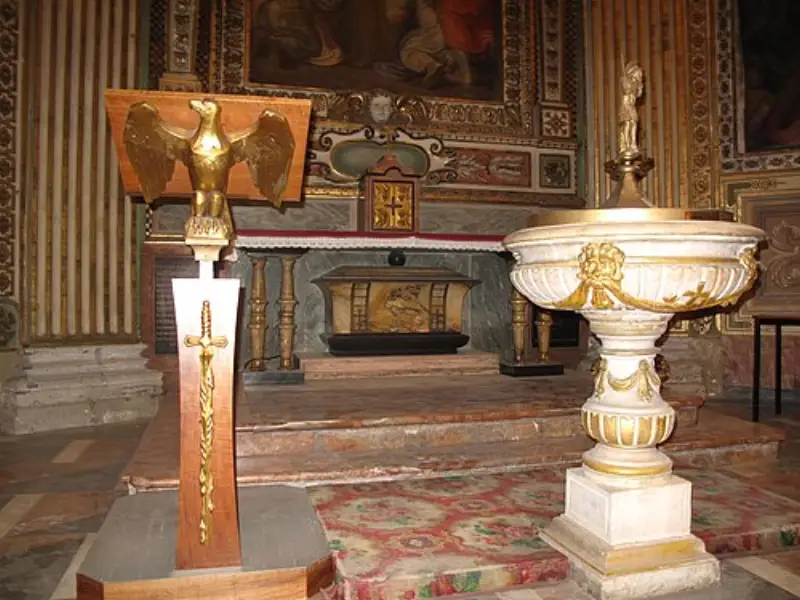
Mirocles died at Milan on November 30, in about the year 316, after an episcopate of perhaps three or four years. He was buried in the city in the church of San Vittore al Corpo, the very church tradition says he had founded in honour of the martyr Victor, so that his remains rested beneath the altar of the soldier-saint he had venerated. The church, rebuilt many times over the following centuries, kept the memory of its founder within its walls. The Catholic Church fixed his feast day on December 3, three days after the anniversary of his death, and has honoured him among the saints of the Ambrosian church ever since; his altar and urn remain objects of veneration in Milan. In the long catalogue of the bishops and archbishops of Milan his name stands fifth from the apostolic beginnings of the see, between Monas and Maternus, in the company of Ambrose and Charles Borromeo who came long after him. He is remembered as the bishop under whom Milan's Christianity stepped out of hiding — the man who first raised a cathedral there and first carried the concerns of the Italian church into the council chambers of a Christian empire.
§ Life
Timeline
- 313
Ruled the see of Milan when Constantine and Licinius proclaimed the Edict of Milan, establishing religious toleration in the empire.
§ Life
- Oct 313
Attended the Lateran council in Rome under Pope Miltiades, which condemned Donatus Magnus and sided with Caecilianus of Carthage.
§ Life
- 1 Aug 314
Took part in the council of all the Western bishops at Arles, which upheld the sentence on Donatus and issued canons for the government of the church.
§ Life
- 30 Nov 316
Died at Milan and was buried in the church of San Vittore al Corpo.
§ Life
The Record
- Major works
- basilica vetus, the first cathedral of Milan·church of San Vittore al Corpo, Milan (attributed)
- Canonization
- Pre-congregation saint; honoured as a saint in the Catholic Church since antiquity, with his feast on December 3.
Prayer
Bibliography
Show 3 sources
- Ruggeri, Fausto (1991). I Vescovi di Milano. Milano: NED. p. 9. ISBN 88-7023-154-2. (in Italian)
- Cazzani, Eugenio (1996). Vescovi e arcivescovi di Milano. Milano: Massimo. pp. 13-14. ISBN 88-7030-891-X. (in Italian)
- Pasini, Cesare (1990). "Materno di Milano, santo (sec. IV)". Dizionario della Chiesa Ambrosiana. Vol. 4. Milano: NED. pp. 2255-2258. ISBN 88-7023-102-X. (in Italian)
Profile text adapted from the Wikipedia article, licensed CC BY-SA 4.0.
Pray with this saint every day
Save St. Mirocles to your favorites, read the full profile, and get feast-day reminders in the Saints app.
Get the Saints AppFree on the App Store for iPhone and iPad