
433 – 466·Feast not recorded in the source
St. Mitre
Beheaded field worker and martyr of Aix-en-Provence
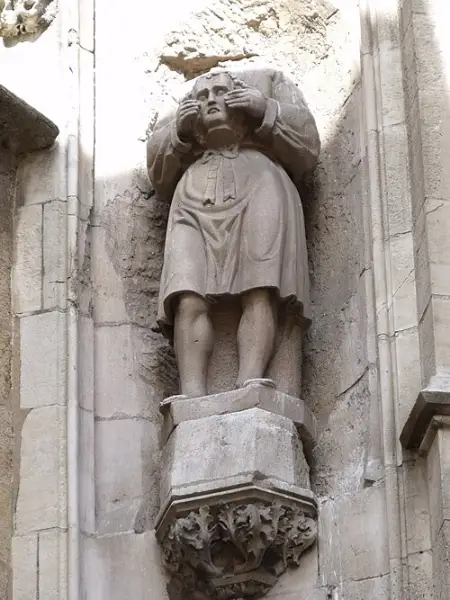
Overview
Mitre was born at Thessaloniki in Greece in 433 and died at Aix-en-Provence in 466, a martyr whose cult has been rooted in Provence for more than fifteen centuries. According to the legend that preserves his memory, he lived at Aix as a field worker in the household of Arvendus, and there worked a miracle. For making that miracle come true he was charged with witchcraft and condemned to beheading. The legend continues with the image for which he is chiefly remembered: after his execution Mitre picked up his own head and carried it to the church of Notre-Dame de la Seds in Aix, joining the company of cephalophore saints of Provence. His relics were kept with reverence, and on 23 October 1383 they were translated to the Cathédrale Saint-Sauveur, the great church of Aix, where his tombstone rests against a column. It is said that this column bears a shining hole from which a liquid good for curing eye sores issues, a sign of the healing devotion that gathered at his tomb. A chapel dedicated to him was built in the city in the seventeenth century, a painting by Nicolas Froment commemorates his legend, and a neighbouring commune still carries his name.
The Complete Life
Martyrdom and the Shrine at Aix
The cult of Mitre rests upon a martyrdom suffered at Aix-en-Provence in the fifth century. A field worker living with Arvendus, he was said to have worked a miracle, and for that act he was denounced as a practitioner of witchcraft. The sentence was beheading, and the legend of the young Greek-born labourer closes with the sign by which Provence knew its cephalophore saints: Mitre raised his severed head and carried it with his own hands to the church of Notre-Dame de la Seds, presenting at the altar the witness he had rendered. His remains were guarded by the church of Aix through the following centuries, and on 23 October 1383 they were moved with solemnity to the Cathédrale Saint-Sauveur, the metropolitan church of the city. There his tombstone was set against one of the columns, and a strange mark of favour attached itself to the place: the right-hand column that holds the stone is said to carry a gleaming aperture, from which flows a moisture believed to heal afflictions of the eyes. Those with failing sight came seeking the healing flow at the martyr's tomb, and the veneration of Mitre remained alive in Aix from the earliest Christian ages without any formal act of canonization.
§ Biography
Chapel, Painting, and Commune
The memory of Mitre found enduring witnesses in the city and countryside of Provence. In the seventeenth century a chapel dedicated to Saint-Mitre was built at Aix-en-Provence, and the cathedral itself preserves a Chapel St Mitre among its altars. The Cathédrale Saint-Sauveur holds as well a painting by Nicolas Froment entitled Légende de saint Mitre, executed between 1470 and 1475, which carried the story of the martyr into the visual language of the late medieval church and remains one of the artistic treasures associated with his name. His cult also marked the map beyond the city walls: the commune of Saint-Mitre-les-Remparts, standing above the Étang de Berre country, took its name from him. Literature kept the memory alive in a different register, for Émile Zola, the novelist raised at Aix, names Mitre in the opening chapter of La Fortune des Rougon, summoning the saint from the devotional world of the old city into the opening pages of one of the great novels of nineteenth-century France. Through chapel, panel, place name, and printed page, the field worker put to death for a miracle has never altogether left the city that put him to death.
§ Influence
Timeline
- 433
Born at Thessaloniki in Greece.
§ Biography
- 466
Beheaded at Aix-en-Provence, condemned as a sorcerer for the miracle he was said to have worked.
§ Biography
- 23 Oct 1383
Relics translated to the Cathédrale Saint-Sauveur at Aix-en-Provence.
§ Biography
The Record
- Canonization
- Pre-congregation; venerated as a martyr at Aix-en-Provence from early centuries.
Prayer
Bibliography
Show 2 sources
- Roux-Alphéran, Ambroise. Les Rues d'Aix. 1846–1848.
- célébrités d'Aix-en-Provence (archived 2007-05-17 at the Wayback Machine).
Profile text adapted from the Wikipedia article, licensed CC BY-SA 4.0.
Pray with this saint every day
Save St. Mitre to your favorites, read the full profile, and get feast-day reminders in the Saints app.
Get the Saints AppFree on the App Store for iPhone and iPad