
1623 – 1703·Feast August 7
St. Mitrophan of Voronezh
First Bishop of Voronezh and Wonderworker of Russia
Overview
Mitrophan of Voronezh, known in English as Metrophanes, became in 1682 the first bishop of Voronezh and one of the most beloved hierarchs of the Russian Church. Born on November 8, 1623, and named Mikhail, he lived as a married man until his wife's death in 1663, when he took monastic vows and rose to govern two monasteries in turn: the Kosmin Monastery near Yuryev-Polsky and the Unzha Monastery at Makaryev. Elevated to the new see of Voronezh, he served Peter the Great faithfully during the years when the tsar built Russia's first warships on the Voronezh river, supporting the shipyards while remaining an honest critic of the tsar's Westernizing reforms. He died on November 23, 1703, and found burial at the Annunciation Monastery of Voronezh with the tsar himself standing in attendance. Fourteen years later his tomb was opened and his body found whole, and his relics were credited with healing. His formal canonization followed on June 25, 1832, after which Tsar Nicholas I visited his shrine and pilgrims streamed to Voronezh from across Central Russia. The Bolsheviks confiscated his relics; they were returned to the Church in 1989 and rest today at the Annunciation Cathedral in Voronezh.
The Complete Life
Mikhail of Antilokhovo
The future bishop was born on November 8, 1623, in the village of Antilokhovo, in the Savinsky District of the Russian lands, and received at baptism the common Russian name Mikhail. Of his parents, his schooling, and his youth the records say little; what is known is that he followed the ordinary path of a layman of his time and married. His life changed decisively in 1663, when his wife died. In the spirit of Russian piety, which often read such bereavement as a call to a stricter discipleship, the widower of forty exchanged the world for the monastery and received the tonsure under the name Mitrophan. The man who entered the cloister in middle age brought with him the experience of family life, of work, and of loss — an experience that would later make him, in the memory of the Russian Church, a particular patron of children and of family concerns. From the village of his birth to the episcopal city of his death, his would be a career built in the second half of life, the fruit of a maturity tested by grief.
§ Mitrophan of Voronezh
The Monastic Years
After his profession of vows in 1663, Mitrophan advanced quickly in the monastic life and was entrusted with the government of two monasteries in succession. The first was the Kosmin Monastery, lying near the old town of Yuryev-Polsky in the lands north-east of Moscow; the second was the Unzha Monastery at Makaryev, on the river of the same name in the Volga region. Governing these houses trained him in the administration of property, the care of monks, and the conduct of relations with the world — the practical arts that Russian monastic superiors needed and that recommended monks for the episcopate. It was from this monastic apprenticeship that he was called in 1682 to one of the most demanding new postings in the Russian Church: the newly erected bishopric of Voronezh on the southern frontier. The move from the monasteries of the interior to the wooden fortress-town on the edge of the steppe was a lowering in comfort and a raising in responsibility. He accepted it, and for the last twenty-one years of his life Voronezh was his field of labour.
§ Mitrophan of Voronezh
First Bishop of Voronezh and Servant of the Tsar
In 1682 Mitrophan was appointed the first bishop of the new see of Voronezh, a frontier diocese through which, a decade later, the ambitions of Peter the Great would run. When the young tsar resolved to create a navy and chose the Voronezh river as the place to build Russia's first warships, the bishop proved a steadfast partner. He supported the sovereign's great shipbuilding effort, encouraging his flock to serve the imperial project and lending the authority of the Church to the tsar's enterprise. Yet his support was never servility. The sources remember him as generally critical of Peter's Westernization policies — the wholesale importation of European dress, customs, and manners that unsettled traditional Russian life. He could aid the tsar in building ships while resisting the tsar in remaking the soul of the nation, and the combination made him a model for Russian hierarchs caught between throne and conscience. He was also credited with miracle-working powers during his lifetime and after, a reputation that drew the faithful to his cathedral city from the steppe country around. The partnership between the old bishop and the young tsar was one of the remarkable alliances of the age, joining the oldest loyalties of Muscovite Russia to the most disruptive ambitions of the new empire, and it was carried on, on both sides, with a respect that outlived them both.
§ Mitrophan of Voronezh
A Hierarch of the Old Faith
The spirituality that emerges from Mitrophan's career is one of fidelity held in tension: fidelity to the emperor and fidelity to the inherited faith of Russia. He showed that the two could be companions by serving Peter's navy while dissenting from Peter's cultural revolution, and generations of Russian churchmen have seen in that stance the pattern of a bishop's patriotism. His reputation for holiness rested on the ancient signs — ascetic discipline, care for his flock, and the wonderworking that the faithful reported at his tomb — rather than on writings or learned distinction; no treatise of his survives, and his teaching was embodied in governance and prayer. The Church he served remembered him afterwards as a protector of children and of statesmen, an odd and telling pairing that unites the two halves of his life: the family man of Antilokhovo who became a monk, and the monk who became a counsellor of the most formidable ruler in Russian history. His feasts, August 7 for the finding of his relics and September 4 for their second finding, keep alive the story of a holiness repeatedly buried and repeatedly revealed.
§ Mitrophan of Voronezh
Death in the Tsar's Presence
Mitrophan died on November 23, 1703, after twenty-one years as bishop of Voronezh. The tsar he had served honoured him in death: the bishop was buried in the Annunciation Monastery at Voronezh in the tsar's own presence, a rare mark of imperial respect for a hierarch who had opposed so much of the imperial programme. The funeral joined the two great forces of the age — the old Church and the new state — in a single act of mourning. Fourteen years later, in 1717, the monk's tomb was opened, and those present found the body whole and uncorrupted. The discovery was read in the traditional way as a testimony to his purity, and from that day his remains were venerated as relics with healing power. Pilgrims began to come to the Annunciation Monastery, laying the foundation for the canonization that would follow a century later. He had governed his frontier diocese through plague, war, and the upheavals of Peter's early reforms, and he left behind a church that could stand in the new age without forgetting the old. The piety of Voronezh gathered around his grave from the first, and the account of what was found when the tomb was opened spread quickly through the monasteries of Central Russia.
§ Mitrophan of Voronezh
Canonization and the Pilgrims of Central Russia
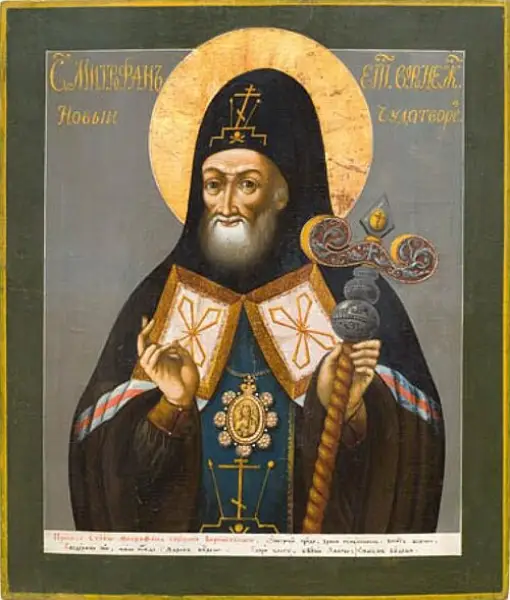
The formal recognition of Mitrophan's sanctity came long after the first devotions at his tomb. On June 25, 1832, the ceremonial opening of his relics took place at Voronezh, and the Church formally enrolled him among the saints; the event fell within the reign of Tsar Nicholas I, who is recorded in connection with the canonization and who afterwards paid a personal visit to the shrine. The imperial pilgrimage confirmed what popular devotion already knew, and the effect was immediate: his fame increased greatly, and large numbers of pilgrims from Central Russia began to flock to his tomb at Voronezh. The shrine became one of the principal holy places of the region, and the wonderworker of Voronezh took his place in the calendar of the Russian Church with feasts on August 7, the finding of his relics, and September 4, their second finding. A nineteenth-century icon shows him in episcopal vestments, the first bishop of his city and its eternal patron. The canonization of 1832 stands as one of the notable saint-makings of the Synodal period, honouring a bishop of the frontier whose reputation had survived intact for more than a century.
§ Mitrophan of Voronezh
Relics Lost and Restored
The twentieth century tested the saint's memory as harshly as his lifetime had tested his loyalty. After the Bolshevik revolution the new regime confiscated his relics, scattering one of the holiest possessions of the Voronezh church; the desecration was part of the wider assault on the Russian Church's shrines. The story reversed only at the end of the century: in 1989 the relics were returned to the Russian Orthodox Church, and they were enshrined in the Annunciation Cathedral in Voronezh, where an ornate statue of Saint Mitrophan stands before the cathedral doors. By then his cult had long outgrown its home diocese — the first church in Moscow consecrated in his name had been dedicated in 1895 — and he is honoured today as patron of the whole Voronezh Oblast and of the Teykovsky District of his birth, as well as of children and statesmen. For the faithful of post-Soviet Russia, the return of his relics in 1989 made him a sign of the Church's own resurrection after decades of persecution: the bishop who had stood beside Peter the Great had outlasted Peter's successors' most violent heirs.
§ Mitrophan of Voronezh
Timeline
- 8 Nov 1623
Born in the village of Antilokhovo in the Savinsky District and named Mikhail.
§ Mitrophan of Voronezh
- 1663
Took monastic vows after the death of his wife, beginning his life in the Church.
§ Mitrophan of Voronezh
- 1682
Appointed the first bishop of Voronezh, after governing the Kosmin and Unzha monasteries.
§ Mitrophan of Voronezh
- 23 Nov 1703
Died at Voronezh; Tsar Peter stood in attendance as the bishop was laid to rest at the Annunciation Monastery.
§ Mitrophan of Voronezh
- 1717
His tomb was opened fourteen years after his death; his body was found whole and his relics proclaimed to have healing power.
§ Mitrophan of Voronezh
- 25 Jun 1832
Formally canonized; Tsar Nicholas I afterwards paid a visit to his shrine at Voronezh.
§ Mitrophan of Voronezh
- 1895
The first church in Moscow dedicated to his name was consecrated.
§ Mitrophan of Voronezh
- 1989
His relics, confiscated under the Bolsheviks, were returned to the Russian Orthodox Church.
§ Mitrophan of Voronezh
The Record
- Patron of
- Voronezh Oblast·Teykovsky District·children·statesmen
- Canonization
- Canonized on June 25, 1832, under Tsar Nicholas I of Russia, after the ceremonial opening of his relics at Voronezh.
Prayer
Bibliography
Show 5 sources
- "Борисоглебская епархия - Книжная выставка «Святитель Митрофан – покровитель Воронежской земли»" (in Russian). 2023-09-22.
- "Покровители земли Воронежской. Как отметили праздник Собора всех святых". vrn.aif.ru (in Russian). АиФ-Воронеж. 19 September 2019.
- "Святитель Митрофан Воронежский, чудотворец". Days.pravoslavie.ru. Retrieved 2016-12-16.
- Боханов (2014-08-14). Император Николай I. Directmedia. ISBN 9785445888932.
- Abigail Green; Vincent Viaene (2012-09-18). Religious Internationals in the Modern World: Globalization and Faith. Palgrave Macmillan. p. 152. ISBN 9780230319509. Retrieved 2016-12-16.
Profile text adapted from the Wikipedia article, licensed CC BY-SA 4.0.
Pray with this saint every day
Save St. Mitrophan of Voronezh to your favorites, read the full profile, and get feast-day reminders in the Saints app.
Get the Saints AppFree on the App Store for iPhone and iPad