
died 637·Feast March 30
St. Mo Chua of Balla
Founder of Balla and Wonderworker of Connaught
Overview
Mo Chua, also known as Cronan Mac Bécáin and by the names Claunus, Cuan, Mochua, Moncan, and Moncain, was an Irish abbot who died on March 30, 637, and is remembered as the founder of the monastery of Balla in County Mayo. A legendary figure in large part, he was the youngest of three sons of Becan, a man said to descend from Lugaid mac Con, and of Cumne, whose father was Conamail of the Dál mBuinne. A sickly child whose hair fell out in patches, he worked as a shepherd until Comgall of Bangor, visiting his father's house, noticed the boy neglected by his family and took him to Bangor Abbey for education. He grew to adulthood there but was expelled with other monks of Roman sympathies who resisted the absorption of the Irish monasteries into the clan system. He founded Feara-rois monastery in Monaghan, then traveled in 616, at thirty-five years of age, to Connaught, where the chieftain Eochaidh Minnech found the hermit in his stone cell and granted him land for the monastery of Balla. Twenty-one or thirty-one years later, he died there on March 30, 637, the day his feast is still kept.
The Complete Life
The Neglected Shepherd Boy
Mo Chua came of distinguished stock on both sides: his father Becan was said to descend from Lugaid mac Con, a legendary high king, while his mother Cumne was daughter of Conamail of the Dál mBuinne. He was the youngest of three sons, and his childhood was marked by affliction — his hair fell out in patches, and in a household that appears to have given him little care, he was put to work as a shepherd. Providence arrived in the person of a visitor. Comgall, the celebrated abbot of Bangor, happened to call at Becan's house and found the boy neglected by the family. Whatever Comgall saw in the sickly child, he acted on it: he took Mo Chua with him to Bangor Abbey, on the coast of what is now Northern Ireland, to educate him. The story has become one of the classic Irish tales of monastic vocation — the disregarded child raised up by a great saint — and it explains how a boy of the western aristocracy entered the most influential monastery of the age. The legends even preserve an early sign of his future fame: a woman who came to Bangor hoping the young monk would pray for her to have children found him weeping in prayer, caught his tears, drank them, and obtained her desire.
§ Life
Bangor and the Romanist Cause
At Bangor Abbey, under the tradition of Comgall, Mo Chua grew to adulthood in the discipline of one of the most demanding monastic schools in Ireland. Yet his career there ended not in succession but in expulsion. He shared the convictions of those Irish monks who were called Romanists — the party alarmed by how deeply the Celtic Church's monasteries and clergy had sunk into the kinship structures of Ireland, surrendering their freedom to the lay princes of the Gaelic nobility. For holding these opinions he and many other monks were driven out of Bangor. The expulsion, painful as it was, marked the direction of his whole life: he belonged to the reforming current in Irish monasticism, the party that would eventually prevail at the synods of the seventh century, and his departures — first from Bangor, later from his own foundations — carried that current westward. The legends that gathered around his student years picture him already as a wonderworker of prayer and tears, and the tradition of his education at Bangor placed him in the lineage of Columbanus and the other Irish monks whose Roman loyalties reshaped the western Church.
§ Life
Feara-rois and the Founding of Balla
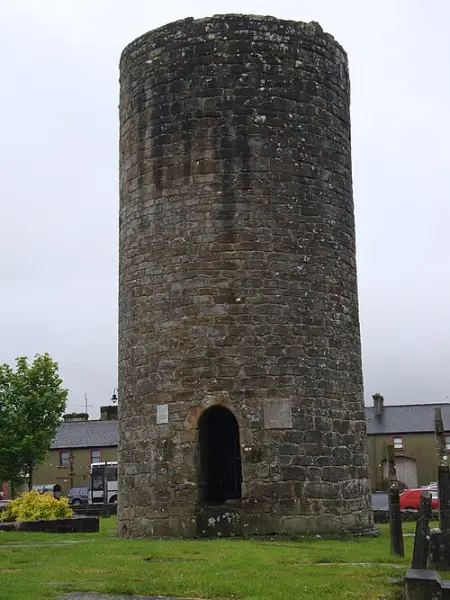
Leaving Bangor, Mo Chua founded the monastery of Feara-rois in Monaghan, his first work as an abbot in his own right. In 616, when he was thirty-five, he set out for Connaught and withdrew into solitude, living as a hermit in a stone cell. It was there that the chieftain Eochaidh Minnech, head of the clan Fiachra, found him. Struck by the hermit, the chief gave him land on which to found a monastery, and the locals came to call him Mochua of the narrow prison, a name that recalled both his cell and his austerity. Thus arose Balla, in what is now County Mayo, the foundation with which his name has ever since been joined. The place kept the memory of its founder in stone: the ruins of the monastery and the later Balla Round Tower still stand on the site. The legends tell that the site itself was chosen by heaven — a holy well is said to have moved before him from Bangor across the country, past Gael, Fore, Tech Telle, Hy Many and Lough Cime, halting at Ros Dairbhreach, where the great stones rose of themselves into a tower. At Balla he lived out the remainder of his life, twenty-one years by some accounts and thirty-one by others.
§ Life
The Yellow Crozier and the Legends of the West
Mo Chua died at Balla on March 30, 637, and the Catholic Church has kept his feast on that day ever since, though the Acta Sanctorum mistakenly lists it as January 1. He is in large part a legendary figure, and the legends are the richest part of his memory. They tell how he split open a mountainside so that the waters of Lough Leane could feed a mill at Fore; how he overcame a monster dwelling in Lough Cime; how he shook his crozier to create a bridge of land over Lough Conn, joining Inishlee Island to the mainland. They record his meeting with Bee and Lithben, two mighty women who ferried passengers in a basket across a dangerous creek and whom he converted and baptized together with their fathers. Most enduring of all is the story of the Yellow Plague: the saint is said to have drawn the disease's yellow colour out of the stricken countryside and onto his own crozier, winning from that act the title Bachall Buidhe, the Yellow Crozier, by which Irish tradition long knew him. Whatever history lies behind these tales, they mark a saint remembered as a healer of plagues, a tamer of monsters, and a builder of bridges, and the round tower of Balla still stands as his monument.
§ Legend
Timeline
- 616
Traveled to Connaught at the age of thirty-five and took up life as a hermit in a stone cell.
§ Life
- 30 Mar 637
Died at Balla after some twenty-one or thirty-one years there; his feast is kept on this day.
§ Life
The Record
- Major works
- monastery of Balla·Feara-rois monastery, Monaghan
- Symbols
- the Yellow Crozier (Bachall Buidhe)
- Canonization
- Pre-congregation saint; venerated by the Catholic Church, with his feast on March 30.
Prayer
Bibliography
Show 6 sources
- Baring-Gould, Sabine. "Saint Mochua, or Cronan, of Balla". Lives of the Saints, 1872. CatholicSaints.Info. 6 May 2018.
- Grattan-Flood, William. "Cronan." The Catholic Encyclopedia Vol. 4. New York: Robert Appleton Company, 1908. 29 July 2019.
- O'Connor, Frank (1968). A Short History of Irish Literature: A Backward Look. p. 22.
- Olden, Thomas (1894). "Mochua". In Lee, Sidney (ed.). Dictionary of National Biography. Vol. 38. London: Smith, Elder & Co.
- Butler, Alban. "Saint Mochua, alias Cronan, of Bella, Abbot in Ireland". Lives of the Fathers, Martyrs, and Principal Saints, 1866. CatholicSaints.Info. 20 January 2013.
- Room, Adrian. A Dictionary of Irish Place Names. Appletree Press, 1988. p. 19.
Profile text adapted from the Wikipedia article, licensed CC BY-SA 4.0.
Pray with this saint every day
Save St. Mo Chua of Balla to your favorites, read the full profile, and get feast-day reminders in the Saints app.
Get the Saints AppFree on the App Store for iPhone and iPad