
died 637·Feast May 14
St. Mo Chutu of Lismore
Abbot of Rahan and Founder of Lismore
Overview
Mo Chutu mac Fínaill, remembered also as Mochuda, Carthach, Carthach the Younger, or Saint Carthage, died on May 14, 637, after a life that joined two of the great monasteries of early Ireland. Through his father Fínall Fíngein he belonged to the Ciarraige Luachra, and his mother Finmed came of the Corco Duibne; his foster father, according to notes in the Félire Óengusso, was Carthach mac Fianáin, known as Carthach the Elder. Mo Chutu first served as abbot of Rahan, a monastery in the territory of the southern Uí Néill, where he composed for his monks a metrical rule in Irish of 580 lines, divided into nine sections — one of the notable literary relics of the early Irish Church. The Annals of Ulster record that he was driven out of Rahan as Easter drew near in 637, an episode bound up with the Easter controversy that divided Irish Christianity over the reckoning of the feast. He led his monks to the Déisi in Munster, made a peaceful land agreement with its king, and founded Lismore Abbey, in modern County Waterford. Lismore flourished long after his death, eclipsing Rahan and withstanding the Viking age, and the saint's memory is kept on May 14.
The Complete Life
A Prince's Lineage in the West
Mo Chutu was born into the intertwined peoples of early Munster. Through his father, Fínall Fíngein, he belonged to the Ciarraige Luachra, the people of the Kerry highlands, while his mother, Finmed, sprang from the Corco Duibne, the folk of the Dingle peninsula — a double inheritance from the Gaelic West. Notes added to the Félire Óengusso, the Martyrology of Óengus, add a further name to his upbringing: his foster father was Carthach mac Fianáin, called Carthach the Elder, an active churchman of the late sixth century. The boy took from this fosterage the name by which Latin and English tradition would know him — Carthach, Latinized as Carthagus and Anglicized as Carthage — distinguishing him ever after as Carthach the Younger. Beyond these genealogical facts the record of his youth is silent, but the circumstances point to a man formed at the meeting of two worlds: the aristocratic kinships of Munster, which supplied the monks and abbots of the age, and the monastic movement, which claimed its finest sons. The several Lives of the saint that survive, in Irish as in Latin, descend from a Latin life composed somewhere in the eleventh or twelfth century, and they begin their story where the genealogies end: with the abbot of Rahan.
§ Life
Abbot of Rahan and the Rule of 580 Lines
Mo Chutu's first great charge was the abbacy of Rahan, a monastery lying in the territory of the southern Uí Néill, in what is now County Offaly, at the heart of the midlands. There he governed as abbot and left a monument unusual among Irish founders: a written rule for his monks, composed in the Irish language as a metrical poem of 580 lines and divided into nine separate sections. Scholars treasure the work among the choicest survivals of the early Irish Church, opening a window onto the discipline, ideals, and daily order of a seventh-century community, and a rare instance of a founder's legislation surviving in the vernacular rather than in Latin. The rule implies a large and organized monastery under firm governance, and the later history of Rahan's abbot shows a man attached to principle at any cost. His years at Rahan placed him, too, in the politics of the age: the monastery sat in Uí Néill country, while his training in Munster aligned him with the Roman party in the disputes then dividing Irish Christianity. Both facts would converge, with fatal consequences for his tenure, in the spring of 637.
§ Life
Expulsion and the Founding of Lismore
The Annals of Ulster place the eviction of Mo Chutu from Rahan in the Easter-tide of 637. That episode belongs to the long quarrel over Easter, which stirred Irish Christianity throughout the seventh century: trained in Munster, Mo Chutu may have followed the Roman system of calculating the date of Easter, a position that brought him into conflict with the adherents of the Celtic reckoning in Leinster and the midlands. Whatever the precise cause, the abbot did not resist by force. He led his monks away toward the Déisi of the south, taking refuge along the riverbank at the monastic site of Ardfinnan, on Déclan's pilgrim path between Cashel and Ardmore. There the King of the Déisi came out against the strangers, but the confrontation ended in peace: a land agreement gave the exiles leave to settle, and monastic cells were established at Ardfinnan and, further south along the pilgrim path, at Lismore in modern County Waterford, where Mo Chutu founded the great abbey of Les Mór Mo Chutu. The medieval Lives, Irish and Latin, make little of the saint's misfortune at Rahan; they prefer to show him resisting the oppressive Uí Néill rulers and welcomed with joy among the Déisi, a heroic figure celebrated in the tale called The Expulsion of Mo Chutu from Rahan.
§ Life
Lismore's Glory and the Saint's Two Feasts
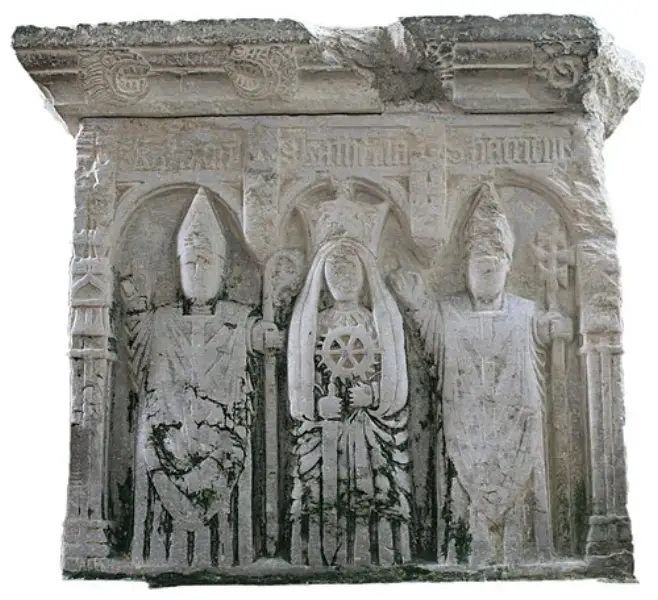
Mo Chutu died on May 14, 637, not long after the expulsion that had founded his last monastery, and Lismore grew into the greatest of his monuments. The abbey flourished after his lifetime until it eclipsed the reputation of his earlier church at Rahan; it withstood the Viking depredations that ravaged the region, and it prospered through the generosity of the kings of Munster, notably the Mac Carthaig of Desmond. When a diocesan structure was laid over the ancient monastic landscape, the honour of the episcopal see — sought also by Déclan's earlier foundation at Ardmore — went to Lismore, and the medieval cathedral of Saint Carthage still crowns the town; the saint is depicted in its glass holding his crozier and a model of his abbey, and on a 1543 altar tomb within it he stands in the company of Catherine and Patrick. His feast of May 14 is fixed in the Irish martyrologies and in the Great Synaxaristes of the Eastern Orthodox Church, which venerates him among its saints; in the present calendar of the Catholic Church in Ireland, where May 14 belongs to Saint Matthias, his memorial is kept on May 15. Expelled from one monastery, he founded another that outlived the kingdoms that expelled him.
§ Life
Timeline
- 637
Expelled from the monastery of Rahan during the Easter season, an incident linked to the seventh-century Easter controversy.
§ Life
- 14 May 637
Died after founding Lismore Abbey among the Déisi; his feast is kept on this day in the Irish martyrologies.
§ Life
The Record
- Major works
- metrical monastic rule in 580 lines, composed for the monks of Rahan·Lismore Abbey, County Waterford·Ardfinnan Abbey (monastic cells established)
- Patron of
- Lismore, Ireland
- Symbols
- bishop's crozier·model of Lismore Abbey
- Canonization
- Pre-congregation saint; venerated by the Catholic Church and the Eastern Orthodox Church, with his feast on May 14.
Prayer
Bibliography
Show 6 sources
- Annals of Inisfallen, entry AI639.3; date confirmed by Mc Carthy, Daniel P. (1998). "The Chronology of the Irish Annals". Proceedings of the Royal Irish Academy. 98C. Royal Irish Academy: 203-255.
- Grattan Flood, William Henry (1908). "St. Carthage". In Catholic Encyclopedia. Vol. 3. New York: Robert Appleton Company.
- The Roman Missal. Veritas 2011. ISBN 978-1-84730-297-7. p. 760.
- Johnston, Elva. "Munster, saints of (act. c. 450 - c. 700)". Oxford Dictionary of National Biography. Oxford University Press, September 2004, online edition May 2008.
- Óengus of Tallaght (1905). Stokes, Whitley (ed.). The Martyrology of Oengus the Culdee. Henry Bradshaw Society. Vol. 29. London.
- Herbermann, Charles, ed. (1913). "St. Carthage". Catholic Encyclopedia. New York: Robert Appleton Company.
Profile text adapted from the Wikipedia article, licensed CC BY-SA 4.0.
Pray with this saint every day
Save St. Mo Chutu of Lismore to your favorites, read the full profile, and get feast-day reminders in the Saints app.
Get the Saints AppFree on the App Store for iPhone and iPad