
614-697·Feast June 17
St. Mo Ling
Seventh-Century Irish Bishop of Ferns and Founder of St Mullin's
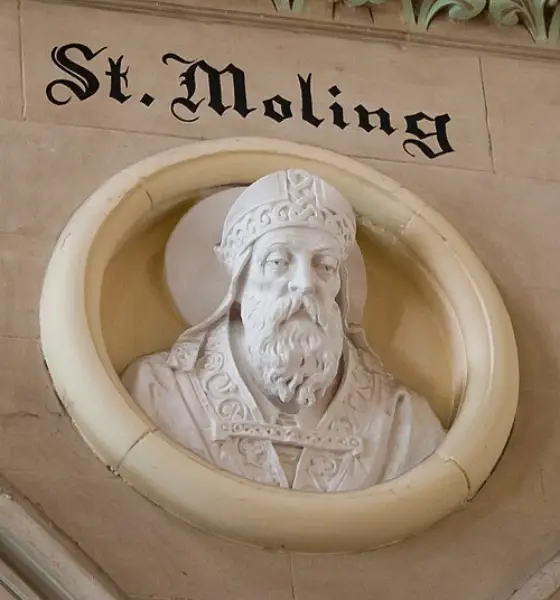
Overview
Mo Ling — in Irish tradition Moling Luachra, the name joined to the district of his birth — was born in 614 at Sliabh Luachra in County Kerry and died in 697 after a long career in the church of seventh-century Ireland. He rose to become the second Bishop of Ferns, and later writers ranked him among the four great prophets of Erin, a description that places this Kerry-born churchman in the first flight of the country's holy men. The foundation most firmly his is the monastery he established at St Mullin's in County Carlow, whose ruins still mark the site; during that same hundred years, it is said, a church was raised at Mullennakill in County Kilkenny under his direction. The stories told of him turn on a striking act of public intercession: the kings of Tara had long exacted a cattle tribute from the kings of Leighlin, a burden rooted in an old blood-feud, and Mo Ling brought the exaction to an end. His feast is kept on 17 June, and his memory rests above all in two medieval manuscripts — the Birth and Life of St. Moling among them, and with it the Borama — which hand his story on.
The Complete Life
A Kerry Beginning
The man whom Irish tradition calls Mo Ling, and elsewhere Moling Luachra, was born in the year 614 at Sliabh Luachra, a district of County Kerry in the south-west of the island. His by-name preserves the bond between the saint and that landscape: Luachra is the place of his birth, carried in his very name through every century of retelling. Kerry lay at some remove from the ecclesiastical heartlands of the east where his mature career would unfold, and the distance makes his later eminence the more striking. Of his family and his earliest years the surviving records are nearly silent; the manuscripts that keep his memory concern themselves with the bishop and the wonder-worker rather than the child. What they leave instead is the outline of a life that travelled far from its starting point, from the uplands of the south-west to an episcopal throne and a monastery of lasting fame in the province of Leinster. That arc — a Kerry boy become one of the named prophets of the Irish church — is the first fact of his biography and the frame within which everything else about him must be read.
§ Introduction
Second Bishop of Ferns
Mo Ling's place in the Irish church found formal expression in his elevation to the see of Ferns, of which he is remembered as the second bishop. To succeed the founder of an important Irish see was to inherit oversight of a living Christian community and all the pastoral weight that came with it, and it marks him as a churchman of the first rank in his own generation. Later writers gave the measure of his reputation in plainer terms: surveying Ireland's ancient schools and scholars, John Healy placed him with the four great prophets of Erin, a rank that sets this seventh-century bishop among the small company of holy men whom the whole island claimed as its own. The description has travelled with his name ever since, and it explains how a figure whose recorded acts are comparatively few could occupy so firm and honoured a place in the memory of Irish Christianity. His episcopal office also supplied the means for what followed, for a bishop's authority carried with it the capacity to found monasteries and build churches, and it was in that work of foundation that Mo Ling left the marks by which the landscape still remembers him.
§ Introduction
Foundations and the Ending of the Tribute
The foundation most surely attached to Mo Ling's name is the monastery he established at St Mullin's in County Carlow, a house of such consequence that its ruins are still pointed out on the site today. During the same hundred years, so the tradition runs, he directed the building of a church at Mullennakill in County Kilkenny, spreading his patronage across the provincial border and scattering his patronage through the south-east of the island. The traditions surrounding him, however, turn on more than stones. The kings of Tara had imposed a cattle tribute upon the kings of Leighlin, a standing exaction whose origin lay in blood: the son of the king of Leighlin had driven a raid as far as Clonfert, and in the course of it several princesses were killed. The levy endured as retribution for that outrage until Mo Ling brought it to an end, an act of intercession remembered as among the greatest deeds of his life. To stand between the high kings and a subject people, and to lift from them a burden sanctioned by an old grievance, required a weight of personal sanctity and standing that no office alone could supply.
§ Introduction
Memory in Manuscript and Stone
Two manuscripts above all carry the traditions of Mo Ling to later ages: The Birth and Life of St. Moling and the Borama, each of which expounds the story of the cattle tribute and its ending, fixing that act of deliverance at the centre of his cult. His death in 697 closed a life of more than eighty years, most of them given to the service of the church in the south-east of Ireland. His feast is kept on 17 June, the day on which Irish piety has renewed his memory generation after generation. The landscape itself keeps his record: the ruins of the monastery at St Mullin's in County Carlow stand where he founded it, and the name of Mullennakill in County Kilkenny preserves the church he is said to have built there in the seventh century. In the parish church of St Mary and St Michael at New Ross a relief of the saint witnesses to the devotion he still commands in the south-east. A separate medieval tale, the story of Mo Ling and the leper, survives in an Irish manuscript, and its survival shows that it was not only his public deeds but his personal charity that the tradition thought worth remembering.
§ Introduction
Timeline
- 614
Born at Sliabh Luachra in County Kerry, the birthplace remembered in his by-name Moling Luachra
§ Introduction
- 697
Died after serving as the second Bishop of Ferns and founding the monastery of St Mullin's in County Carlow
§ Introduction
In Their Own Words
one of the four great prophets of Erin
The Record
- Major works
- Monastery of St Mullin's, County Carlow·Church at Mullennakill, County Kilkenny
- Canonization
- Pre-congregation; venerated as a saint in Ireland from the early medieval period
Prayer
Bibliography
Show 6 sources
- Ó Riain, Pádraig (2011). A Dictionary of Irish Saints. Four Courts Press. pp. 487-490. ISBN 978-1-84682-318-3.
- Healy, John (1912). "Chapter XVIII: The School of Glendalough". Insula Sanctorum et Doctorum Or, Ireland's Ancient Schools and Scholars (6 ed.). Dublin/London/New York: Sealy, Bryers & Walker/Burns & Oates/Benziger Brothers. p. 429.
- Meehan, Cary (2004). Sacred Ireland. Somerset: Gothic Image Publications. p. 352. ISBN 0 906362 43 1.
- "St Myllin's Church, Llanfyllin". Mathrafal Deanery. Retrieved 19 April 2015.
- A Compendium of Irish Biography.
- Ghosh, Shubha (30 October 2020). Forgotten Intellectual Property Lore: Creativity, Entrepreneurship and Intellectual Property. Edward Elgar Publishing. p. 120. ISBN 978-1-78897-871-2.
Profile text adapted from the Wikipedia article, licensed CC BY-SA 4.0.
Pray with this saint every day
Save St. Mo Ling to your favorites, read the full profile, and get feast-day reminders in the Saints app.
Get the Saints AppFree on the App Store for iPhone and iPad