
died c. 609·Feast August 4
St. Mo Lua of Killaloe
Sixth-Century Irish Abbot and Founder of Killaloe
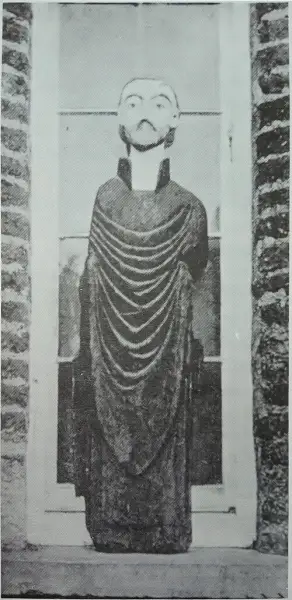
Overview
Mo Lua — his name also given as Lua or Da Lua, and originally Lughaidh — was an Irish priest and abbot of the sixth century who died about 609. Like Columba and Gall, he trained in the monastery at Bangor in County Down, one of the great schools of early Irish monasticism, and the formation he received there shaped the rest of his life. He is remembered chiefly as the founder of Killaloe, which in Irish is Cill-da-Lua, the church of Lua, and which still bears his name. There he kept his oratory on Friar's Island, a site later replaced by a stone church near the present village. The little that survives about him sum up in three words — monk, builder and perhaps hermit — and tell of a hospitality so settled in him that he took every guest for Christ himself, and of a gentleness that had the whole of creation mourning him at his grave. His principal disciple was Saint Flannan, who succeeded him at Killaloe, and his monastery at Clonfert-Mulloe in Osraige later produced the scholar Laidcenn mac Buith Bannaig. His feast falls on 4 August.
The Complete Life
The Boy Lughaidh
The future abbot began life under another name altogether. His original name was Lughaidh, pronounced Lua, the short form from which the name by which history knows him eventually grew. He came from a family with roots on both sides of the southern provinces. For his father the tradition gives Coche — Carthach in some tellings — a man of the Corca Oiche, a people standing close to the Ui Fidgenti of the Limerick country; Sochla, the mother, came from Ossory. The boy thus carried the blood of both Munster and the south-eastern kingdom, a double inheritance that later generations found worth recording even after so much else about his early years had slipped from memory. His birthplace went unrecorded, but the family connections point toward the mid-western world of the Limerick country where his father's people held land. Of his childhood the sources say nothing further; the single firm tradition bearing on his youth is the one that determined everything after it, namely that he went north for his formation and entered the monastery at Bangor in County Down, roughly twelve miles from Belfast, to be trained in its celebrated school of monastic discipline and learning.
§ Life
Formation at Bangor
At Bangor, Mo Lua received the formation that made him a priest of the sixth century and a monk in the fullest sense of the word. He was not alone in that schooling: Columba and Gall, names that would resound through the whole history of Irish Christianity, trained in the same monastery, and the company in which he is remembered is itself the best witness to the quality of the house that formed him. Bangor stood among the first schools of the Irish church, and its discipline joined ceaseless prayer with study and manual work, a pattern that left visible marks on everything Mo Lua afterwards did. Three compressed words describe the man that school produced — monk, builder, and, more tentatively, hermit — and each one is revealing. The monk recalls the rule under which he lived; the builder anticipates the oratory and the foundations that would carry his name; the hermit, offered more tentatively, hints at a temperament drawn to solitude and austerity beneath his public roles. Whatever balance he struck among those callings, it was struck early and held to the end of his life.
§ Life
Founder of Killaloe
Mo Lua's lasting work was the foundation of Killaloe, called in Irish Cill-da-Lua, the church of Lua, a settlement that grew around his monastery and still bears his name today. His own oratory stood on Friar's Island, a quiet station near the present village of Killaloe; in later times the wooden oratory gave way to a stone church, marking the permanence the community had attained. Open-handed welcome marked him, as it marked most of the Irish saints, and the tradition preserves the conviction that governed it: whoever crossed his threshold was the Lord himself received, since welcoming others meant welcoming Christ. The same warmth extended beyond the human circle, for he showed the same gentleness to beasts as to people, and the affection he inspired passed into the loveliest story told of him — that every living thing grieved at his grave. It is the farewell of a whole creation to a man whom it had found harmless, and it completes the picture of a founder whose authority rested not on severity but on a charity so unforced that beast and person alike felt it.
§ Life
Disciples and Commemoration
The work Mo Lua began did not end with him. His principal disciple was Saint Flannan, who succeeded him at Killaloe and carried the house forward, giving the foundation an episcopal future that endured long after its founder's death about 609. Nor was Killaloe his only fruit: his monastery at Clonfert-Mulloe in Osraige became a source of learning, producing the scholar Laidcenn mac Buith Bannaig, whose career showed that the school of this quietly hospitable abbot could send forth minds as well as monks. His commemoration settled on 4 August, the day on which his feast is still observed, and his name has continued to be honoured in both the Catholic Church and the Eastern Orthodox Church, a double veneration that testifies to how widely his cult travelled beyond the Shannon. The town of Killaloe itself remains his most visible monument, its very form — Cill-da-Lua, the church of Lua — a sentence of memory spoken daily in the local speech. For a saint of whom so little was written, the endurance of that name in place, calendar, and church is a considerable afterlife.
§ Legacy
The Record
- Major works
- Foundation of Killaloe (Cill-da-Lua)·Oratory on Friar's Island, later replaced by a stone church·Monastery of Clonfert-Mulloe in Osraige
- Canonization
- Pre-congregation; venerated in the Catholic Church and the Eastern Orthodox Church
Prayer
Bibliography
Show 3 sources
- Farmer, David Hugh. The Oxford Dictionary of Saints. Oxford: Oxford University Press, 1992. ISBN 0-19-283069-4.
- "Who was St. Molua". St. Molua's Church, Stormont.
- Herbermann, Charles, ed. (1910). "Diocese of Killaloe". Catholic Encyclopedia. Vol. 8. New York: Robert Appleton Company.
Profile text adapted from the Wikipedia article, licensed CC BY-SA 4.0.
Pray with this saint every day
Save St. Mo Lua of Killaloe to your favorites, read the full profile, and get feast-day reminders in the Saints app.
Get the Saints AppFree on the App Store for iPhone and iPad